


Prenatal Triptan Exposure and Internalising and Externalising Behaviour Problems in 3-Year-Old Children: Results from the Norwegian Mother and Child Cohort Study
- PMID: 26525300
- PMCID: PMC4749405
- DOI: 10.1111/ppe.12253
Prenatal Triptan Exposure and Internalising and Externalising Behaviour Problems in 3-Year-Old Children: Results from the Norwegian Mother and Child Cohort Study
Abstract
Background: Triptans are commonly prescribed for migraine, a pain condition that is highly prevalent in women of childbearing age. No prior studies have investigated associations between exposure to triptans during fetal life and risk of externalising and internalising behaviours in children.
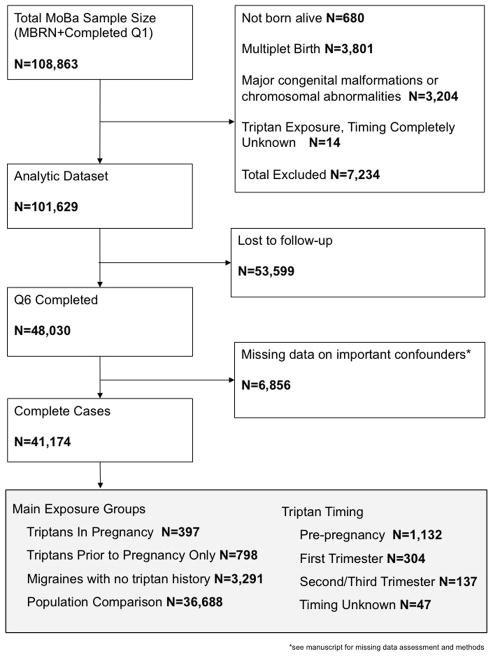
Methods: This study was set in the Norwegian Mother and Child Cohort study, a prospective birth cohort. A total of 41,173 live, singleton births without major malformations present at 36-month post-partum follow-up were included in this study; 396 used a triptan during pregnancy, 798 used a triptan prior to pregnancy only, 3291 reported migraine without triptan use, and 36,688 reported no history of migraine or triptan use. Marginal structural models were used to analyse the association between timing of triptan exposure and neurodevelopmental outcome.
Results: Children exposed to triptans during pregnancy had a 1.39-fold increased risk of externalising behaviours compared with those whose mothers used triptans prior to pregnancy only (95% CI 0.97, 1.97), a 1.36-fold increased risk compared with the unmedicated migraine group (95% CI 1.02, 1.81), and a 1.41-fold increased risk compared with the population comparison group (95% CI 1.08, 1.85). The greatest risk was associated with first trimester exposure (RR 1.77, 95% CI 0.98, 3.14). Risk differences were small, ranging from 3-6%.
Conclusions: This study found an increased risk of clinically relevant externalising behaviours in children with prenatal exposure to triptans, and this risk was highest for first trimester exposure. Absolute risks were small, and the results may be due to confounding by underlying migraine severity.
Keywords: neurodevelopment; pregnancy; triptans.
© 2015 John Wiley & Sons Ltd.
References
-
- MacGregor EA. Headache in pregnancy. Neurol Cinics. 2012;30(3):835–66. - PubMed
-
- Nezvalová-Henriksen K, Spigset O, Nordeng H. Triptan safety during pregnancy: A Norwegian population registry study. Eur J Epidemiol. 2013;28:759–769. - PubMed
-
- Nezvalova-Henriksen K, Spigset O, Nordeng H. Maternal characteristics and migraine pharmacotherapy during pregnancy: cross-sectional analysis of data from a large cohort study. Cephalalgia. 2009;29(12):1267–1276. - PubMed
-
- Marchenko A, Etwel F, Olutunfese O, Nickel C, Koren G, Nulman I. Pregnancy Outcome Following Prenatal Exposure to Triptan Medications: A Meta-Analysis. Headache J Head Face Pain. 2015 n/a–n/a. - PubMed
Publication types
MeSH terms
Substances
Grants and funding
LinkOut - more resources
Full Text Sources
Other Literature Sources
Medical
