


Review
doi: 10.1016/j.tim.2015.10.001.
Epub 2015 Oct 29.
Game of 'Somes: Protein Destruction for Mycobacterium tuberculosis Pathogenesis
Affiliations
- PMID: 26526503
- PMCID: PMC4698092
- DOI: 10.1016/j.tim.2015.10.001
Item in Clipboard
Review
Game of 'Somes: Protein Destruction for Mycobacterium tuberculosis Pathogenesis
Trends Microbiol.
2016 Jan.
Abstract
The proteasome system of Mycobacterium tuberculosis is required for causing disease. Proteasomes are multisubunit chambered proteases and, until recently, were only known to participate in adenosine triphosphate (ATP)-dependent proteolysis in bacteria. In this review, we discuss the latest advances in understanding how both ATP-dependent and ATP-independent proteasome-regulated pathways contribute to M. tuberculosis virulence.
Keywords: Mycobacterium tuberculosis; pathogenesis; proteasome; pupylation.
Copyright © 2015 Elsevier Ltd. All rights reserved.
Figures
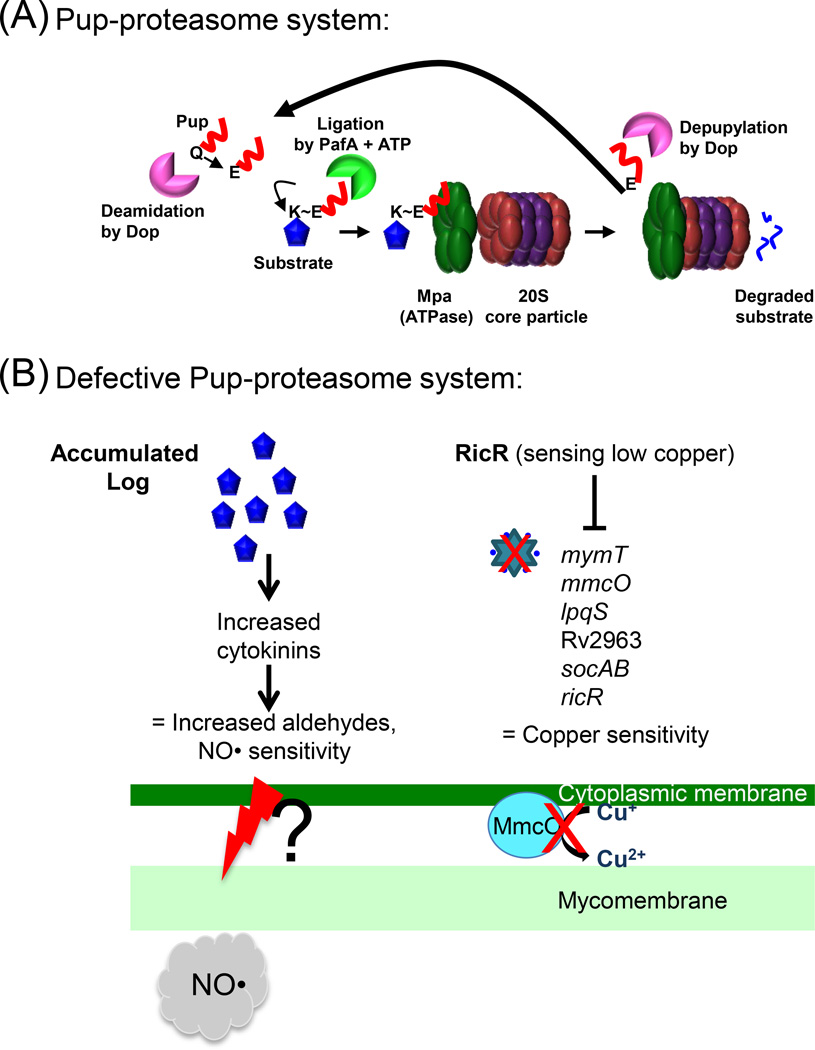
(A) ATP-dependent degradation by the proteasome. 20S core particle subunits are colored in red (α-subunit, PrcA) and purple (β-subunit, PrcB). Pup (red line) is an intrinsically disordered protein. In M. tuberculosis, the last amino acid of Pup is glutamine (Gln, Q), which must be deamidated on its side chain by Dop to convert it to glutamate (Glu, E). The Glu is the phosphorylated by PafA, making it prime for attack by the amino group on the side chain of a substrate lysine (Lys, K). Although Pup is largely disordered, it forms helices upon interacting with amino-terminal coiled-coil domains of Mpa. This interaction is essential for targeting pupylated proteins for degradation. In M. tuberculosis, Pup appears to be recycled by Dop in an Mpa-dependent manner, suggesting depupylation can occur just before proteins are threaded into the proteasome core particle. See text for additional details and references. (B) Disrupted proteasomal degradation results in several dysregulated pathways. Left: Accumulation of the enzyme Lonely Guy (Rv1205, Log) results in the hyperproduction of cytokinins, which can break down into aldehydes. Aldehydes synergize with NO by an unknown mechanism to kill mycobacteria. A mechanism of aldehyde-mediated toxicity might include damage (as represented by the red lightening bolt) to the mycobacterial membranes. This damage may be exacerbated in the presence of host-produced NO. Right: The RicR regulon is partially repressed in mpa and pafA mutants, leading to reduced copper (Cu) resistance. Red Xs indicate loss of MymT (Cu metallothionein) and MmcO (mycobacterial multi-copper oxidase) activities.
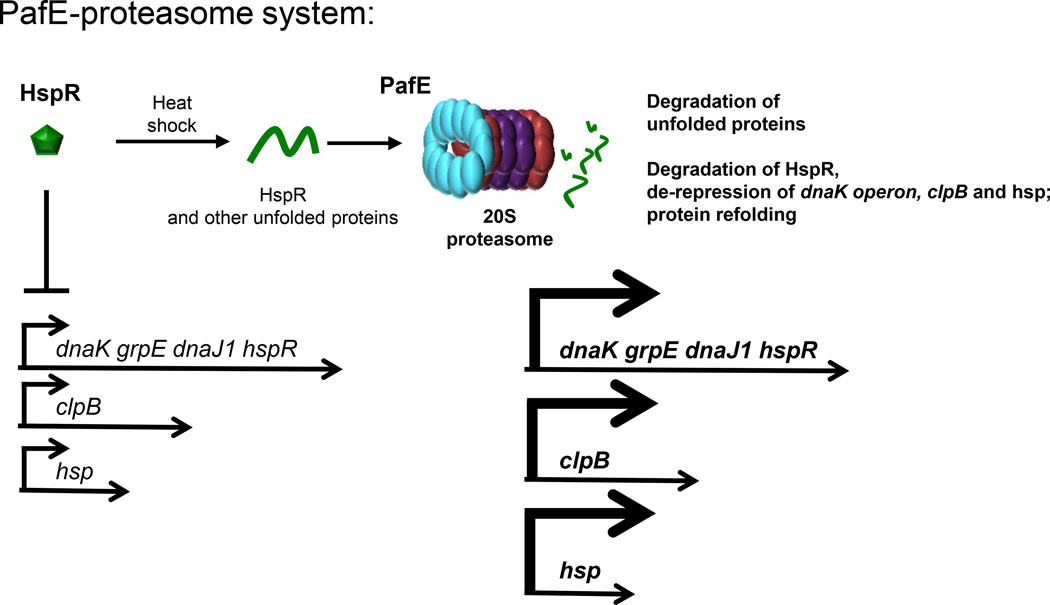
PafE (blue) forms dodecameric rings and caps 20S CPs. This allows the ATP-independent opening of 20S CPs to facilitate the degradation of peptides and denatured proteins as well as HspR. HspR represses expression of the dnaK operon, clpB and hsp (Rv0249c). See text for details.
References
-
- WHO. World Health Organization; 2014. Tuberculosis fact sheet 2014.
-
- WHO. 2014 Update. World Health Organization; 2014. Multidrug-Resistance Tuberculosis (MDR-TB)
-
- Cambier CJ, Falkow S, Ramakrishnan L. Host evasion and exploitation schemes of Mycobacterium tuberculosis. Cell. 2014;159:1497–1509. - PubMed
-
- Bowman LA, McLean S, Poole RK, Fukuto JM. The diversity of microbial responses to nitric oxide and agents of nitrosative stress close cousins but not identical twins. Adv Microb Physiol. 2011;59:135–219. - PubMed
Publication types
MeSH terms
Substances
Grants and funding
LinkOut - more resources
Full Text Sources
Other Literature Sources
Medical
