


Comparison between Ultrasound Guided Transperineal and Transrectal Prostate Biopsy: A Prospective, Randomized, and Controlled Trial
- PMID: 26526558
- PMCID: PMC4630643
- DOI: 10.1038/srep16089
Comparison between Ultrasound Guided Transperineal and Transrectal Prostate Biopsy: A Prospective, Randomized, and Controlled Trial
Abstract
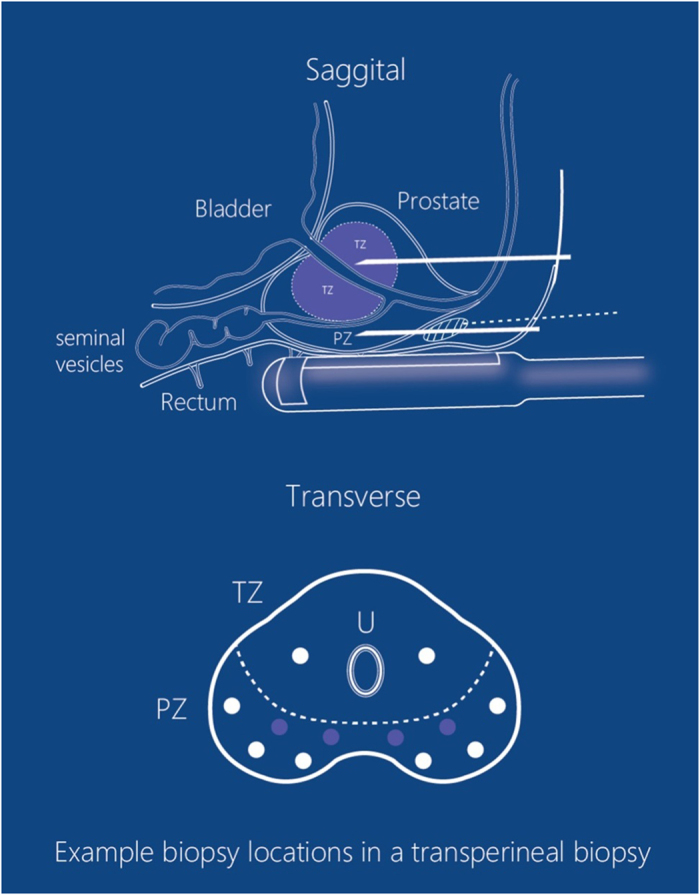
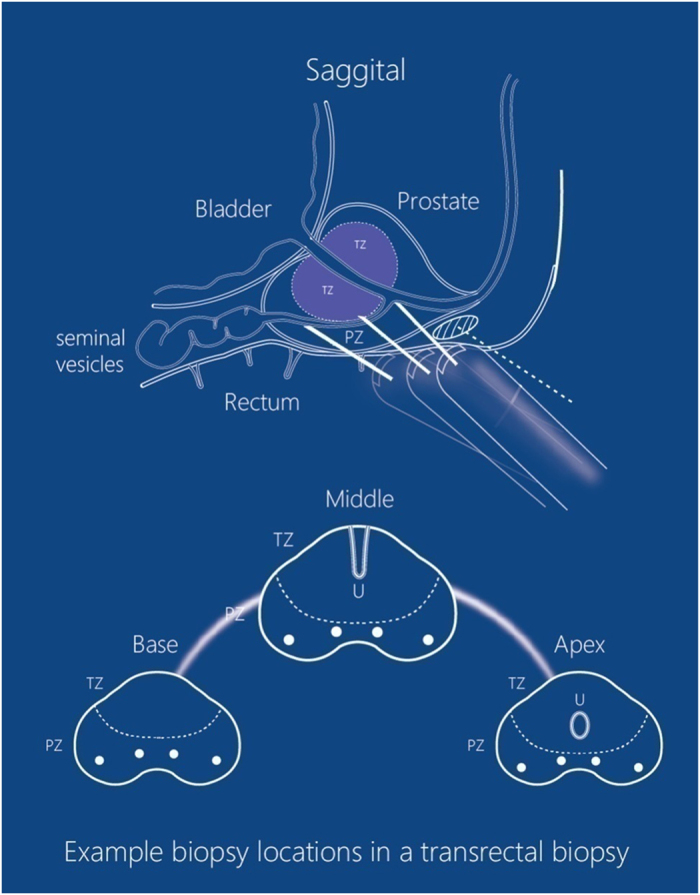
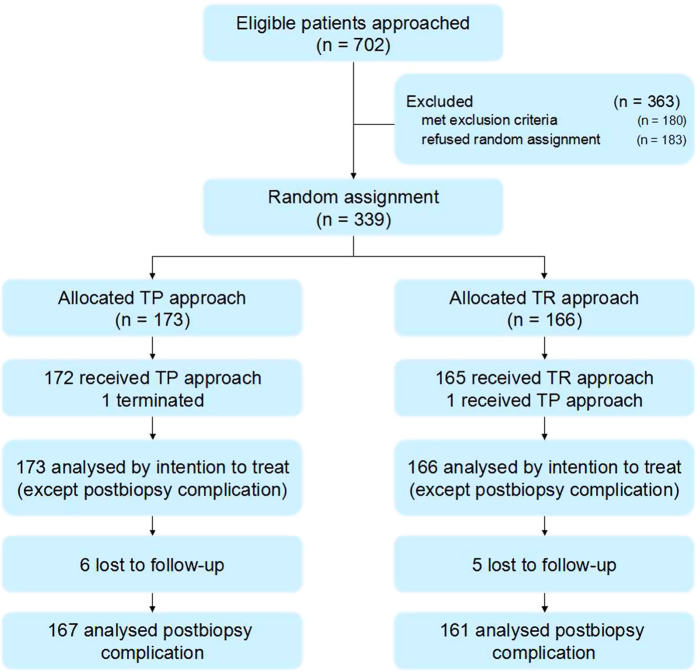
This prospective study of comparing transperineal prostate biopsy (TPBx) with transrectal prostate biopsy (TRBx) was aimed to provide evidence for clinicians to select the appropriate biopsy approach under different conditions. TPBx (n = 173) and TRBx (n = 166) were performed randomly for 339 patients who were suspicious of prostate cancer (PCa). The cancer detection rate (CDR), complication rate, visual analogue scale (VAS) score, most painful procedure, number of repeated biopsy and additional anesthesia, and operating time (starting from lying down on the operating table to getting up) were recorded. The results showed that TPBx and TRBx were equivalent in CDR (35.3% vs. 31.9%) and minor complication rate (44.9% vs. 41.0%) (both P > 0.05). The major complication rate was lower in TPBx than in TRBx (0.6% vs. 4.3%, P < 0.05). TPBx was more time-consuming (17.51 ± 3.33 min vs. 14.73 ± 3.25 min) and painful (VAS score: 4.0 vs. 2.0); and it had higher rates of repeated biopsy (3.2% vs. 1.1%) and additional anesthesia (15.0% vs. 1.2%) (all P < 0.05). In summary, both TPBx and TRBx are effective to detect PCa. The major complication rate for TRBx is higher, whereas TPBx procedure is more complex and painful.
Figures
References
-
- Siegel R., Naishadham D. & Jemal A. Cancer statistics, 2013. CA Cancer J Clin. 63, 11–30 (2013). - PubMed
-
- Ferlay J. et al. Cancer incidence and mortality patterns in Europe: estimates for 40 countries in 2012. Eur J Cancer. 49, 1374–403 (2013). - PubMed
-
- Hodge K. K., McNeal J. E., Terris M. K. & Stamey T. A. Random systematic versus directed ultrasound guided transrectal core biopsies of the prostate. J Urol. 142, 71–4; discussion 74-5 (1989). - PubMed
-
- Heidenreich A. et al. EAU guidelines on prostate cancer. part 1: screening, diagnosis, and local treatment with curative intent-update 2013. Eur Urol. 65, 124–37 (2014). - PubMed
-
- Schroder F. H. et al. Screening and prostate-cancer mortality in a randomized European study. N Engl J Med. 360, 1320–8 (2009). - PubMed
Publication types
MeSH terms
Substances
LinkOut - more resources
Full Text Sources
Other Literature Sources
Medical
