Review
. 2016:78:481-504.
doi: 10.1146/annurev-physiol-021115-105238. Epub 2015 Nov 2.

The Microbiome and the Respiratory Tract

Affiliations
Review

The Microbiome and the Respiratory Tract

Robert P Dickson et al. Annu Rev Physiol. 2016.

Abstract

Although the notion that "the normal lung is free from bacteria" remains common in textbooks, it is virtually always stated without citation or argument. The lungs are constantly exposed to diverse communities of microbes from the oropharynx and other sources, and over the past decade, novel culture-independent techniques of microbial identification have revealed that the lungs, previously considered sterile in health, harbor diverse communities of microbes. In this review, we describe the topography and population dynamics of the respiratory tract, both in health and as altered by acute and chronic lung disease. We provide a survey of current techniques of sampling, sequencing, and analysis of respiratory microbiota and review technical challenges and controversies in the field. We review and synthesize what is known about lung microbiota in various diseases and identify key lessons learned across disease states.

Keywords: 16S rRNA; culture independent; lung; microbial ecology; microbiota; pulmonary.


Figures
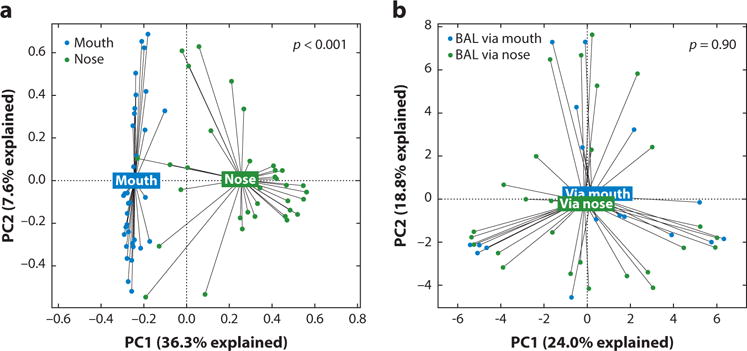
Figure 1
Figure 1
Lack of influence of upper respiratory tract microbiota on bronchoalveolar lavage (BAL) microbiota. Although the microbial communities of the mouth and nose differ significantly (a), the route of bronchoscope insertion (via mouth or via nose) has no appreciable effect on BAL microbiota (b). Panel a adapted with permission from data published in Reference . Panel b adapted with permission from Reference .
Figure 2
Figure 2
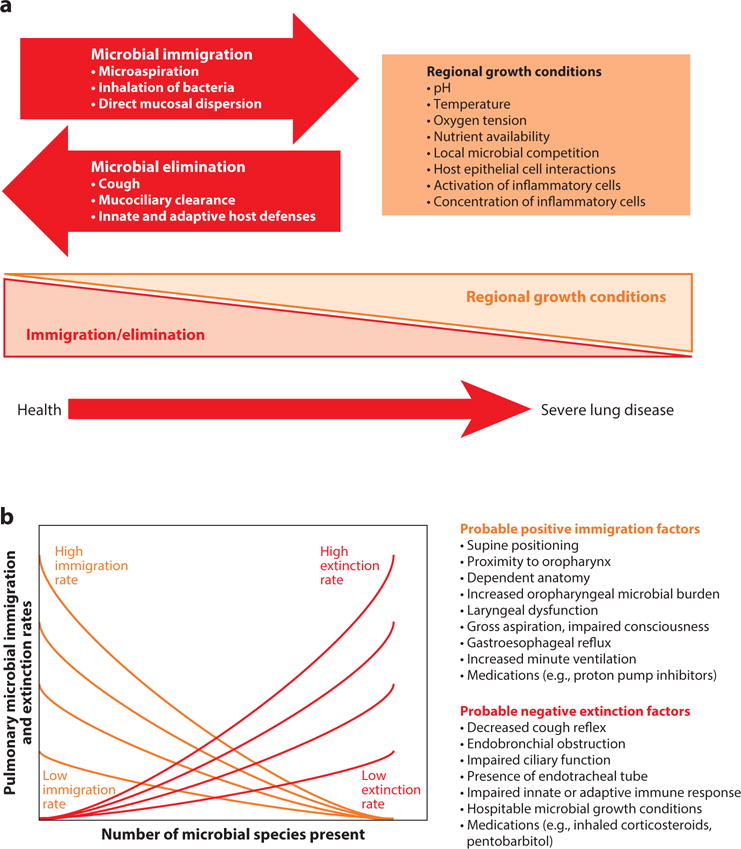
Ecological modeling of the respiratory microbiome. (a) The constitution of the respiratory microbiome is determined by three factors: microbial immigration, microbial elimination, and the relative reproduction rates of its members. In health, community membership is determined primarily by immigration and elimination; in advanced lung disease, membership is determined primarily by regional growth conditions. Adapted with permission from Reference . (b) The adapted island model of lung biogeography. Community richness in health for a given site in the respiratory tract is a function of immigration and elimination factors. Adapted with permission from Reference .
Figure 3
Figure 3
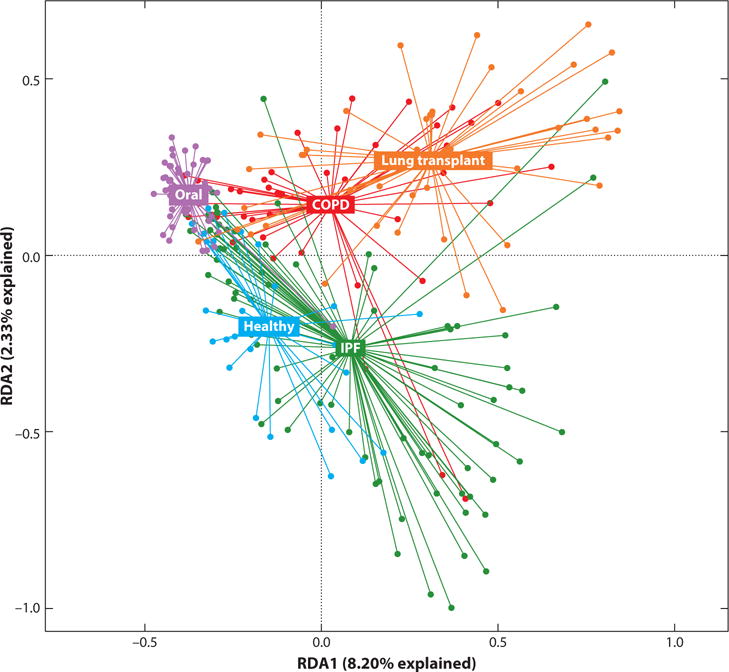
Lung microbiome communities vary by disease state. Each data point represents the bacterial community detected in a specimen acquired from the population labeled. The unique constellation of anatomical and physiological changes that define each lung disease translates into a unique constellation of environmental conditions and altered microbial communities. “All healthy lungs are alike; every unhealthy lung is unhealthy in its own way.”
Figure 4
Figure 4
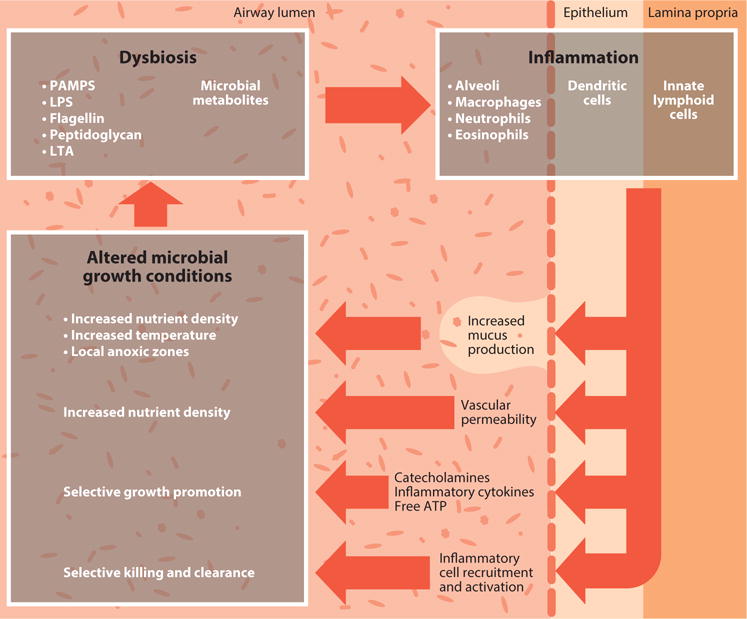
The dysbiosis-inflammation cycle. Inflammation of the airways alters environmental growth conditions of airway microbiota via positive and negative selective pressures. Disordered growth conditions result in a disordered microbiome, which provokes further airway inflammation via pathogen-associated molecular pattern (PAMP)–pattern recognition receptor (PRR) interactions, via microbial metabolite signaling to leukocytes and epithelial cells, and via other pathways. This cascade results in a self-amplifying cycle of airway inflammation and respiratory dysbiosis. Adapted from Reference .

References

    1. Lederberg J. ‘Ome sweet ‘omics—a genealogical treasury of words. The Scientist. 2001 Apr 2;
    1. Cotran RS, Kumar V, Collins T, Robbins SL. Robbins Pathologic Basis of Disease. Philadelphia: Saunders; 1999.
    1. Horikoshi K, Grant WD. Extremophiles: Microbial Life in Extreme Environments. New York: Wiley-Liss; 1998.
    1. Hilty M, Burke C, Pedro H, Cardenas P, Bush A, et al. Disordered microbial communities in asthmatic airways. PLOS ONE. 2010;5:e8578. - PMC - PubMed
    1. Pasteur L. Expériences relatives aux générations dites spontanées. C R Hebd Séances Acad Sci D. 1860;50:303–7.

Publication types