Application of Evolutionary Principles to Cancer Therapy
- PMID: 26527288
- PMCID: PMC4693617
- DOI: 10.1158/0008-5472.CAN-15-1337
Application of Evolutionary Principles to Cancer Therapy
Abstract
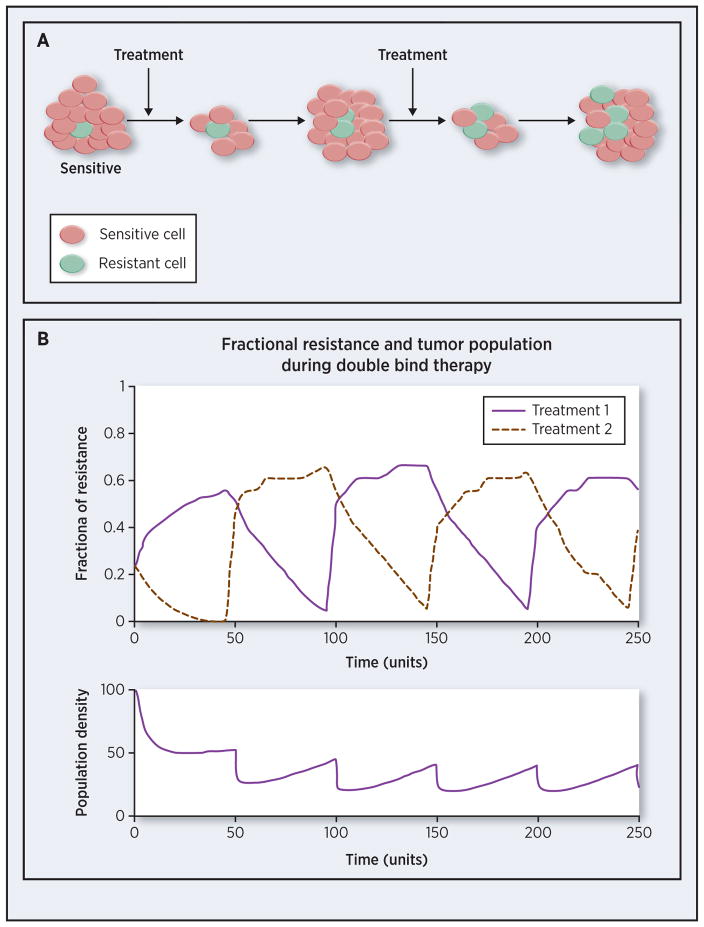
The dynamic cancer ecosystem, with its rich temporal and spatial diversity in environmental conditions and heritable cell phenotypes, is remarkably robust to therapeutic perturbations. Even when response to therapy is clinically complete, adaptive tumor strategies almost inevitably emerge and the tumor returns. Although evolution of resistance remains the proximate cause of death in most cancer patients, a recent analysis found that evolutionary terms were included in less than 1% of articles on the cancer treatment outcomes, and this has not changed in 30 years. Here, we review treatment methods that attempt to understand and exploit intratumoral evolution to prolong response to therapy. In general, we find that treating metastatic (i.e., noncurable) cancers using the traditional strategy aimed at killing the maximum number of tumor cells is evolutionarily unsound because, by eliminating all treatment-sensitive cells, it enables rapid proliferation of resistant populations-a well-known evolutionary phenomenon termed "competitive release." Alternative strategies, such as adaptive therapy, "ersatzdroges," and double-bind treatments, shift focus from eliminating tumor cells to evolution-based methods that suppress growth of resistant populations to maintain long-term control.
©2015 American Association for Cancer Research.
Figures
References
-
- Axtell RC, Arends JJ. Ecology and management of arthropod pests of poultry. Annual review of entomology. 1990;35:101–26. - PubMed
-
- Renton M, Busi R, Neve P, Thornby D, Vila-Aiub M. Herbicide resistance modelling: past, present and future. Pest management science. 2014;70:1394–404. - PubMed
-
- Gatenby RA. A change of strategy in the war on cancer. Nature. 2009;459:508–9. - PubMed
Publication types
MeSH terms
Grants and funding
LinkOut - more resources
Full Text Sources
Other Literature Sources