. 2015 Oct 12:6:1498.
doi: 10.3389/fpsyg.2015.01498. eCollection 2015.

PsyAcoustX: A flexible MATLAB(®) package for psychoacoustics research

Affiliations

PsyAcoustX: A flexible MATLAB(®) package for psychoacoustics research

Gavin M Bidelman et al. Front Psychol. .

Abstract

The demands of modern psychophysical studies require precise stimulus delivery and flexible platforms for experimental control. Here, we describe PsyAcoustX, a new, freely available suite of software tools written in the MATLAB(®) environment to conduct psychoacoustics research on a standard PC. PsyAcoustX provides a flexible platform to generate and present auditory stimuli in real time and record users' behavioral responses. Data are automatically logged by stimulus condition and aggregated in an exported spreadsheet for offline analysis. Detection thresholds can be measured adaptively under basic and complex auditory masking tasks and other paradigms (e.g., amplitude modulation detection) within minutes. The flexibility of the module offers experimenters access to nearly every conceivable combination of stimulus parameters (e.g., probe-masker relations). Example behavioral applications are highlighted including the measurement of audiometric thresholds, basic simultaneous and non-simultaneous (i.e., forward and backward) masking paradigms, gap detection, and amplitude modulation detection. Examples of these measurements are provided including the psychoacoustic phenomena of temporal overshoot, psychophysical tuning curves, and temporal modulation transfer functions. Importantly, the core design of PsyAcoustX is easily modifiable, allowing users the ability to adapt its basic structure and create additional modules for measuring discrimination/detection thresholds for other auditory attributes (e.g., pitch, intensity, etc.) or binaural paradigms.

Keywords: auditory perception; experiment design software; forward masking; gap detection; psychoacoustics; psychometric; temporal effect; temporal modulation.


Figures
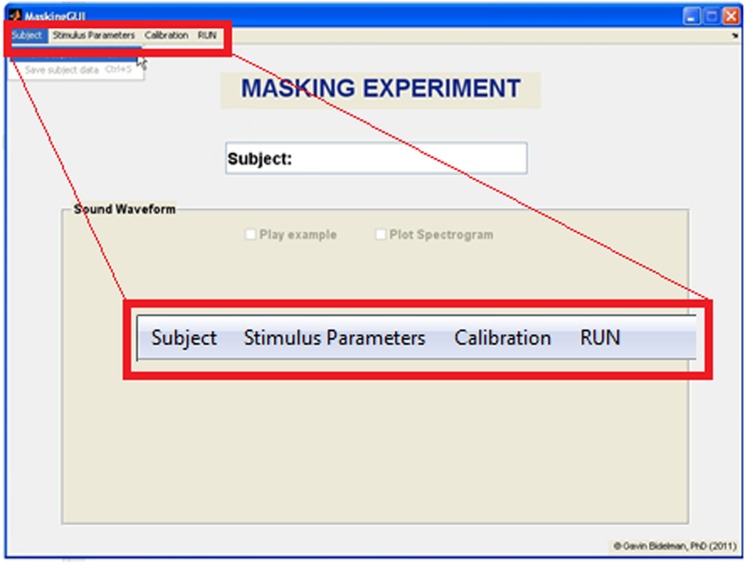
FIGURE 1
FIGURE 1
Home window of the PsyAcoustX GUI for psychoacoustics research. From the home screen, users can enroll new subjects to their experiment, define stimulus parameters, calibrate their system, and run the selected experiment.
FIGURE 2
FIGURE 2
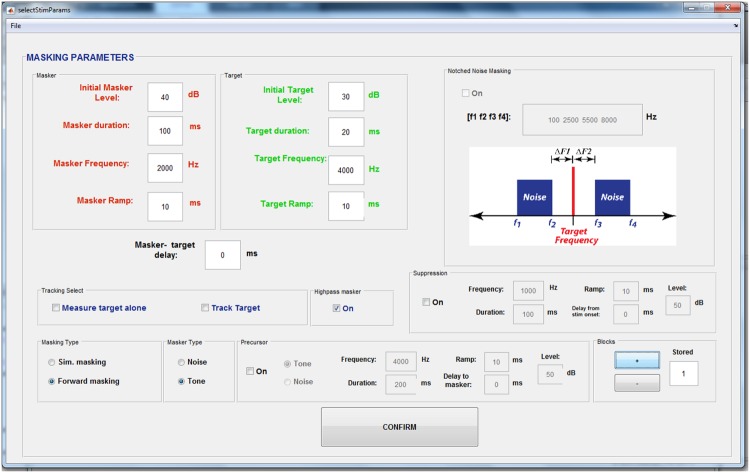
The PsyAcoustX stimulus generation window. A large number of tunable stimulus parameters are accessible to the user including properties of the probe, maskers, and control sounds as well as their spectrotemporal relations to one another (e.g., masker-probe delay). Precursor signals (Jennings et al., 2009; Roverud and Strickland, 2014), suppression (Duifhuis, 1980), and notched noise (Patterson, 1976; Glasberg and Moore, 1990; Jennings and Strickland, 2012) options are also available for more advanced masking paradigms. A toggle to implement high-frequency masking to limit off-frequency listening (Patterson and Nimmo-Smith, 1980; O’Loughlin and Moore, 1981; Jennings and Strickland, 2012) is also provided.
FIGURE 3
FIGURE 3
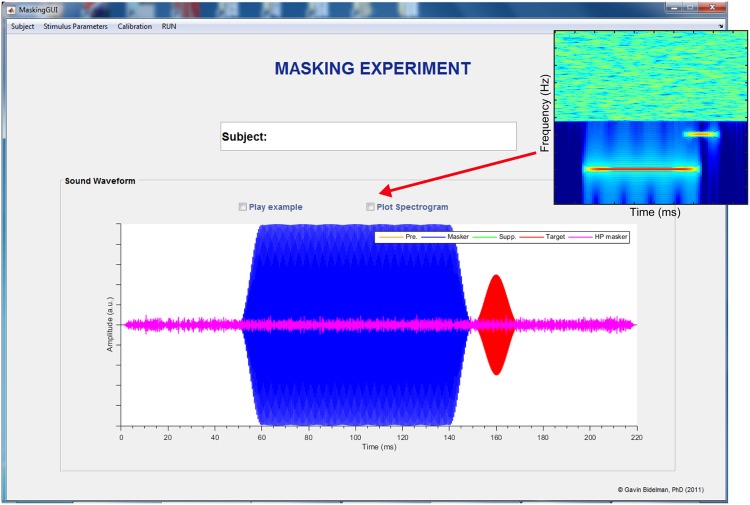
The PsyAcoustX stimulus visualization window. Once desired stimulus parameters are selected the program provides a convenient graphical representation to confirm the time course and spectral (inset) details of the stimulus. Users can also play an example of the stimuli to familiarize themselves with the listening task. The example here illustrates a forward masking condition (off-frequency masker). Low-level high-pass masking noise is also implemented to limit off-frequency listening (Patterson and Nimmo-Smith, 1980; Jennings and Strickland, 2012).
FIGURE 4
FIGURE 4
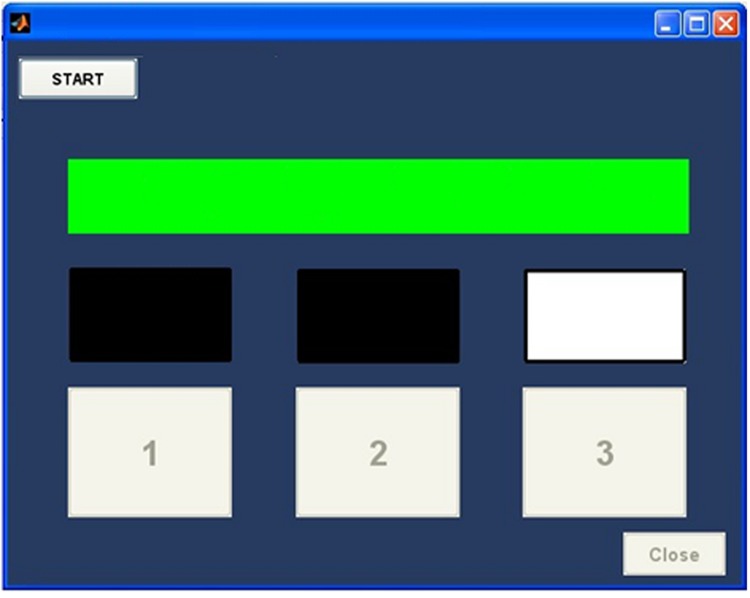
The PsyAcoustX response window. The program implements a 3IFC paradigm (2-down, 1-up tracking; Levitt, 1971) via a simple three-button response interface. Users initiate the experimental run through a START button. Behavioral thresholds are then measured adaptively. The response box includes lights to visualize the presentation order of the intervals and another graphical light for response feedback (green = correct; red = incorrect).
FIGURE 5
FIGURE 5
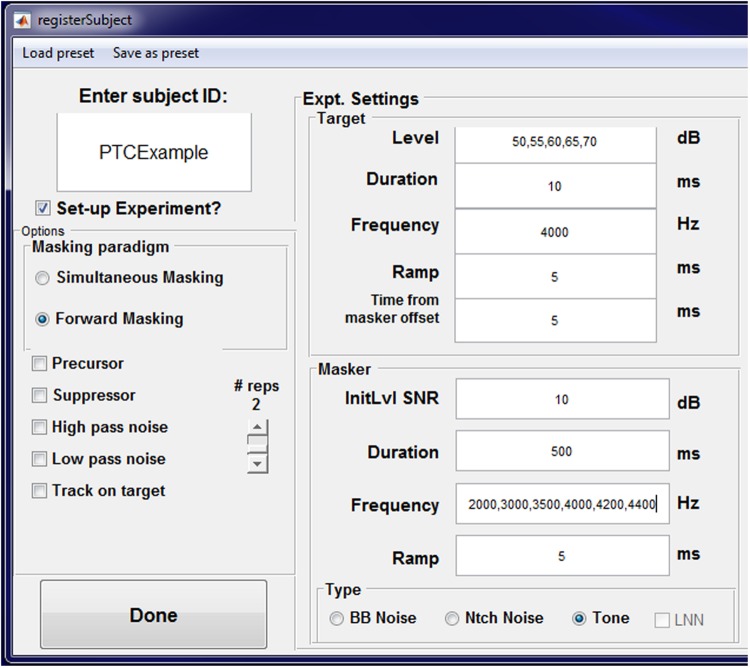
The PsyAcoustX enroll subject window. This window appears when the user selects “New Subject” from PsyAcoustX’s home window. Fields in the enroll subject window allow for multiple entries, separated by commas. When multiple entries are provided, PsyAcoustX will generate all possible stimulus conditions associated with the entries in the fields, and make a folder to store these conditions for the subject designated in “subject ID.” The example provided demonstrates a hypothetical experiment measuring psychophysical tuning curves with a 4000 Hz probe at several probe levels.
FIGURE 6
FIGURE 6
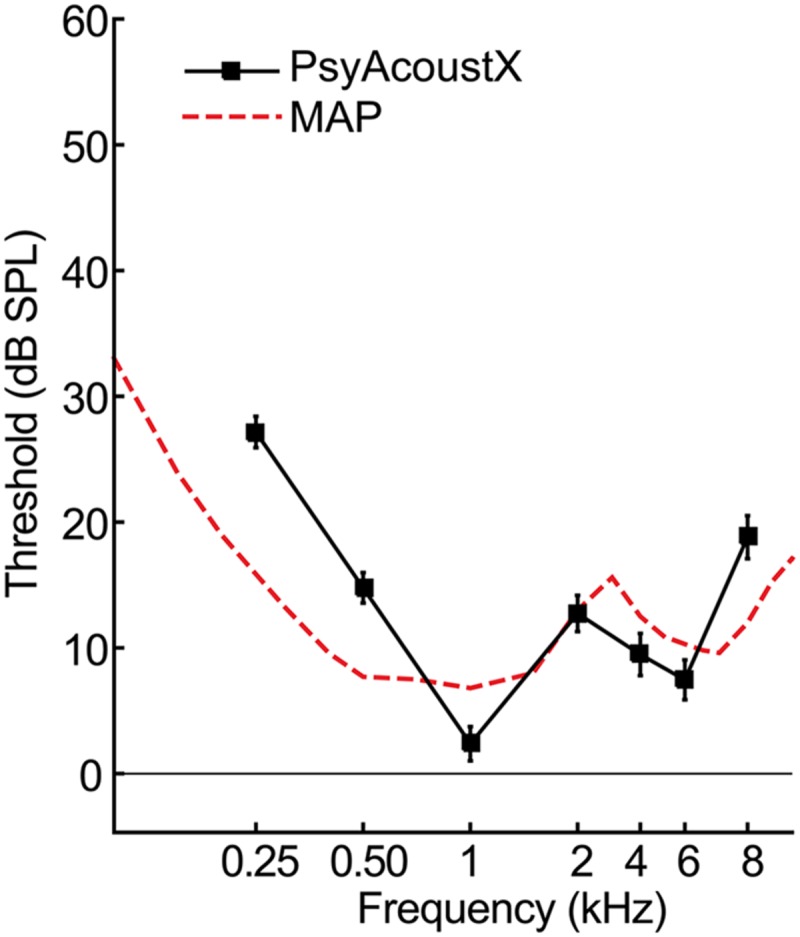
Representative audiometric hearing threshold data. Average air conduction hearing thresholds (i.e., audiograms) for n = 17 normal hearing listeners. Also shown for comparison is the minimum audible pressure (MAP, dashed line; Killion, 1978), representing auditory thresholds measured under headphone listening. Audiometric thresholds measured via PsyAcoustX agree well with those measured via other hardware/software platforms. Errorbars = ±1SEM.
FIGURE 7
FIGURE 7
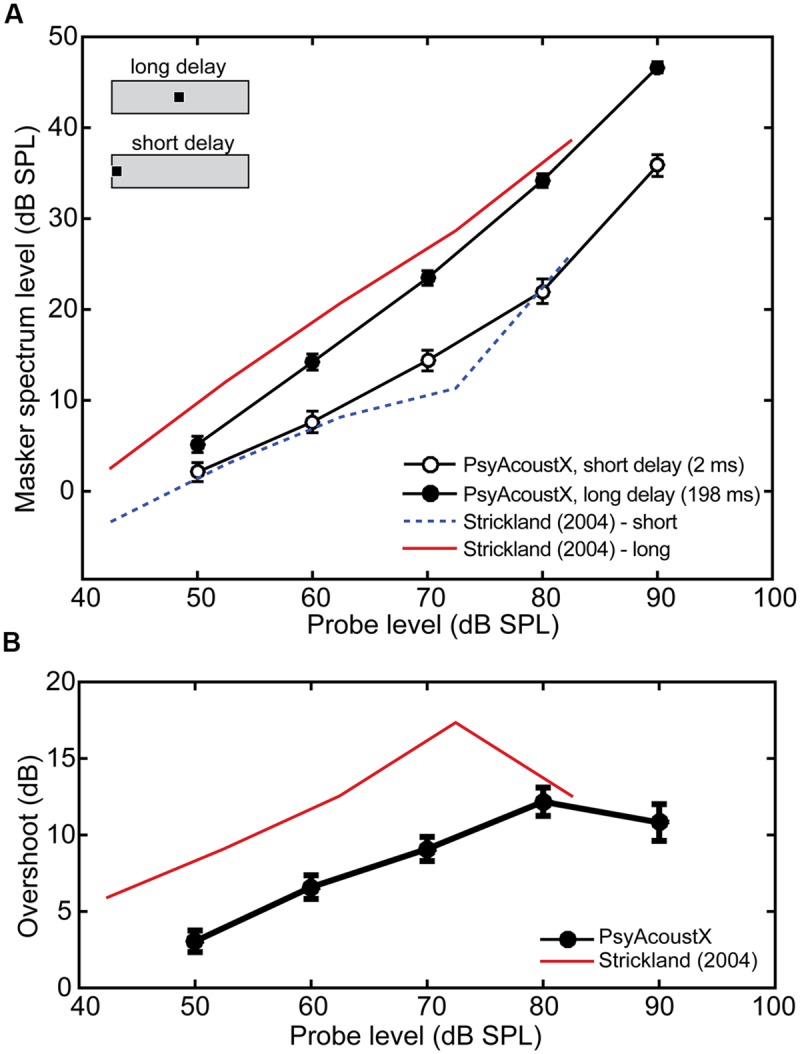
Representative simultaneous masking (overshoot) data. (A) Masking thresholds for probes presented at the onset (open symbols, “short delay”) or temporal center (filled symbols, “long delay”) of the masker. (B) Overshoot calculated from data in (A). Data from Strickland (2004) are shown for comparison; their input levels have been adjusted by 7.54 dB to account for stimulus ramping.
FIGURE 8
FIGURE 8
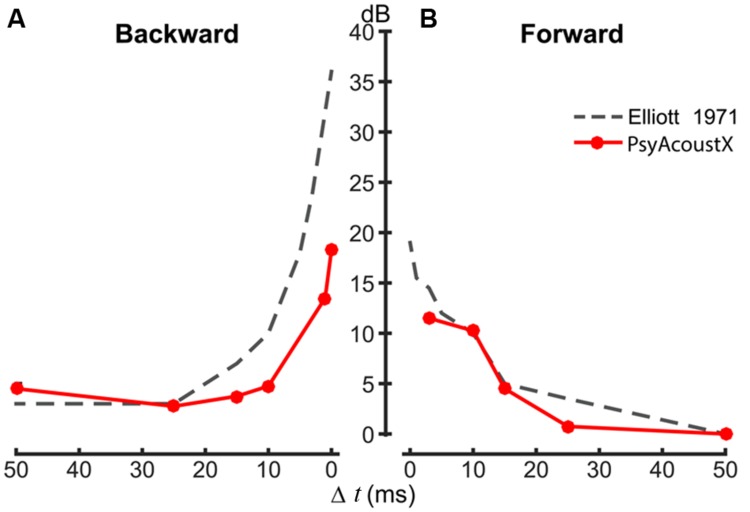
Representative temporal (forward and backward) masking data. (A) Backward and (B) forward masking functions. The time delay between the noise masker and probe tone (Δt) was varied parametrically between –50 and +50 ms; Δt = 0 represents the condition where the masker and probe are contiguous. Temporal masking functions were modeled after stimulus parameters from Elliott (1971) (10 ms, 1-kHz probe masked by 70 dB SPL, 50-ms wideband noise). Data measured in PsyAcoustX agree well with experimental data and show the characteristic asymmetry in temporal masking; forward masking is more effective (i.e., persists longer) than backwards masking.
FIGURE 9
FIGURE 9
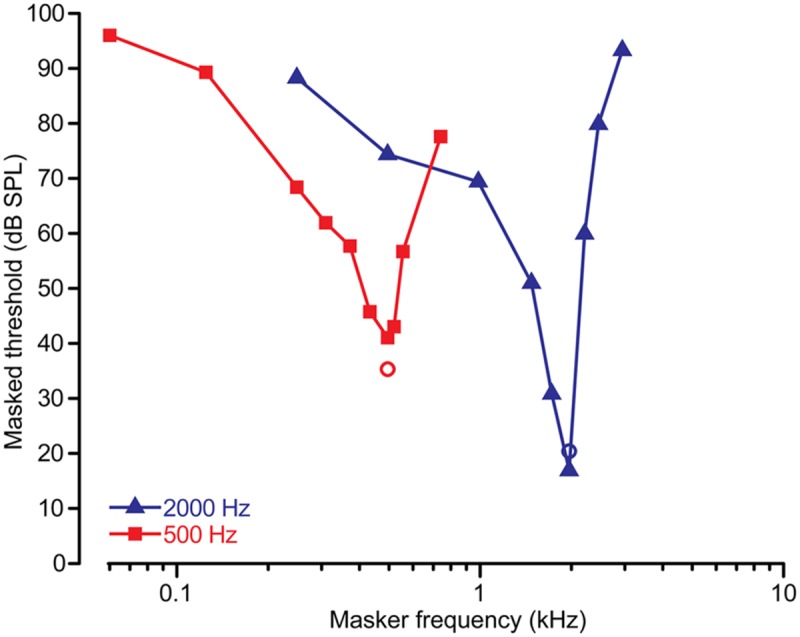
Representative psychophysical tuning curve (PTC) data. PTCs were measured for signal frequencies of 500 and 2000 Hz using a forward masking paradigm (Bidelman et al., 2014). Circles show the level and frequency of the probe. PTCs show the typical “V-shape” with a low-frequency tail, highly selective tip, and steep high-frequency skirt characteristic of auditory filters. Also apparent is the higher quality factor (i.e., sharpness) in human tuning for higher compared to lower characteristic frequencies (CFs) (Shera et al., 2002).
FIGURE 10
FIGURE 10
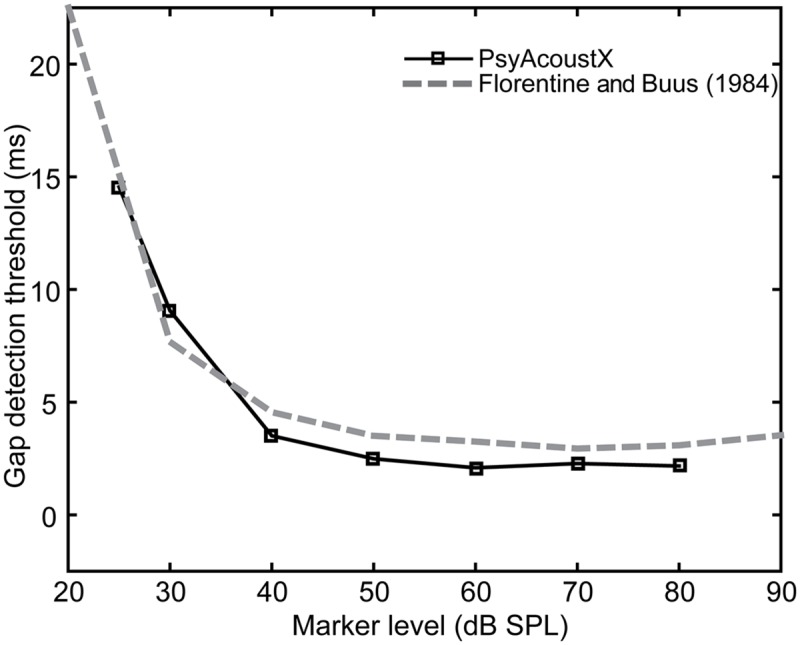
Representative gap detection thresholds (GDTs) as a function of marker level. Squares are data collected using PsyAcoustX in one normal hearing subject. Data from Florentine and Buus (1984) are shown for comparison.
FIGURE 11
FIGURE 11
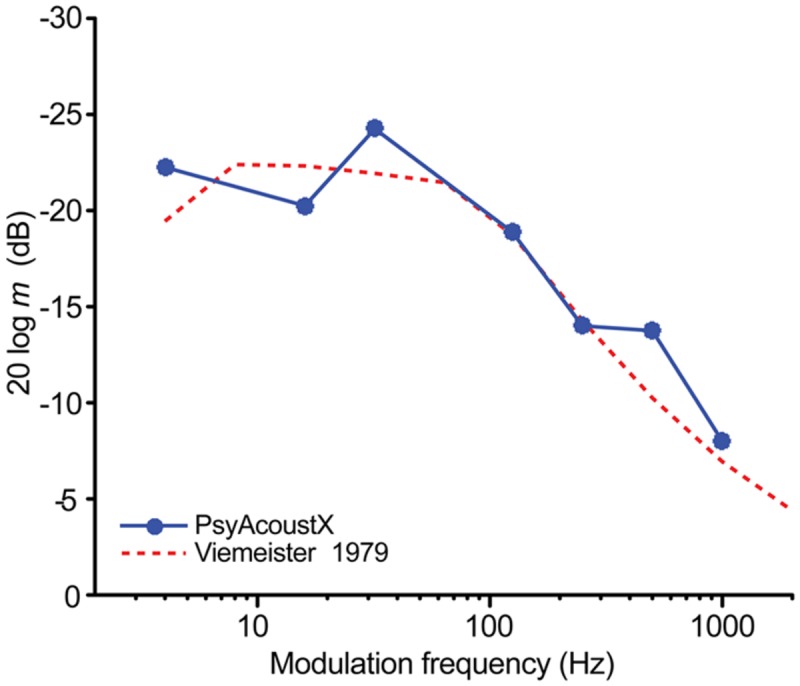
Representative temporal modulation transfer function (TMTF) data. The TMTF recorded from a representative normal hearing listener illustrates temporal acuity for detecting amplitude fluctuations in continuous sounds as a function of modulation frequency. Broadband noise was modulated with a sinusoidally amplitude modulated (SAM) tone of varying modulation frequencies. Data from Viemeister (1979) (their Figure 6) are shown for comparison. TMTFs reveal a characteristic low-pass filter shape indicating better temporal resolution at lower compared to higher modulation frequencies.

References

    1. Abbas P. J., Sachs M. B. (1976). Two-tone suppression in auditory-nerve fibers: extension of a stimulus-response relationship. J. Acoust. Soc. Am. 59 112–122. 10.1121/1.380841 - DOI - PubMed
    1. Bacon S. P. (1990). Effect of masker level on overshoot. J. Acoust. Soc. Am. 88 698–702. 10.1121/1.399773 - DOI - PubMed
    1. Bacon S. P., Healy E. W. (2000). Effects of ipsilateral and contralateral precursors on the temporal effect in simultaneous masking with pure tones. J. Acoust. Soc. Am. 107 1589–1597. 10.1121/1.428443 - DOI - PubMed
    1. Bidelman G. M., Schug J. M., Jennings S. G., Bhagat S. P. (2014). Psychophysical auditory filter estimates reveal sharper cochlear tuning in musicians. J. Acoust. Soc. Am. 136 EL33–EL39. 10.1121/1.4885484 - DOI - PubMed
    1. Bidelman G. M., Syed Khaja A. (2014). Spectrotemporal resolution tradeoff in auditory processing as revealed by human auditory brainstem responses and psychophysical indices. Neurosci. Lett. 572 53–57. 10.1016/j.neulet.2014.04.037 - DOI - PubMed

LinkOut - more resources