Review
. 2015 Oct 16:6:214.
doi: 10.3389/fneur.2015.00214. eCollection 2015.

Role of the Contralesional Hemisphere in Post-Stroke Recovery of Upper Extremity Motor Function

Affiliations
Review

Role of the Contralesional Hemisphere in Post-Stroke Recovery of Upper Extremity Motor Function

Cathrin M Buetefisch. Front Neurol. .

Abstract

Identification of optimal treatment strategies to improve recovery is limited by the incomplete understanding of the neurobiological principles of recovery. Motor cortex (M1) reorganization of the lesioned hemisphere (ipsilesional M1) plays a major role in post-stroke motor recovery and is a primary target for rehabilitation therapy. Reorganization of M1 in the hemisphere contralateral to the stroke (contralesional M1) may, however, serve as an additional source of cortical reorganization and related recovery. The extent and outcome of such reorganization depends on many factors, including lesion size and time since stroke. In the chronic phase post-stroke, contralesional M1 seems to interfere with motor function of the paretic limb in a subset of patients, possibly through abnormally increased inhibition of lesioned M1 by the contralesional M1. In such patients, decreasing contralesional M1 excitability by cortical stimulation results in improved performance of the paretic limb. However, emerging evidence suggests a potentially supportive role of contralesional M1. After infarction of M1 or its corticospinal projections, there is abnormally increased excitatory neural activity and activation in contralesional M1 that correlates with favorable motor recovery. Decreasing contralesional M1 excitability in these patients may result in deterioration of paretic limb performance. In animal stroke models, reorganizational changes in contralesional M1 depend on the lesion size and rehabilitation treatment and include long-term changes in neurotransmitter systems, dendritic growth, and synapse formation. While there is, therefore, some evidence that activity in contralesional M1 will impact the extent of motor function of the paretic limb in the subacute and chronic phase post-stroke and may serve as a new target for rehabilitation treatment strategies, the precise factors that specifically influence its role in the recovery process remain to be defined.

Keywords: functional magnetic resonance image; motor cortex reorganization; motor stroke recovery; neurorehabilitation of motor function; transcranial magnetic stimulation.


Figures
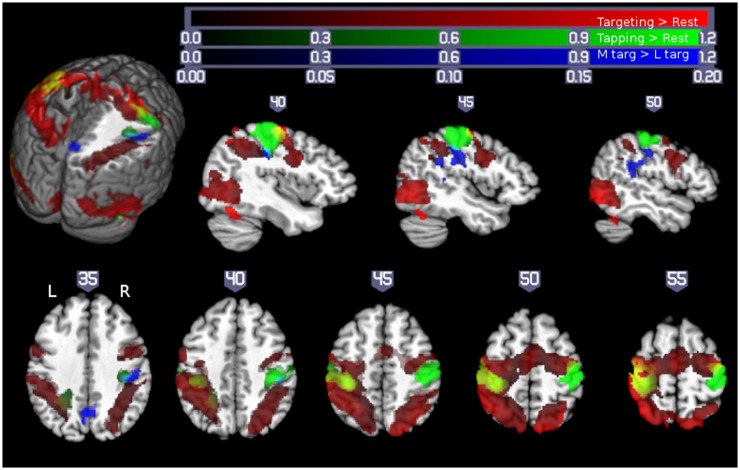
Figure 1
Figure 1
Motor demand-dependent activation of motor cortices using a pointing task: pointing and finger tapping tasks related brain activation: Activity related to the pointing task (collapsed across XL, L, and M targets) is indicated in red. Activation related to right- and left-handed finger tapping is indicated in green, with overlap between finger tapping and pointing task performance shown in yellow. Note that while there was extensive bilateral activation for the pointing task, M1 activation in the finger tapping tasks was only seen contralateral to the performing hand, so that the left hemisphere is solely due to right-handed finger tapping (with left hemisphere yellow areas show overlap between right-handed finger tapping and right-handed pointing task performance) and the right hemisphere activity is solely due to left-handed finger tapping (yellow colors in the right hemisphere show overlap between activity due to the right-handed targeting task and left-handed finger tapping task, outlined with a yellow border for ease of visualization). Significant activation related to increasing motor demand (M targets > L targets) is indicated in blue (overlap between this region and left-handed finger tapping shown in cyan, outlined for clarity). All activations are shown overlaid on the Colin27 template in standard space, thresholded at a corrected p < 0.05 (uncorrected threshold p < 0.005 and cluster size >2360 mm3). Increased color intensity corresponds to higher estimates of percent signal change. Cuts in the three-dimensional rendering are shown at x = 0, y = −15, and z = 35. The right hemisphere is depicted in the upper panel. The right (R) and left (L) side of the brain are indicated in the lower panel. Numerical labels above each slice show slice coordinates in the x dimension (sagittal sections) or z dimension (axial sections) (11).
Figure 2
Figure 2
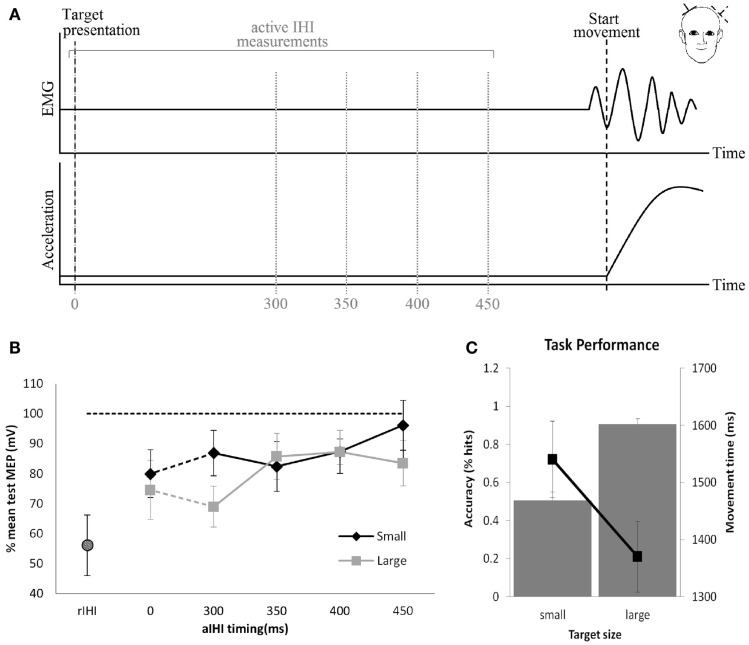
Resting and active interhemispheric inhibition (IHI): (A) IHI can be demonstrated by applying a conditioning stimulus to M1, which inhibits the size of the motor-evoked potential (MEP) produced by the test stimulus applied to the homotopic area of the opposite M1. These measures are obtained during rest (resting IHI, rIHI) or in the pre-movement period during preparation of a movement (active IHI). (B) During rest, there is significant rIHI (round symbol) from one M1 on the other M1. Active IHI (rectangular symbol) decreases immediately prior to the movement onset depending on kinematics of the movement (B,C). (B,C) Pointing to a large target with less demand on accuracy (square) results in less reduction of active IHI compared to pointing at a small target (diamond) with high demand on accuracy (33).
Figure 3
Figure 3
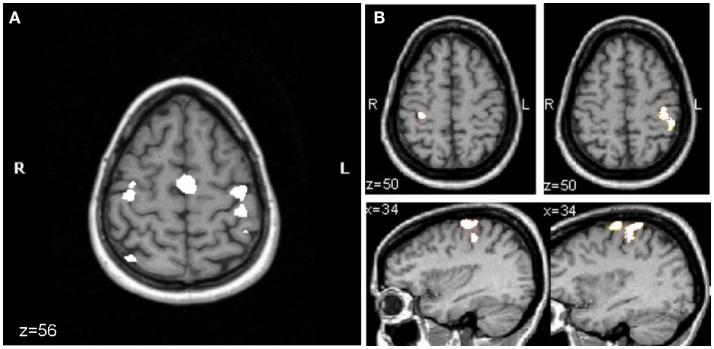
Mean fMRI activation map of the performance of a finger sequence with the affected hand in patients (n = 5) (A) and with either hand in the age-matched control group (n = 9) (B). For both groups, the activation map is superimposed on the T1-weighted MRI of the same healthy control subject. (A) In patients, right in the axial slice of brain (z = 56) corresponds to the lesioned hemisphere and left to the contralesional hemisphere. Activation of contralesional precentral gyrus is evident (corrected p < 0.05). (B) For the control group performing the finger sequence with the left (lower left image, corrected p = 0.05) or right (lower right image, uncorrected p < 5.8e−12) hand, there was activation in the precentral gyrus of the hemisphere that is contralateral to the performing hand. Initially, the significance level was set as low as corrected p = 0.05 to pick up any activity in the motor cortex ipsilateral to the moving hand (shown for left hand movement, lower left image). At this significance level, massive activation was seen in the pre- and postcentral gyrus contralaterally when moving the right hand. To separate clusters of activity in pre- and postcentral gyrus, the significance level was increased until the two clusters became distinct (uncorrected p < 5.8e−12, lower right panel) (16).
Figure 4
Figure 4
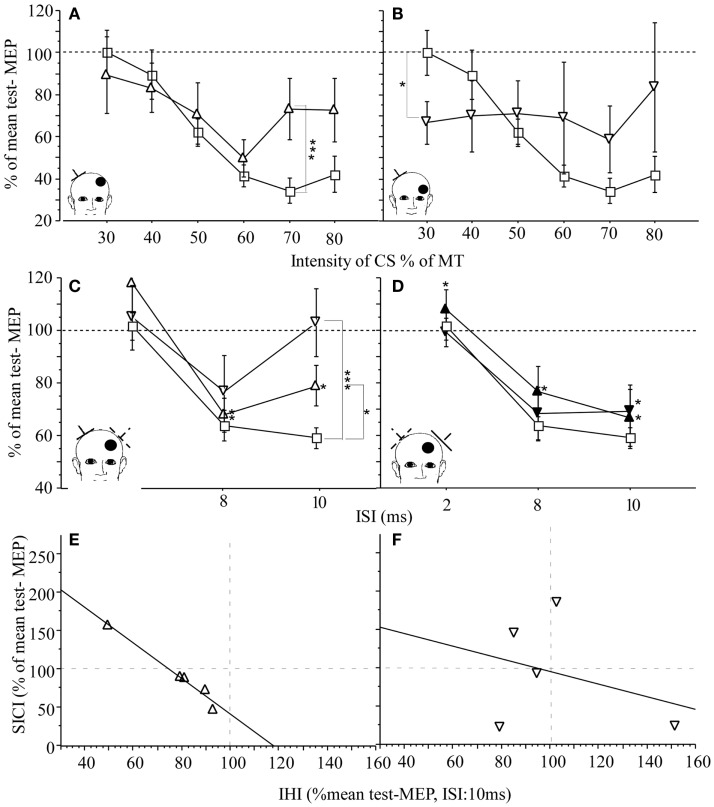
M1 excitability and IHI in patients with subacute stroke (n = 23) and healthy age-matched controls (n = 20): EMG was recorded from the first dorsal interosseus muscle (FDI). (A,B) Effect of lesion location on SICI in patients. Control (square) and contralesional M1 of patients with cortical [open triangle (A)] and subcortical location of infarction [open inverted triangle (C)]. IHI of the lesioned M1 on the contralesional M1 is reduced in patients with cortical (open triangle) or subcortical infarction (open inverted triangle) when compared to healthy controls (square). (D) IHI from contralesional M1 on the lesioned M1 was intact for cortical infarction (black triangle) and subcortical infarction (black inverted triangle). The conditioned MEP amplitude is expressed as percentage of the mean test-MEP. (E,F) Relationship between M1 excitability, SICI (CS at 80% MT), and IHI in patients with cortical infarction (triangle) and subcortical infarction (inverted triangle). For each patient (each point represents one subject), SICI of the contralesional M1 was plotted against IHI from lesioned on the contralesional M1 (open symbols). Regression was calculated. For cortical location of the infarction, there was an inverse linear relationship between SICE of the contralesional M1 and IHI from lesioned on the contralesional M1 [(E) r2 = 0.972, p = 0.002]. Although there is a similar trend in the subcortical group (F), the relationship was more variable [(F)r2 = 0.105, p = ns]. The insert indicates the position of the coil for application of CS (dotted lines) and the TS (solid lines). The location of the lesion is indicated by the bullet. CS = intensity of conditioning stimulus, MT = motor threshold. The scattered lines indicate the cutoff between facilitation (>100) and inhibition (<100). Mean ± SE. *p < 0.05, **p < 0.02, and ***p < 0.01 (29).

References

    1. Chollet F, Dipiero V, Wise RJ, Brooks DJ, Dolan RJ, Frackowiak RS. The functional anatomy of motor recovery after stroke in humans: a study with positron emission tomography. Ann Neurol (1991) 29:63–71. 10.1002/ana.410290112 - DOI - PubMed
    1. Carr LJ, Harrison LM, Evans AL, Stephens JA. Patterns of central motor reorganization in hemiplegic cerebral palsy. Brain (1993) 116(Pt 5):1223–47. 10.1093/brain/116.5.1223 - DOI - PubMed
    1. Hummel F, Celnik P, Pascual-Leone A, Fregni F, Byblow WD, Buetefisch CM, et al. Controversy: noninvasive and invasive cortical stimulation show efficacy in treating stroke patients. Brain Stimul (2008) 1:370–82. 10.1016/j.brs.2008.09.003 - DOI - PubMed
    1. Jones TA, Allred RP, Jefferson SC, Kerr AL, Woodie DA, Cheng SY, et al. Motor system plasticity in stroke models: intrinsically use-dependent, unreliably useful. Stroke (2013) 44:S104–6. 10.1161/STROKEAHA.111.000037 - DOI - PMC - PubMed
    1. Dancause N, Touvykine B, Mansoori BK. Inhibition of the contralesional hemisphere after stroke: reviewing a few of the building blocks with a focus on animal models. Prog Brain Res (2015) 218:361–87. 10.1016/bs.pbr.2015.01.002 - DOI - PubMed

LinkOut - more resources