


Modeling and Prediction of Oyster Norovirus Outbreaks along Gulf of Mexico Coast
- PMID: 26528621
- PMCID: PMC4858391
- DOI: 10.1289/ehp.1509764
Modeling and Prediction of Oyster Norovirus Outbreaks along Gulf of Mexico Coast
Abstract
Background: Oyster norovirus outbreaks often pose high risks to human health. However, little is known about environmental factors controlling the outbreaks, and little can be done to prevent the outbreaks because they are generally considered to be unpredictable.
Objective: We sought to develop a mathematical model for predicting risks of oyster norovirus outbreaks using environmental predictors.
Methods: We developed a novel probability-based Artificial Neural Network model, called NORF model, using 21 years of environmental and norovirus outbreak data collected from Louisiana oyster harvesting areas along the Gulf of Mexico coast, USA. The NORF model involves six input variables that were selected through stepwise regression analysis and sensitivity analysis.
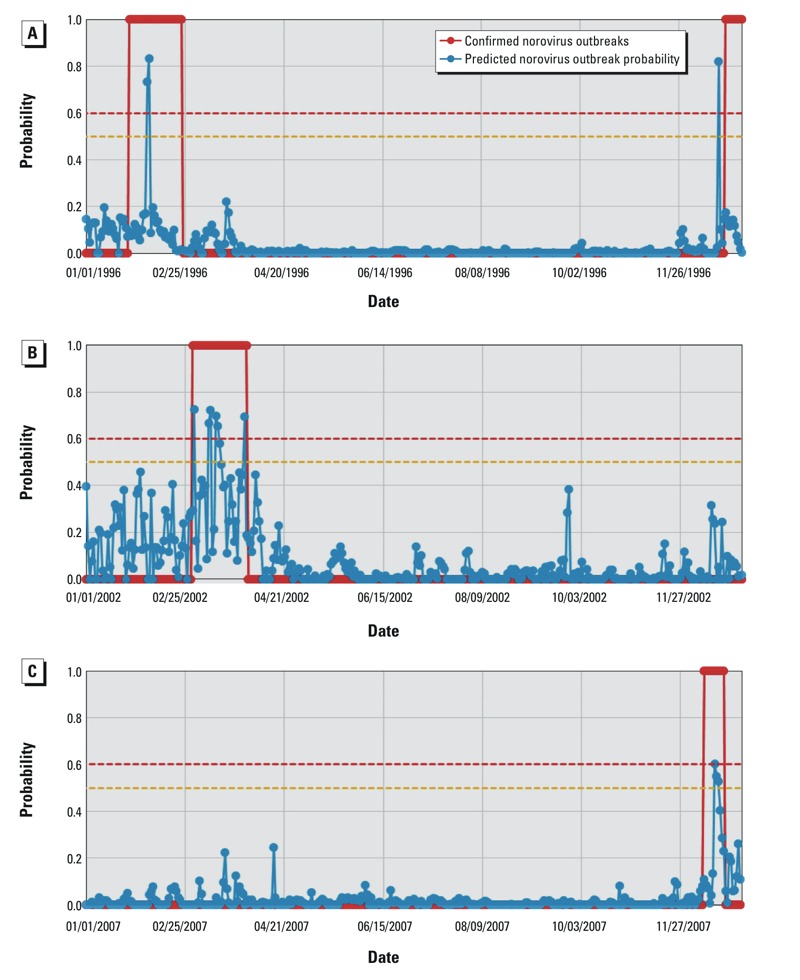
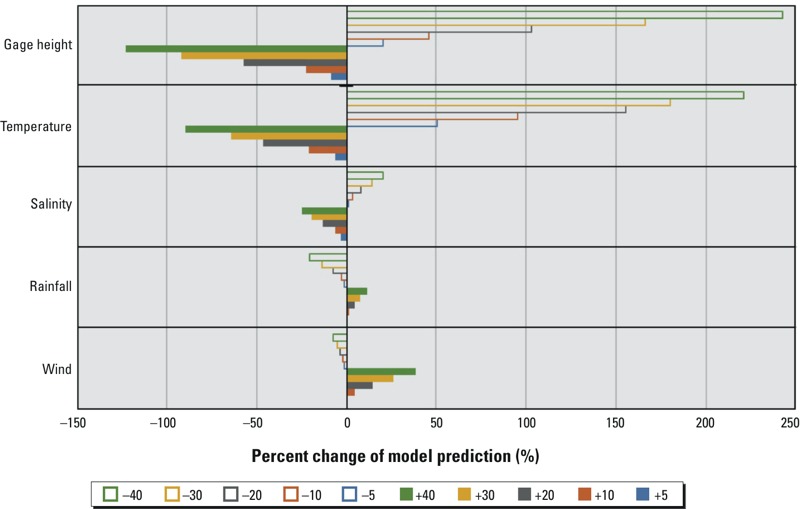
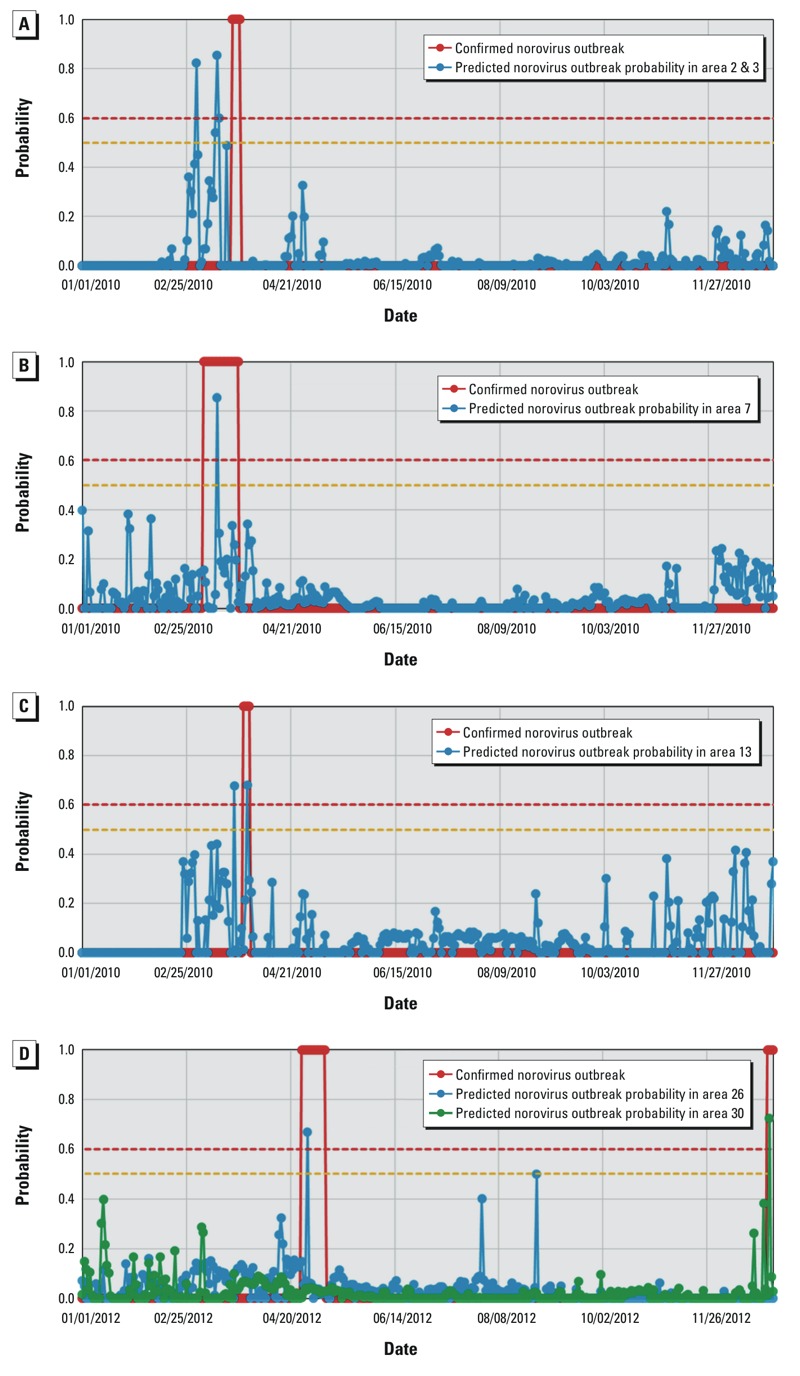
Results: We found that the model-based probability of norovirus outbreaks was most sensitive to gage height (the depth of water in an oyster bed) and water temperature, followed by wind, rainfall, and salinity, respectively. The NORF model predicted all historical oyster norovirus outbreaks from 1994 through 2014. Specifically, norovirus outbreaks occurred when the NORF model probability estimate was > 0.6, whereas no outbreaks occurred when the estimated probability was < 0.5. Outbreaks may also occur when the estimated probability is 0.5-0.6.
Conclusions: Our findings require further confirmation, but they suggest that oyster norovirus outbreaks may be predictable using the NORF model. The ability to predict oyster norovirus outbreaks at their onset may make it possible to prevent or at least reduce the risk of norovirus outbreaks by closing potentially affected oyster beds.
Citation: Wang J, Deng Z. 2016. Modeling and prediction of oyster norovirus outbreaks along Gulf of Mexico coast. Environ Health Perspect 124:627-633; http://dx.doi.org/10.1289/ehp.1509764.
Conflict of interest statement
The authors declare they have no actual or potential competing financial interests.
Figures
References
-
- FDA (U.S. Food and Drug Administration.) FDA Warns Consumers not To Eat Oysters from Copano Bay in Aransas County, Texas. Oysters Harvested from Copano Bay linked to Norovirus Illnesses in Louisiana. 2014 Available: http://www.fda.gov/NewsEvents/Newsroom/PressAnnouncements/ucm382247.htm [accessed 17 January 2014]
-
- Flannery J, Keaveney S, Rajko-Nenow P, O’Flaherty V, Doré W. Norovirus and FRNA bacteriophage determined by RT-qPCR and infectious FRNA bacteriophage in wastewater and oysters. Water Res. 2013;47(14):5222–5231. - PubMed
MeSH terms
LinkOut - more resources
Full Text Sources
Other Literature Sources
Medical