. 2015 Oct 30;12(11):13981-4020.
doi: 10.3390/ijerph121113981.

MicroRNAs in Breastmilk and the Lactating Breast: Potential Immunoprotectors and Developmental Regulators for the Infant and the Mother

Affiliations

MicroRNAs in Breastmilk and the Lactating Breast: Potential Immunoprotectors and Developmental Regulators for the Infant and the Mother

Mohammed Alsaweed et al. Int J Environ Res Public Health. .

Abstract

Human milk (HM) is the optimal source of nutrition, protection and developmental programming for infants. It is species-specific and consists of various bioactive components, including microRNAs, small non-coding RNAs regulating gene expression at the post-transcriptional level. microRNAs are both intra- and extra-cellular and are present in body fluids of humans and animals. Of these body fluids, HM appears to be one of the richest sources of microRNA, which are highly conserved in its different fractions, with milk cells containing more microRNAs than milk lipids, followed by skim milk. Potential effects of exogenous food-derived microRNAs on gene expression have been demonstrated, together with the stability of milk-derived microRNAs in the gastrointestinal tract. Taken together, these strongly support the notion that milk microRNAs enter the systemic circulation of the HM fed infant and exert tissue-specific immunoprotective and developmental functions. This has initiated intensive research on the origin, fate and functional significance of milk microRNAs. Importantly, recent studies have provided evidence of endogenous synthesis of HM microRNA within the human lactating mammary epithelium. These findings will now form the basis for investigations of the role of microRNA in the epigenetic control of normal and aberrant mammary development, and particularly lactation performance.

Keywords: RNA; breastfeeding; breastmilk; cells; development; human milk; immune system; infant formula; lipids; microRNA; skim milk.


Figures
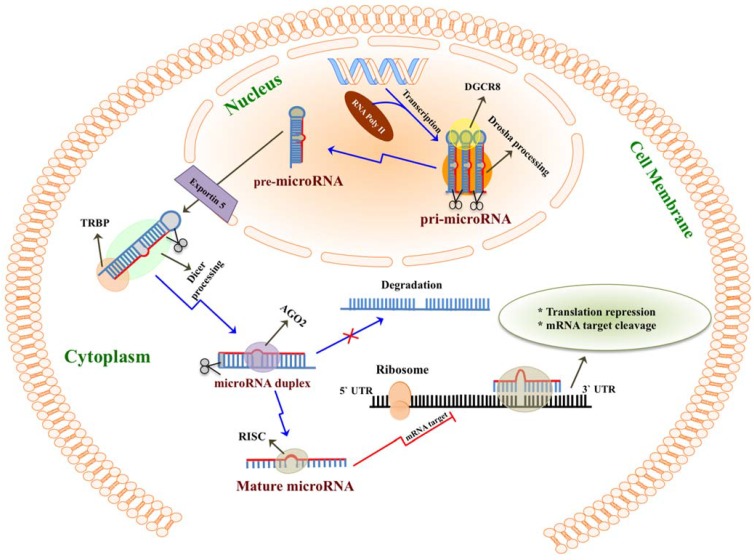
Figure 1
Figure 1
The predicted biogenesis of microRNA. MicroRNA are first transcribed from specific genes on DNA as primary microRNA (pri-microRNA) by RNA polymerase II (RNAPII). In the nucleus, pri-microRNA are converted into ~70-nucleotide precursor hairpin microRNA (pre-microRNA) by the enzymatic Drosha–DGCR8 complex. Pre-microRNA are then transported from nucleus to the cytoplasm by Exportin 5. There, the Dicer-TRBP complex produces ~20 base pair 3s′ microRNA and 5′ microRNA duplex. Dicer with assistance from argonaute 2 (AGO2) generates mature microRNA by cleaving the double strand of pre-microRNA. Only one strand of microRNA (3′ microRNA or 5′ microRNA) can be attached into the RNA-induced silencing complex (RISC). Finally, the microRNA/RISC complex binds into specific mRNA during protein translation, recognizing their target via a 6–8 nucleotides match-mir process (seed region). This results in either repression of the mRNA translation into protein or mRNA degradation.
Figure 2
Figure 2
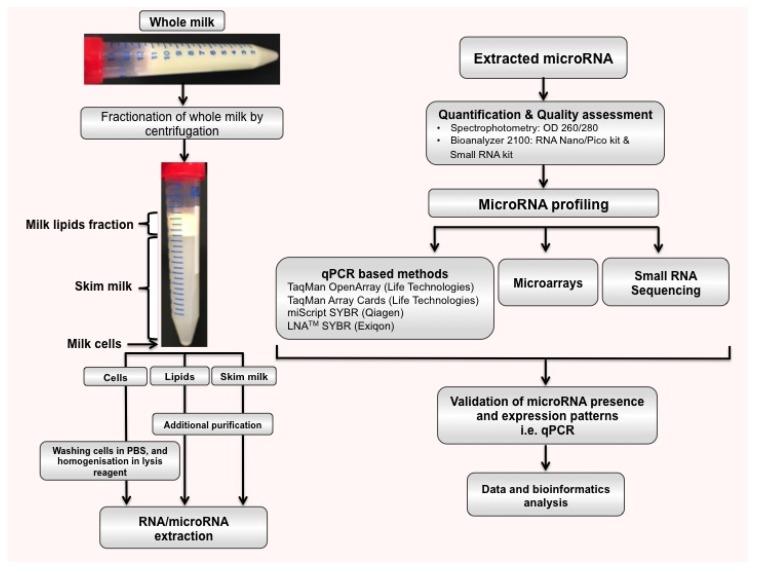
A workflow of microRNA identification in HM. Whole HM can be fractionated by centrifugation for 20 min at 800 g at 20 °C to obtain three fractions including the cells, the lipid layer and skim milk. Total RNA and microRNA can be extracted from each fraction using the optimal kit [47]. Profiling of microRNA after quantification and measurement of its quality can be performed using three different methods [47]: phenol/guanidine, filter column, and a combination of the filter column and phenol/guanidine methods. Small RNA sequencing can determine novel microRNAs and identify all microRNAs in a sample. Microarray analysis and qPCR-based methods can on principle only measure specific microRNAs. Validation of presence and expression patterns of a microRNA of interest is done using qPCR as it is highly sensitive and specific.
Figure 3
Figure 3
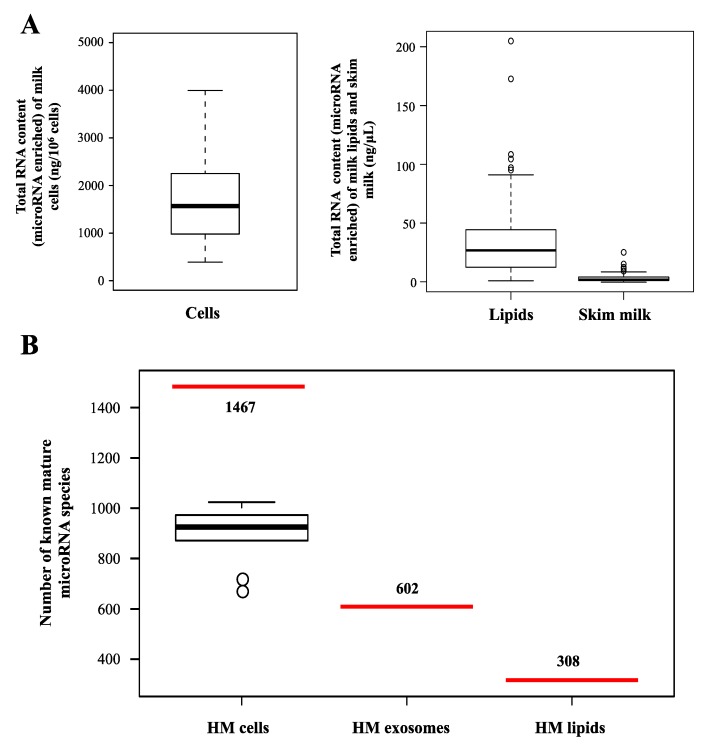
Differences in the microRNA content between the different fractions of human milk. (A) Box plots showing the total RNA content (enriched in microRNA) measured using NanoDrop 2000 in HM cells (n = 30 milk samples from 20 mothers), lipids (n = 127 milk samples from 79 mothers) and skim milk (n = 116 milk samples from 79 mothers) obtained from healthy breastfeeding mothers [35,45,47]. (B) Box plot showing the number of mature microRNA species that have been identified in HM cells, lipids and exosomes using deep small RNA sequencing. HM cell microRNAs were profiled in n = 20 samples collected from 10 healthy exclusively breastfeeding mothers in month 2 of lactation [35] using Illumina HiSeq2000, with total clean reads of 268,681,616 matched to miRBase version 20.0. This study identified 1467 different mature known microRNAs in HM cells. HM lipid samples (n = 7) were sequenced using an Illumina 1G Genome analyzer, with 124,110,646 clean reads mapped to miRBase version 16.0. This study identified 308 mature known microRNAs in HM lipids [44]. HM exosome samples (n = 4) were sequenced using an Illumina Genome analyzer II, with 83,520,000 clean reads matched to miRBase version 17.0. This study identified 602 mature known microRNAs in HM exosomes [36].
Figure 4
Figure 4
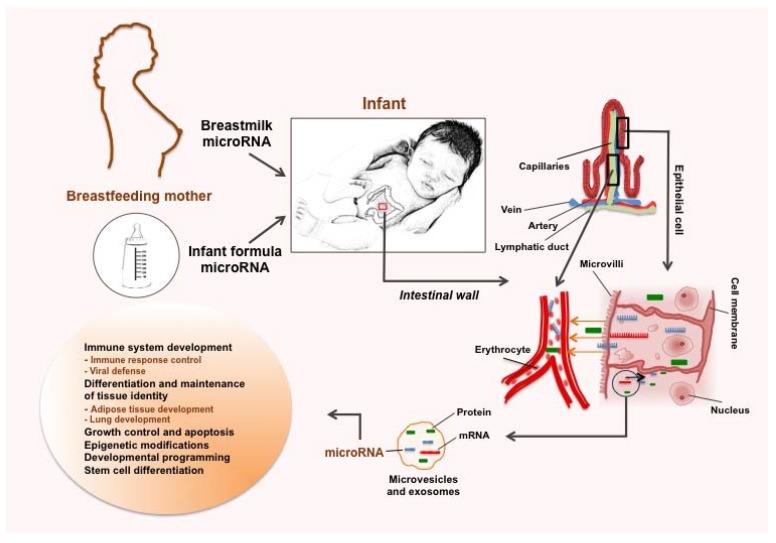
A potential scenario depicting the sources of exogenous microRNA for the infant (breastmilk and infant formulae) and uptake of them along with other macro/micronutrients (i.e., fatty acids and amino acids) in the infant’s gastrointestinal (GI) tract. Breastmilk microRNAs can be delivered to the infant either as free molecules in skim milk, or via uptake of breastmilk cells, exosomes and other milk microvesicles in the GI tract. There, absorption is thought to occur through intestinal epithelial cells, from which milk-derived microRNA may reach various organs and tissues via the bloodstream to potentially perform functions, such as immunoprotection and developmental programming. It is of note that infant formulae are extremely poor in microRNA compared to HM, with potential differences also in the biological activity of these molecules in formula that merit further investigation.

References

    1. Lee R.C., Feinbaum R.L., Ambros V. The C. elegans heterochronic gene lin-4 encodes small RNAs with antisense complementarity to lin-14. Cell. 1993;75:843–854. doi: 10.1016/0092-8674(93)90529-Y. - DOI - PubMed
    1. Bartel D.P. MicroRNAs: Genomics, biogenesis, mechanism, and function. Cell. 2004;116:281–297. doi: 10.1016/S0092-8674(04)00045-5. - DOI - PubMed
    1. He L., Hannon G.J. MicroRNAs: Small RNAs with a big role in gene regulation. Nat. Rev. Genet. 2004;5:522–531. doi: 10.1038/nrg1379. - DOI - PubMed
    1. Pritchard C.C., Cheng H.H., Tewari M. MicroRNA profiling: Approaches and considerations. Nat. Rev. Genet. 2012;13:358–369. doi: 10.1038/nrg3198. - DOI - PMC - PubMed
    1. Fabian M.R., Sonenberg N., Filipowicz W. Regulation of mRNA translation and stability by microRNAs. Annu. Rev. Biochem. 2010;79:351–379. doi: 10.1146/annurev-biochem-060308-103103. - DOI - PubMed

Publication types