. 2015 Nov 3;10(11):e0140778.
doi: 10.1371/journal.pone.0140778. eCollection 2015.

The Role of Anterior Nuclei of the Thalamus: A Subcortical Gate in Memory Processing: An Intracerebral Recording Study

Affiliations

The Role of Anterior Nuclei of the Thalamus: A Subcortical Gate in Memory Processing: An Intracerebral Recording Study

Klára Štillová et al. PLoS One. .

Abstract

Objective: To study the involvement of the anterior nuclei of the thalamus (ANT) as compared to the involvement of the hippocampus in the processes of encoding and recognition during visual and verbal memory tasks.

Methods: We studied intracerebral recordings in patients with pharmacoresistent epilepsy who underwent deep brain stimulation (DBS) of the ANT with depth electrodes implanted bilaterally in the ANT and compared the results with epilepsy surgery candidates with depth electrodes implanted bilaterally in the hippocampus. We recorded the event-related potentials (ERPs) elicited by the visual and verbal memory encoding and recognition tasks.

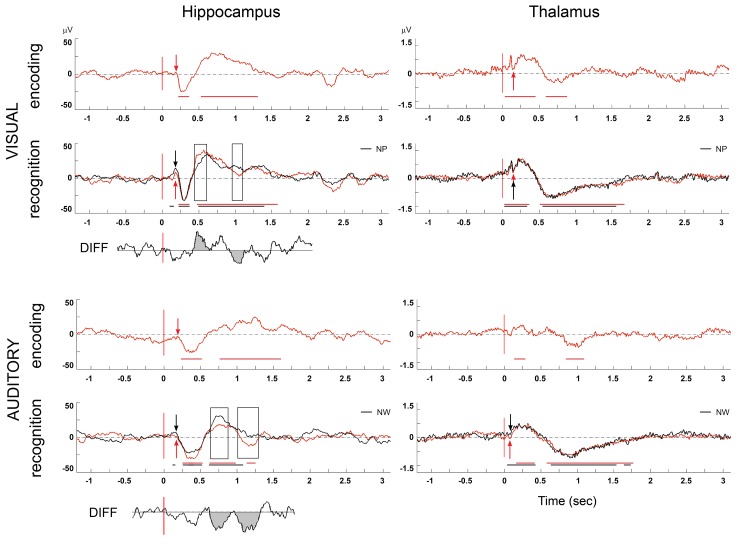
Results: P300-like potentials were recorded in the hippocampus by visual and verbal memory encoding and recognition tasks and in the ANT by the visual encoding and visual and verbal recognition tasks. No significant ERPs were recorded during the verbal encoding task in the ANT. In the visual and verbal recognition tasks, the P300-like potentials in the ANT preceded the P300-like potentials in the hippocampus.

Conclusions: The ANT is a structure in the memory pathway that processes memory information before the hippocampus. We suggest that the ANT has a specific role in memory processes, especially memory recognition, and that memory disturbance should be considered in patients with ANT-DBS and in patients with ANT lesions. ANT is well positioned to serve as a subcortical gate for memory processing in cortical structures.


Conflict of interest statement

Competing Interests: The authors have declared that no competing interests exist.

Figures

Fig 1
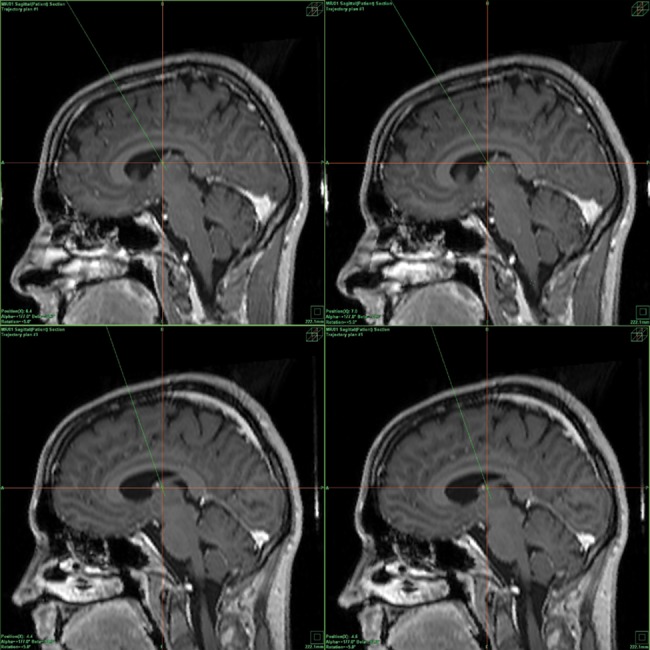
Fig 1. Example of the actual positions of the all ANT contacts in patient 2 (right-left orientation of the sagittal scans, fusion of the MR scans and CT correlation).
Upper picture: position of the right ANT contacts: the R3 contact (left picture), and position of the R4 contact (right picture). Lower picture: position of the left ANT contacts: the L3 contact (left picture) and position of the L4 contact (right picture).
Fig 2
Fig 2. P300-like potentials in the hippocampus and the thalamus (the mean from all hippocampal and thalamic contacts from all patients in bipolar montage during the encoding and the recognition task).
The black curve indicates a new stimulus (new picture/word: NP/NW); red indicates a repeated stimulus during the recognition phase (old picture/word: OP, OW). The arrow shows the beginning of the P300-like potential (red for the repeated stimulus, black for the new one.) Axis x is time (in s); axis y is amplitude in μV. The statistical significance to baseline is highlighted by black and red horizontal lines. The significant difference between tasks in the hippocampus is highlighted by a black rectangle. Simultaneously the difference between tasks is drawn—DIFF.
Fig 3
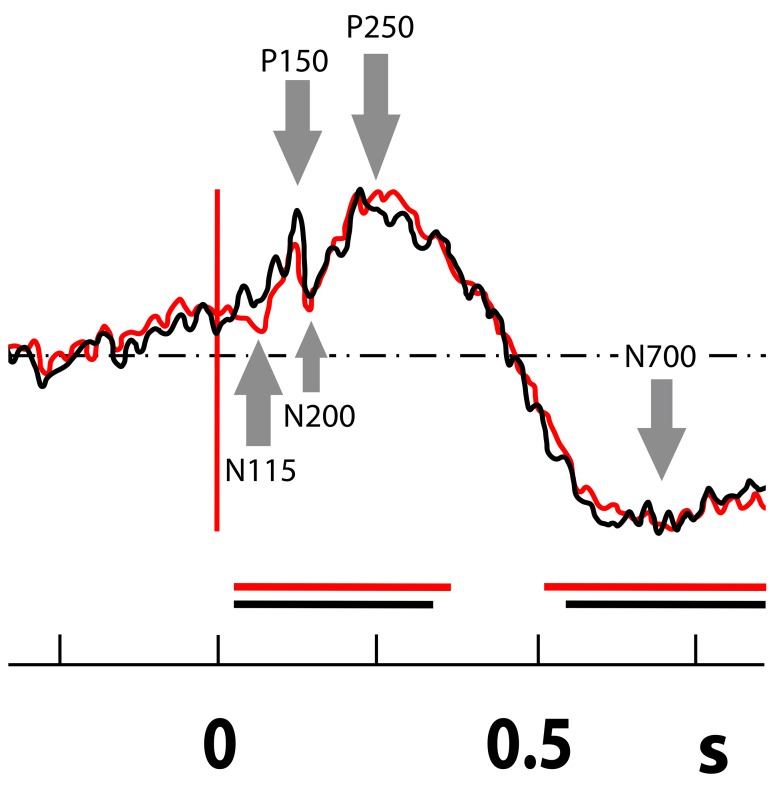
Fig 3. Visual recognition task in the ANT: N 115- P 150- N 200- P 250 and N700 complex (the mean from all thalamic contacts from all patients in bipolar montage during the recognition task).
Arrows mark fast and slow ERP components N115, P150, N200, P250, and N700. The black curve indicates a new stimulus (new picture); red indicates a repeated stimulus during the recognition phase (old picture). On axis x is time (in s). The statistical significance to baseline is highlighted by black and red horizontal lines.

References

    1. Fisher R, Salanova V, Witt T, Worth R, Henry T, Gross R et al. (2010) Electrical stimulation of the anterior nucleus of thalamus for treatment of refractory epilepsy. Epilepsia 51(5):899–908. 10.1111/j.1528-1167.2010.02536.x - DOI - PubMed
    1. Hodaie M, Wennberg RA, Dostrovsky JO, Lozano AM (2002) Chronic anterior thalamus stimulation for intractable epilepsy. Epilepsia 43(6):603–8. - PubMed
    1. Lim SN, Lee ST, Tsai YT et al. (2007) Electrical stimulation of the anterior nucleus of the thalamus for intractable epilepsy: a long-term follow-up study. Epilepsia 48(2):342–7. - PubMed
    1. Hamani C, Dubiela FP, Soares JC et al. (2010) Anterior thalamus deep brain stimulation at high current impairs memory in rats. Exp Neurol 225(1):154–62. 10.1016/j.expneurol.2010.06.007 - DOI - PubMed
    1. Hu R, Eskandar E, and Williams Z (2009) Role of deep brain stimulation in modulating memory formation and recall. Neurosurg Focus 27.1 (2009): E3. - PMC - PubMed

Publication types