. 2015 Nov 4:5:16265.
doi: 10.1038/srep16265.

Analysis of the TCP genes expressed in the inflorescence of the orchid Orchis italica

Affiliations

Analysis of the TCP genes expressed in the inflorescence of the orchid Orchis italica

Sofia De Paolo et al. Sci Rep. .

Abstract

TCP proteins are plant-specific transcription factors involved in many different processes. Because of their involvement in a large number of developmental pathways, their roles have been investigated in various plant species. However, there are almost no studies of this transcription factor family in orchids. Based on the available transcriptome of the inflorescence of the orchid Orchis italica, in the present study we identified 12 transcripts encoding TCP proteins. The phylogenetic analysis showed that they belong to different TCP classes (I and II) and groups (PCF, CIN and CYC/TB1), and that they display a number of conserved motifs when compared with the TCPs of Arabidopsis and Oryza. The presence of a specific cleavage site for the microRNA miRNA319, an important post-transcriptional regulator of several TCP genes in other species, was demonstrated for one transcript of O. italica, and the analysis of the expression pattern of the TCP transcripts in different inflorescence organs and in leaf tissue suggests that some TCP transcripts of O. italica exert their role only in specific tissues, while others may play multiple roles in different tissues. In addition, the evolutionary analysis showed a general purifying selection acting on the coding region of these transcripts.


Figures
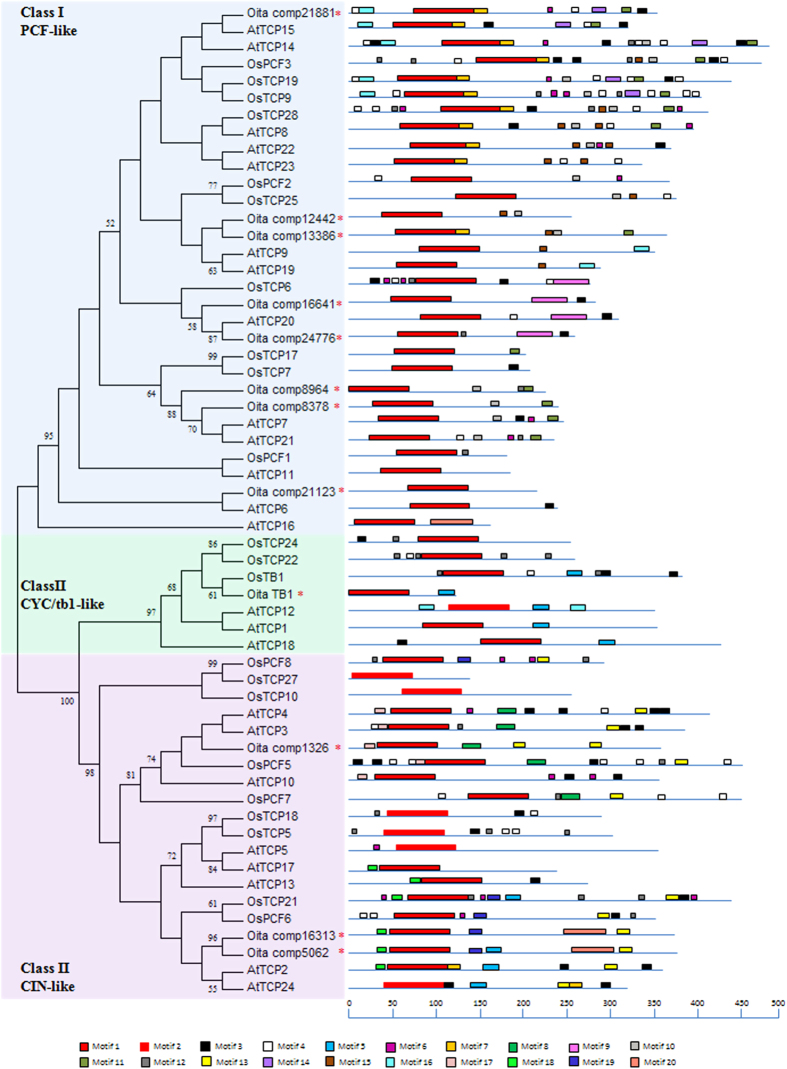
Figure 1
Figure 1. The NJ tree and graphical view of the conserved domains of the TCP proteins examined
. The NJ tree was obtained from the amino acid alignment of the TCP domain of Orchis italica, Arabidopsis thaliana and Oryza sativa (Supplementary Table S1). The bootstrap percentages >50% are shown next to the branches. The red asterisks indicate the sequences of O. italica. The graph of the conserved domains and the corresponding legend were obtained from the MEME search using the full length of the TCP proteins. The scale below the conserved domains indicates the amino acid position.
Figure 2
Figure 2
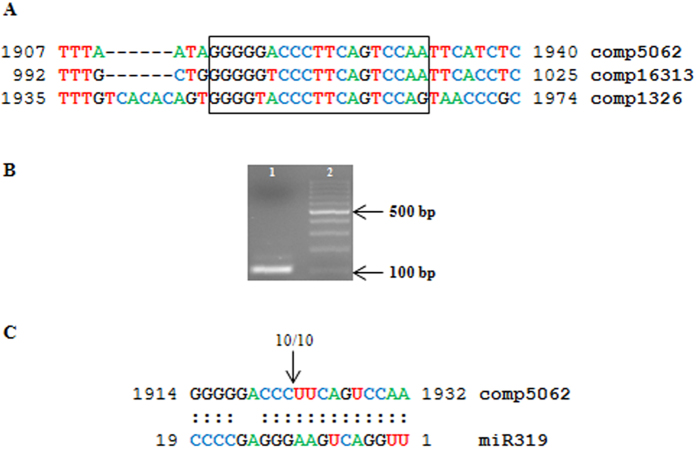
The cleavage site of miR319 on the TCP transcript of O. italica comp5062 . (A) The nucleotide alignment of the in silico predicted target site (highlighted in the box) of miR319 on three TCP transcripts of O. italica. Numbers refer to the nucleotide positions on the transcript. (B) Agarose gel electrophoresis of the modified 5′RACE experiment on the TCP transcript comp5062 (lane 1) and the 100 bp Ladder (Fermentas). (C) Alignment of the target site in the transcript comp5062 and the miR319. The arrow and the numbers above the sequences indicate the cleavage site and the number of sequenced clones that revealed the cleavage in that position, respectively.
Figure 3
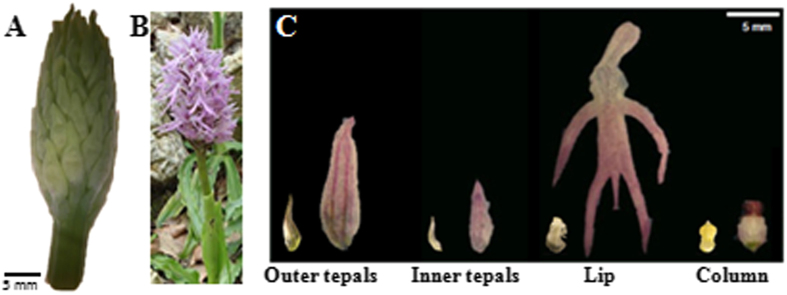
Figure 3. The Mediterranean orchid Orchis italica
. (A) An inflorescence at the early stage; (B) An inflorescence at the late stage, after anthesis. (C) Tepals (outer and inner), lip and column collected from a single floret of the early (left) and late (right) inflorescence of O. italica.
Figure 4
Figure 4
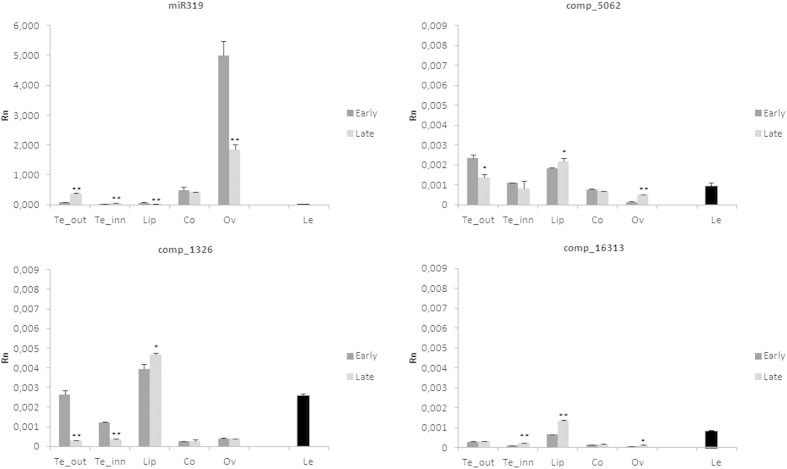
The relative expression of TCP transcripts comp5062, comp1326 and comp16313 and of miR319 in different floral tissues and in leaves of O. italica. The bars indicate standard deviation. The asterisks indicate statistically significant differences between the relative expression of the early and the late stages (*p < 0.05, **p < 0.01). Te_out, outer tepals; Te_inn, inner tepals; Lip, labellum; Co, column; Ov, ovary; Le, leaf. Rn, relative normalized expression.
Figure 5
Figure 5
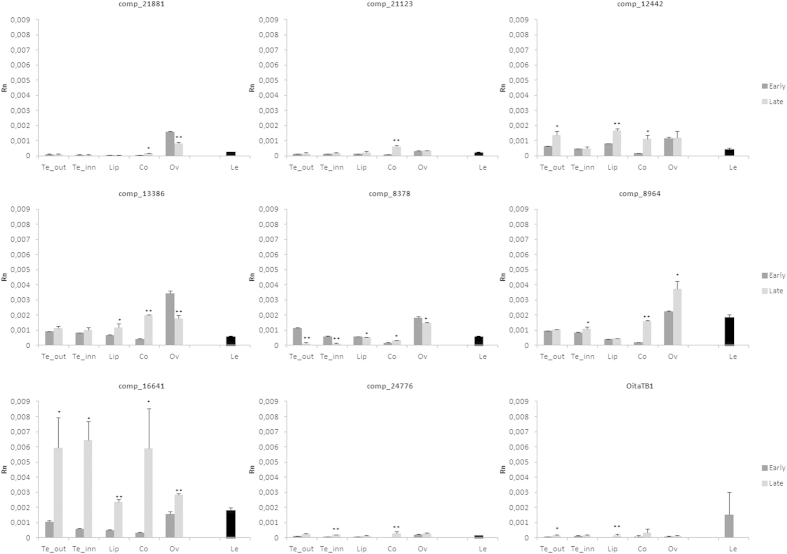
The relative expression of nine TCP transcripts in different floral tissues and in leaves of O. italica. The bars indicate standard deviation. The asterisks indicate statistically significant differences between the relative expression of the early and the late stages (*p < 0.05, **p < 0.01). Te_out, outer tepals; Te_inn, inner tepals; Lip, labellum; Co, column; Ov, ovary; Le, leaf. Rn, relative normalized expression.

References

    1. Navaud O., Dabos P., Carnus E., Tremousaygue D. & Herve C. TCP transcription factors predate the emergence of land plants. J Mol Evol 65, 23–33, doi: 10.1007/s00239-006-0174-z (2007). - DOI - PubMed
    1. Cubas P., Lauter N., Doebley J. & Coen E. The TCP domain: a motif found in proteins regulating plant growth and development. Plant J 18, 215–222 (1999). - PubMed
    1. Martin-Trillo M. & Cubas P. TCP genes: a family snapshot ten years later. Trends Plant Sci 15, 31–39, doi: 10.1016/j.tplants.2009.11.003 (2010). - DOI - PubMed
    1. Doebley J., Stec A. & Hubbard L. The evolution of apical dominance in maize. Nature 386, 485–488, doi: 10.1038/386485a0 (1997). - DOI - PubMed
    1. Luo D., Carpenter R., Vincent C., Copsey L. & Coen E. Origin of floral asymmetry in Antirrhinum. Nature 383, 794–799, doi: 10.1038/383794a0 (1996). - DOI - PubMed

Publication types

MeSH terms

LinkOut - more resources