. 2015 Nov 2:11:51.
doi: 10.1186/s13007-015-0093-3. eCollection 2015.

Digital imaging of root traits (DIRT): a high-throughput computing and collaboration platform for field-based root phenomics

Affiliations

Digital imaging of root traits (DIRT): a high-throughput computing and collaboration platform for field-based root phenomics

Abhiram Das et al. Plant Methods. .

Abstract

Background: Plant root systems are key drivers of plant function and yield. They are also under-explored targets to meet global food and energy demands. Many new technologies have been developed to characterize crop root system architecture (CRSA). These technologies have the potential to accelerate the progress in understanding the genetic control and environmental response of CRSA. Putting this potential into practice requires new methods and algorithms to analyze CRSA in digital images. Most prior approaches have solely focused on the estimation of root traits from images, yet no integrated platform exists that allows easy and intuitive access to trait extraction and analysis methods from images combined with storage solutions linked to metadata. Automated high-throughput phenotyping methods are increasingly used in laboratory-based efforts to link plant genotype with phenotype, whereas similar field-based studies remain predominantly manual low-throughput.

Description: Here, we present an open-source phenomics platform "DIRT", as a means to integrate scalable supercomputing architectures into field experiments and analysis pipelines. DIRT is an online platform that enables researchers to store images of plant roots, measure dicot and monocot root traits under field conditions, and share data and results within collaborative teams and the broader community. The DIRT platform seamlessly connects end-users with large-scale compute "commons" enabling the estimation and analysis of root phenotypes from field experiments of unprecedented size.

Conclusion: DIRT is an automated high-throughput computing and collaboration platform for field based crop root phenomics. The platform is accessible at http://www.dirt.iplantcollaborative.org/ and hosted on the iPlant cyber-infrastructure using high-throughput grid computing resources of the Texas Advanced Computing Center (TACC). DIRT is a high volume central depository and high-throughput RSA trait computation platform for plant scientists working on crop roots. It enables scientists to store, manage and share crop root images with metadata and compute RSA traits from thousands of images in parallel. It makes high-throughput RSA trait computation available to the community with just a few button clicks. As such it enables plant scientists to spend more time on science rather than on technology. All stored and computed data is easily accessible to the public and broader scientific community. We hope that easy data accessibility will attract new tool developers and spur creative data usage that may even be applied to other fields of science.


Figures
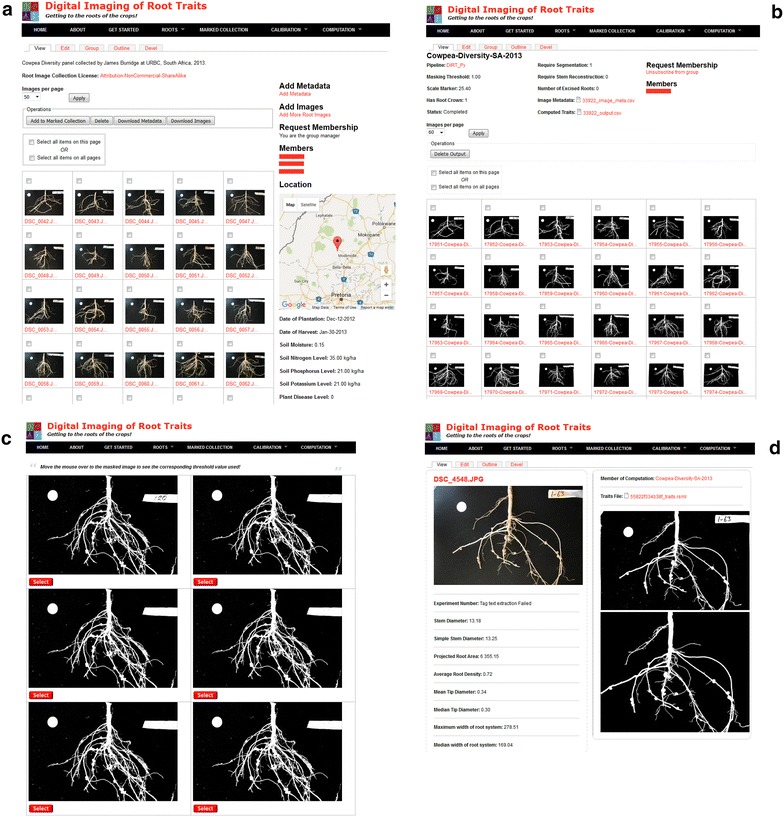
Fig. 1
Fig. 1
Major DIRT functionalities. a A cowpea root dataset annotated with experiment parameters and location and shared with three other members (names were replace with red bars). b The overview of the computed cowpea data set shown in (a). The computation parameters are shown along with icons of the image mask. Computed traits and entered image metadata can be downloaded as Excel compatible.csv files. c A user can visually choose the best threshold parameter to separate the root from the background. d Each of the images in the computation shown in (b) can be assessed in detail. Every image processing step can be followed visually per image and compared to the original image and the computed traits
Fig. 2
Fig. 2
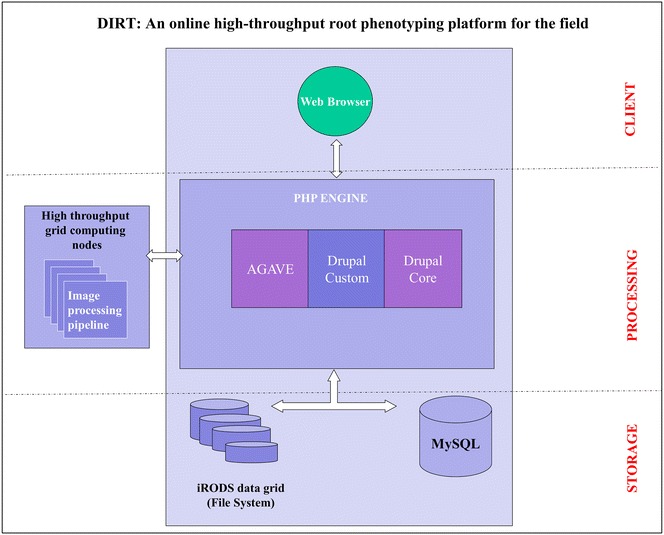
DIRT Architecture. DIRT is programed within the framework of the Drupal content management system and can be configured to interact with any high-throughput grid computing environment. The iPlant installation uses the Agave API to communicate with the high-throughput computing environment. The Agave API is utilized to transfer images from the iPlant data store to the computing platform and execute the computation. Metadata is organized in a MySQL database. All customized Drupal modules are open source and provide the functionality for configuration and communication with remote high-throughput grid computing platform
Fig. 3
Fig. 3
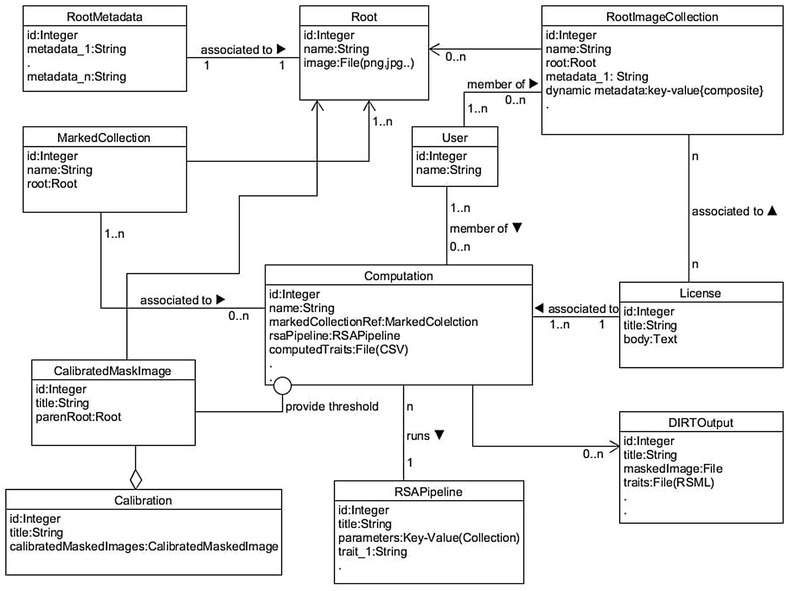
Content model or class association diagram of DIRT. A class association diagram in UML [50] is a static structure diagram to describe the relationship between the contents or classes of a software system including their class attributes. This figure shows the custom contents or classes, their attributes and relationship within DIRT. The rectangular boxes represent the content, the text on top portion of the box represents the name of the content and the text in lower portion of the box represents important content attributes. The line connecting the boxes denote the content association. The symbols at the end of these lines represent the association type and the text on these lines represents the attributes of the association
Fig. 4
Fig. 4
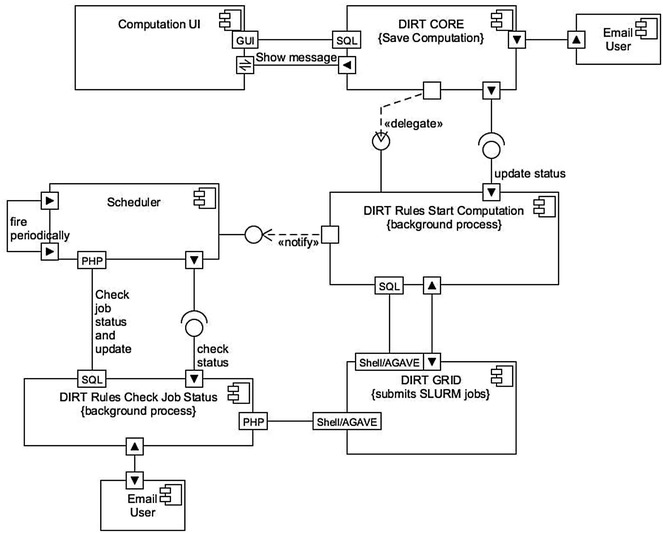
Component diagram showing the components involved in RSA trait computation process on the DIRT platform. In UML [50], a component diagram represents the structural relationships between the components that form larger subsystems. A component is considered as an autonomous, encapsulated unit within a software system that provides one or more interfaces
Fig. 5
Fig. 5
Screenshot from the DIRT web-application. The screenshot shows the root collection overview tab for a maize validation data set collected at the Ukulima Root Biology Center in South Africa. On the top the main menu is visible that contains all functionality to manage root images, create marked collections, run computations and perform the threshold calibration. Individual root images are shown below, along with an informal description of the dataset, an accompanied creative commons license and the location of the root excavation
Fig. 6
Fig. 6
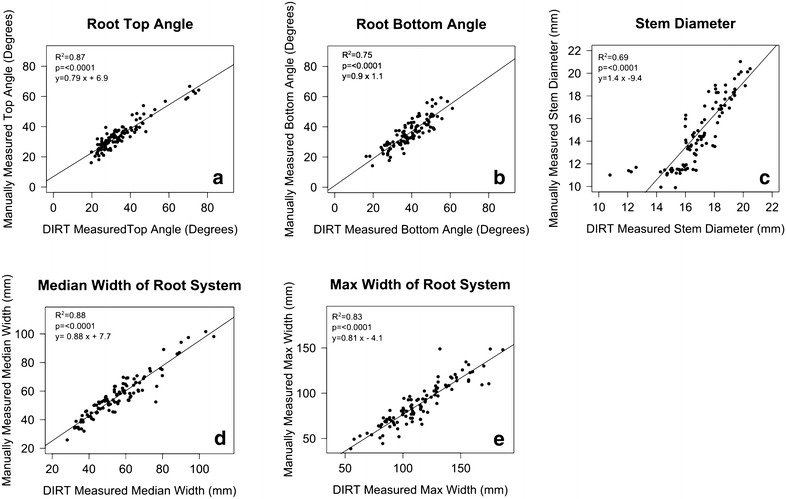
Validation of DIRT traits. a root top angle, b root bottom angle, c stem diameter, d median width of the root system and e maximum width of the root system for the public maize data set accessible at http://dirt.iplantcollaborative.org/content/maize-validation-set. The data set contains 99 maize roots

References

    1. Godfray HCJ, et al. Food security: the challenge of feeding 9 billion people. Science. 2010;327(5967):812–818. doi: 10.1126/science.1185383. - DOI - PubMed
    1. Tilman D, et al. Global food demand and the sustainable intensification of agriculture. Proc Natl Acad Sci. 2011;108(50):20260–20264. doi: 10.1073/pnas.1116437108. - DOI - PMC - PubMed
    1. OECD. OECD Environmental Outlook to 2030. OECD Publishing; 2008.
    1. Lynch JP. Roots of the second green revolution. Aust J Bot. 2007;55(5):493–512. doi: 10.1071/BT06118. - DOI
    1. López-Arredondo D, González-Morales SI, Bello-Bello E, et al. Engineering food crops to grow in harsh environments [version 1; referees: 2 approved]. F1000Research 2015, 4(F1000 Faculty Rev):651. doi:10.12688/f1000research.6538.1. - PMC - PubMed