


doi: 10.1002/psp4.12042.
Epub 2015 Oct 10.
Physiome-on-a-Chip: The Challenge of "Scaling" in Design, Operation, and Translation of Microphysiological Systems
Affiliations
- PMID: 26535154
- PMCID: PMC4625858
- DOI: 10.1002/psp4.12042
Item in Clipboard
Physiome-on-a-Chip: The Challenge of "Scaling" in Design, Operation, and Translation of Microphysiological Systems
CPT Pharmacometrics Syst Pharmacol.
2015 Oct.
Abstract
Scaling of a microphysiological system (MPS) or physiome-on-a-chip is arguably two interrelated, modeling-based activities: on-platform scaling and in vitro-in vivo translation. This dual approach reduces the need to perfectly rescale and mimic in vivo physiology, an aspiration that is both extremely challenging and not substantively meaningful because of uncertain relevance of any specific physiological condition. Accordingly, this perspective offers a tractable approach for designing interacting MPSs and relating in vitro results to analogous context in vivo.
Figures
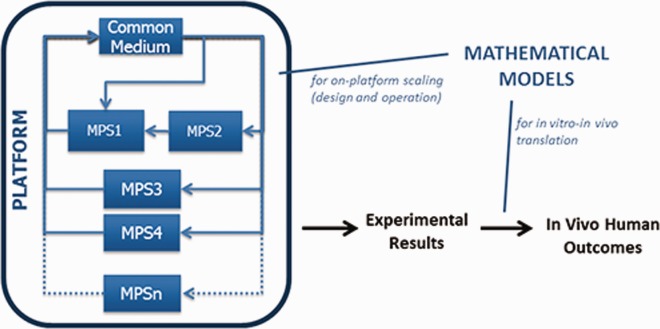
Multi-MPS platforms will require mechanistic mathematical models for both on-platform scaling and in vitro-in vivo translation. The models for each are likely to have common elements, while also being specialized for each intended use.
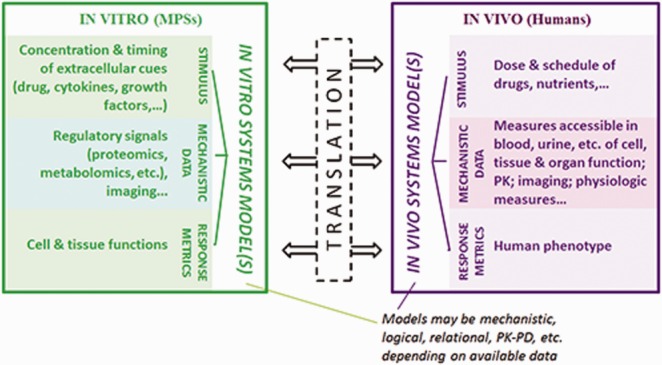
Translation from in vitro studies to in vivo studies will require computational systems models for each that relate stimuli, mechanism, and outcomes. Translation will then occur between the two respective models. These models are most likely to involve quantitative multivariate relational algorithms, relating molecular-/cellular-level measurements to tissue-level phenotypic measurements, although more mechanistic models or simpler PK-PD models may be appropriate at times. For in vitro studies, the molecular-/cellular-level measurements can frequently derive from highly invasive techniques, whereas minimally invasive measurements are generally required for in vivo studies. Hence, the types of mechanistic data used in the models will need to be accessible in both environments, most likely by providing surrogate information about more proximal regulatory molecular/cellular processes.
References
-
- Brown HS, Griffin M. Houston JB. Evaluation of cryopreserved human hepatocytes as an alternative in vitro system to microsomes for the prediction of metabolic clearance. Drug Metab. Dispos. 2007;35:293–301. & ) - PubMed
Grants and funding
LinkOut - more resources
Full Text Sources
Other Literature Sources
