


Performance and Return to Sport After Anterior Cruciate Ligament Reconstruction in Male Major League Soccer Players
- PMID: 26535238
- PMCID: PMC4555483
- DOI: 10.1177/2325967113497189
Performance and Return to Sport After Anterior Cruciate Ligament Reconstruction in Male Major League Soccer Players
Abstract
Background: Anterior cruciate ligament (ACL) rupture is a significant injury in male Major League Soccer (MLS) players in the United States.
Purpose: To determine (1) return-to-sport (RTS) rate in MLS following ACL reconstruction (ACLR), (2) timing of RTS, (3) performance upon RTS, and (4) the difference in RTS and performance between players who underwent ACL reconstruction (ACLR) and controls.
Study design: Case-control study; Level of evidence, 3.
Methods: MLS players undergoing ACLR between 1996 and 2012 were evaluated. Player data were extracted from publically available sources. All demographic data were analyzed. A control group of players matched by age, body mass index (BMI), sex, position, performance, and MLS experience (occurred at 2.6 years into career, designated "index year") was selected from the MLS during the same years as those undergoing ACLR. The RTS and performance in the MLS were analyzed and compared between cases and controls. Student ttests were performed for analysis of within- and between-group variables.
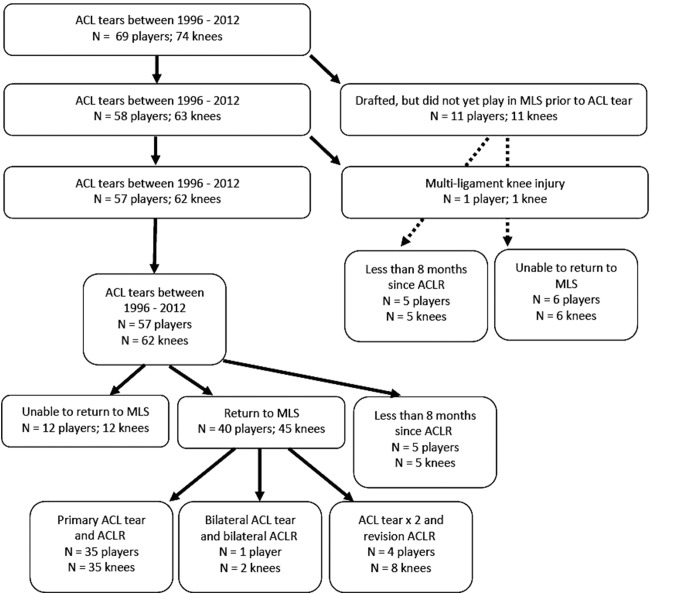
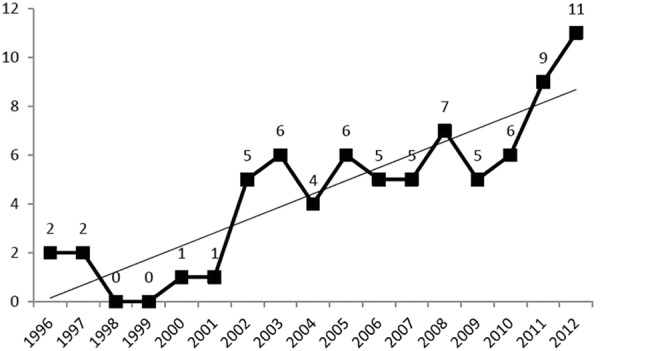
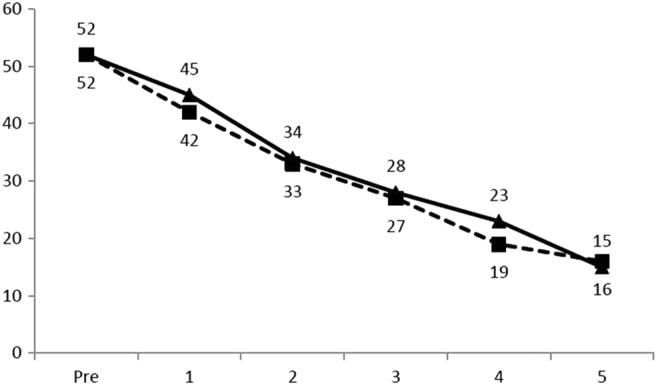
Results: A total of 52 players (57 knees) that met inclusion criteria underwent ACLR while in the MLS. Mean player age was 25.6 ± 3.98 years. Forty players were able to resume play (77%). Of the 40 players (45 knees), 38 (43 knees; 95%) resumed play the season following ACLR (mean, 10 ± 2.8 months after surgery). Mean career length in the MLS after ACLR was 4.0 ± 2.8 years. The revision rate was 10%. There was a significant increase in the incidence of ACL tears in the MLS by year (P < .001), and there was a significantly (P= .002) greater number of ACL tears on the left knee as opposed to the right. Performance in the MLS upon RTS after ACLR was not significantly different versus preinjury. There was no significant difference in survival in the MLS between cases and controls after ACLR or index year. The only significant performance differences between cases and controls were that cases had significantly greater shots taken per season (P= .005) and assists (P= .005) than did controls after the index year.
Conclusion: There is a high RTS rate in the MLS following ACLR. Nearly all players resumed play the season after surgery. Performance was not significantly different from preinjury. Only 2 performance measures (shots taken and assists) were significantly different between cases and controls. A significantly greater number of ACL tears occur in the left versus the right knee.
Keywords: Major League Soccer; anterior cruciate ligament; knee; return to sport.
Conflict of interest statement
One or more of the authors has declared the following potential conflict of interest of source of funding: Dr Cole receives royalties from Arhtrex, DJO, Elsevier, Lippincott, and WB Saunders; is a member of the Genzyme speakers bureau; is a paid consultant for Zimmer, Arthrex, Carticept, Biomimetic, Allosource, and Depuy; receives research support from Regentis, Arthrex, Smith & Nephew, Linvatec, Ossur, DJO, Zimmer, Depuy, and Johnson and Johnson; is on medical publishing boards for
Figures
References
-
- Arendt EA, American Orthopaedic Society for Sports Medicine, American Academy of Orthopaedic Surgeons OKU Orthopaedic Knowledge Update. Sports Medicine 3. 3rd ed Rosemont, IL: American Academy of Orthopaedic Surgeons; 2004.
-
- Brophy R, Silvers HJ, Gonzales T, Mandelbaum BR. Gender influences: the role of leg dominance in ACL injury among soccer players. Br J Sports Med. 2010;44:694–697. - PubMed
-
- Busfield BT, Kharrazi FD, Starkey C, Lombardo SJ, Seegmiller J. Performance outcomes of anterior cruciate ligament reconstruction in the National Basketball Association. Arthroscopy. 2009;25:825–830. - PubMed
-
- DeHaven KE, Lintner DM. Athletic injuries: comparison by age, sport, and gender. Am J Sports Med. 1986;14:218–224. - PubMed
LinkOut - more resources
Full Text Sources
Other Literature Sources
Miscellaneous
