


Trends in the Management of Achilles Tendon Ruptures in the United States Medicare Population, 2005-2011
- PMID: 26535361
- PMCID: PMC4555628
- DOI: 10.1177/2325967114549948
Trends in the Management of Achilles Tendon Ruptures in the United States Medicare Population, 2005-2011
Abstract
Background: Achilles tendon ruptures are one of the most commonly treated injuries by orthopaedic surgeons and general practitioners. Achilles tendon ruptures have classically been thought to affect the middle-aged "weekend warrior" participating in basketball, volleyball, soccer, or any other ground sport that requires speed and agility; however, with a more active elderly population, these tears are becoming more common in older patients.
Purpose: To report trends in nonoperative and operative treatment of Achilles tendon tears in the United States from 2005 to 2011 in patients registered with a large Medicare database.
Study design: Descriptive epidemiological study.
Methods: Patients who underwent nonoperative and operative treatment of Achilles tendon ruptures by either primary repair or primary repair with graft (International Classification of Diseases 9 [ICD-9] diagnosis code 727.67, Current Procedural Terminology [CPT] codes 27650 and 27652) for the years 2005 to 2011 were identified using the PearlDiver Medicare Database. Demographic and utilization data available within the database were extracted for patients who underwent nonoperative as well as operative treatment for Achilles tendon ruptures. Statistical analysis involved Student t tests, chi-square tests, and linear regression analyses, with statistical significance set at P < .05.
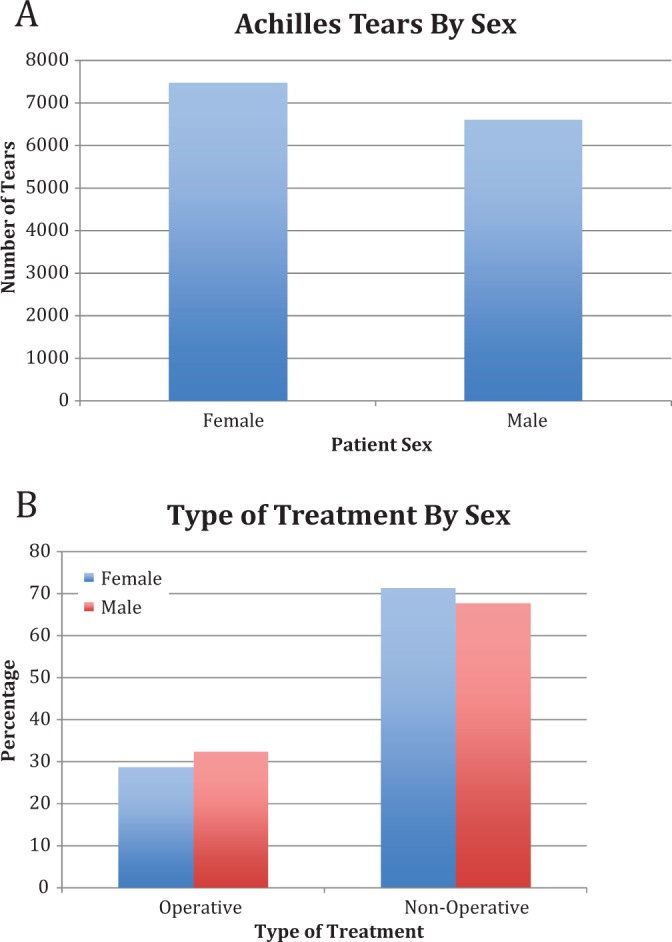
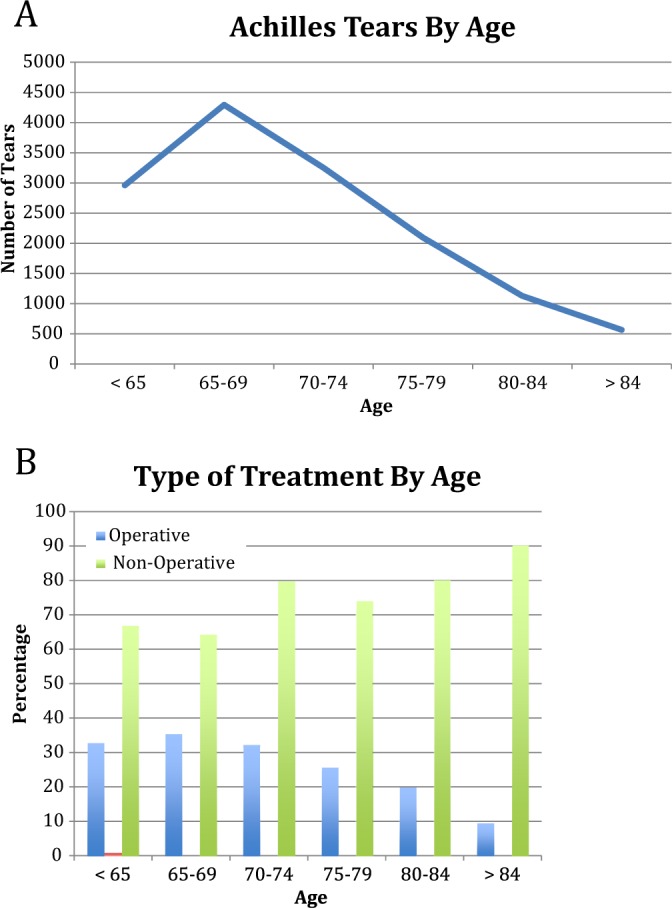
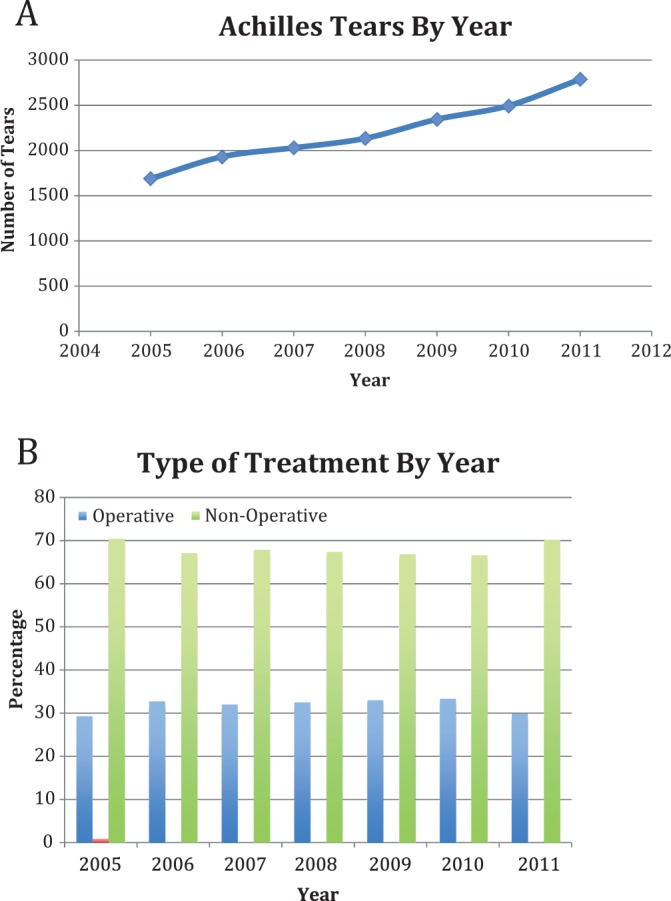
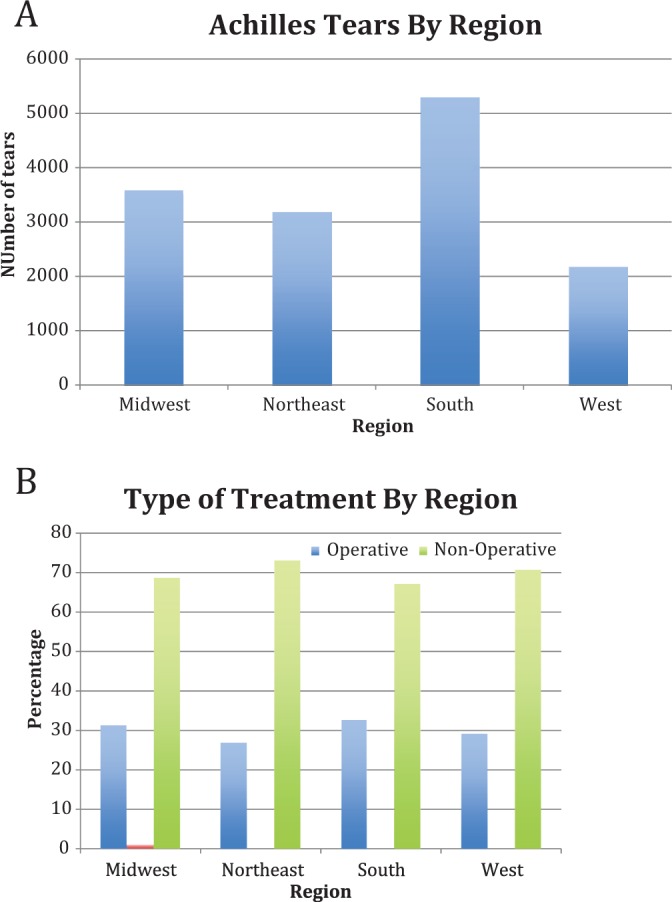
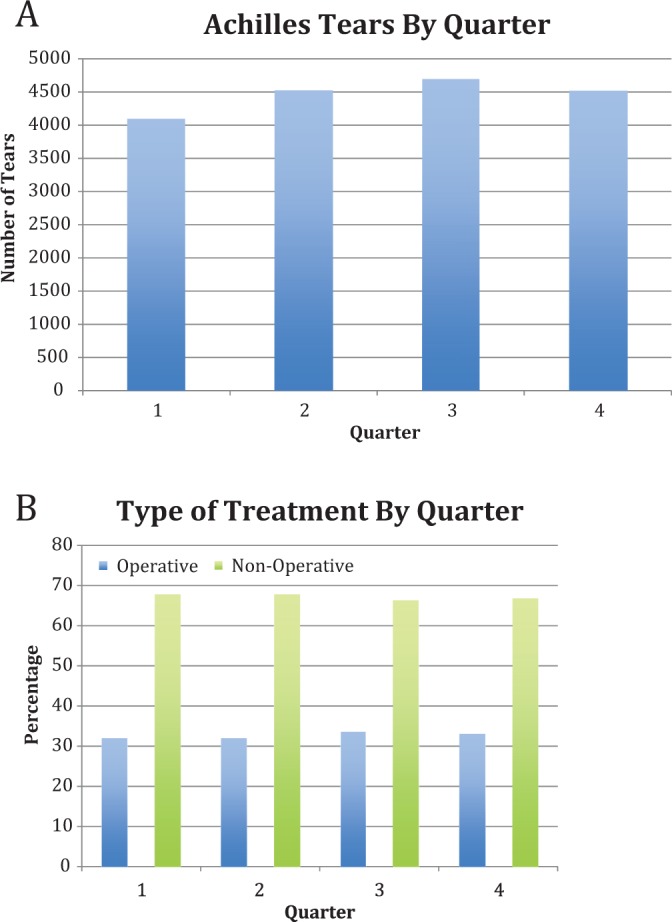
Results: From 2005 to 2011, there were a total of 14,127 Achilles tendon ruptures. Of these, 9814 were managed nonoperatively, 3531 were treated with primary repair, and 782 were treated with primary repair with graft. The incidence of Achilles tendon increased from 0.67 per 10,000 in 2005 to 1.08 per 10,000 in 2011 (P < .01). There was no significant difference in the number of Achilles ruptures between males (6636) and females (7582) (P > .05). There was an increase in the overall number of Achilles tendon ruptures over time (1689 in 2005 compared with 2788 in 2011; P < .001) but no difference in the percentage of Achilles ruptures treated operatively (P > .05). Older patients were more likely to be treated nonoperatively (P < .05). No differences in operative versus nonoperative treatment were seen between yearly quarter (P > .05), sex (P > .05), or region (P > .05).
Conclusion: The incidence of Achilles tendon ruptures is increasing with time, but the trend in operative and nonoperative treatment has not changed between 2005 and 2011. Older patients, especially those older than 85 years, are more likely to be treated nonoperatively. No differences in treatment patterns were seen based on sex, region, or yearly quarter.
Keywords: Achilles tendon; epidemiology; graft; incidence; nonoperative; operative treatment; reconstruction; repair.
Conflict of interest statement
One or more of the authors has declared the following potential conflict of interest or source of funding: B.R.B. receives royalties from SLACK Inc and institutional research support from Arthrex, Ossur, Linvatec, and Smith & Nephew.
Figures
References
-
- Amin NH, Old AB, Tabb LP, Garg R, Toossi N, Cerynik DL. Performance outcomes after repair of complete Achilles tendon ruptures in National Basketball Association players. Am J Sports Med. 2013;41:1864–1868. - PubMed
-
- Barfod KW. Achilles tendon rupture: assessment of nonoperative treatment. Dan Med J. 2014;61:B4837. - PubMed
-
- Deangelis JP, Wilson KM, Cox CL, Diamond AB, Thomson AB. Achilles tendon rupture in athletes. J Surg Orthop Adv. 2009;18:115–121. - PubMed
-
- Hess GW. Achilles tendon rupture: a review of etiology, population, anatomy, risk factors, and injury prevention. Foot Ankle Spec. 2010;3:29–32. - PubMed
-
- Holm C, Kjaer M, Eliasson P. Achilles tendon rupture—treatment and complications: a systematic review [published online March 20, 2014]. Scand J Med Sci Sports. doi:10.1111/sms.12209. - PubMed
LinkOut - more resources
Full Text Sources
Other Literature Sources
