. 2015 Nov 4;11(11):e1005247.
doi: 10.1371/journal.ppat.1005247. eCollection 2015.

Broadening of Virus-Specific CD8+ T-Cell Responses Is Indicative of Residual Viral Replication in Aviremic SIV Controllers

Affiliations

Broadening of Virus-Specific CD8+ T-Cell Responses Is Indicative of Residual Viral Replication in Aviremic SIV Controllers

Takushi Nomura et al. PLoS Pathog. .

Abstract

Control of HIV replication is a rare immunological event, providing clues to understand the viral control mechanism. CD8+ T-cell responses are crucial for virus control, but it is unclear whether lasting HIV containment can be achieved after establishment of infection. Here, we describe lasting SIV containment in a macaque AIDS model. Analysis of ten rhesus macaques that controlled viremia for 2 years post-infection found accumulation of proviral gag and nef CD8+ T-cell escape mutations in four of them. These four controllers mounted CD8+ T cells targeting Gag, Nef, and other viral proteins at 4 months, suggesting that broadening of CD8+ T-cell targets can be an indicator of the beginning of viral control failure. The remaining six aviremic SIV controllers, however, harbored proviruses without mutations and showed no or little broadening of their CD8+ T-cell responses in the chronic phase. Indeed, three of the latter six exhibiting no change in CD8+ T-cell targets showed gradual decreases in SIV-specific CD8+ T-cell frequencies, implying a concomitant reduction in viral replication. Thus, stability of the breadth of virus-specific CD8+ T-cell responses may represent a status of lasting HIV containment by CD8+ T cells.


Conflict of interest statement

The authors have declared that no competing interests exist.

Figures
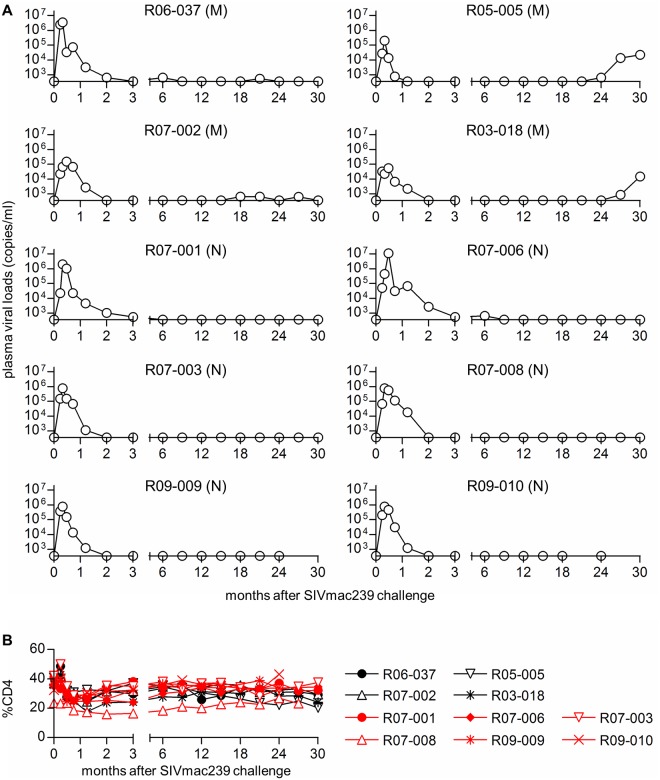
Fig 1
Fig 1. Plasma viral loads and peripheral %CD4 in SIV controllers.
(A) Plasma viral loads (SIV gag RNA copies/ml plasma) determined as described previously [26]. The lower limit of detection is approximately 4 x 10² copies/ml. On the basis of the data on proviral gag nucleotide sequences at 2 years post-infection, animals were divided into two groups, Group M (M) with multiple CD8+ T-cell escape mutations and Group N (N) with no mutation. (B) Percentage of CD4+ T cells in PBMCs.
Fig 2
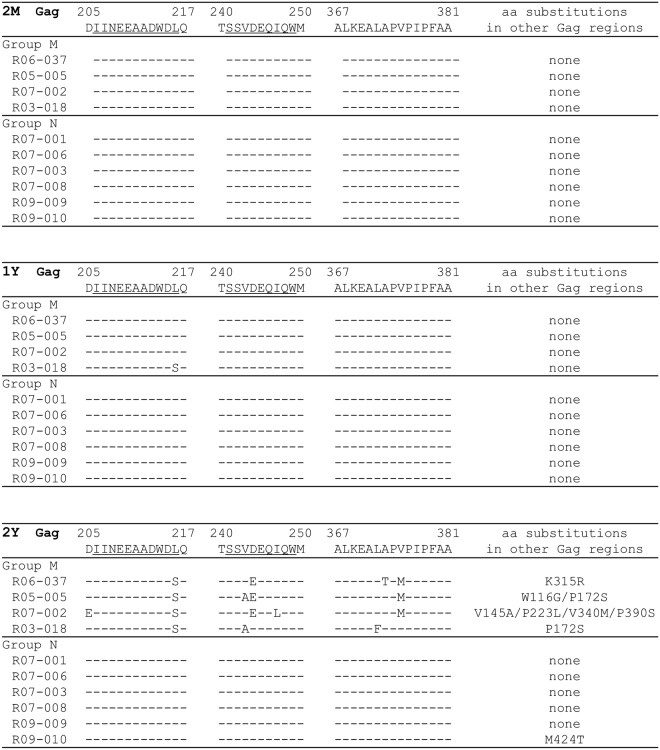
Fig 2. Dominant non-synonymous mutations in proviral gag in SIV controllers.
Amino acid substitutions around SIV Gag206–216, Gag241–249, and Gag367–381 epitopes and in other Gag regions approximately 2 months (2M, top), 1 year (1Y, middle), and 2 years (2Y, bottom) after SIVmac239 challenge are shown. Most of the proviral gag fragments were amplified from CD4+ T cells isolated from PBMCs, while those at 2 years in macaques R06-037, R05-005, R07-001, and R07-006 were from cultured CD4+ T cells due to limitation of available cell numbers. Mutant sequences shown were completely dominant (i.e., wild-type sequences were undetectable at the residues showing mutant sequences) except for the L216S mutation (the ratio of wild type/mutant: 2/5) in macaque R03-018 at 1 year post-infection. No subdominant mutation was detected.
Fig 3
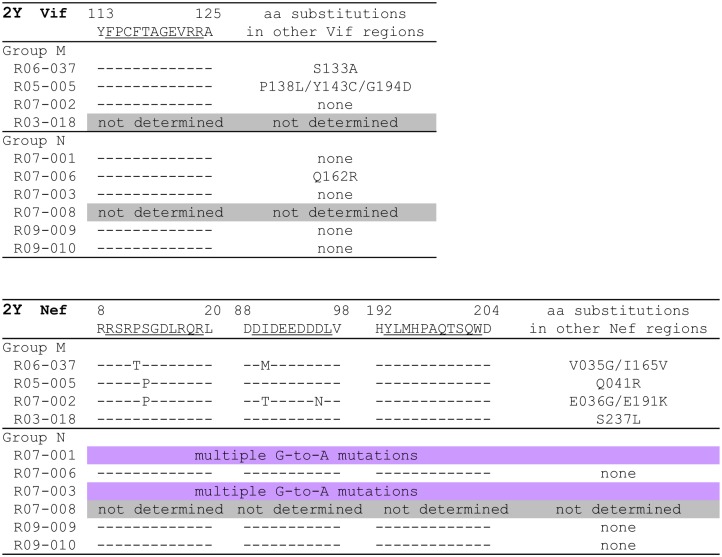
Fig 3. Dominant non-synonymous mutations in proviral vif and nef in SIV controllers.
In the upper panel, amino acid substitutions around SIV Vif114–124 epitope and in other Vif regions approximately 2 years after SIVmac239 challenge are shown. In the lower panel, amino acid substitutions around SIV Nef9–19, Nef89–97, and Nef193–203 epitopes and in other Nef regions approximately 2 years after SIVmac239 challenge are shown. Sequences of vif in macaques R03-018 and R07-008 and nef in macaques R07-008 were not determined because these cDNA fragments could not be amplified. Macaques R07-001 and R07-003 had multiple G-to-A mutations in nef (See S1 Fig). Mutant sequences shown were completely dominant except for vif P138L (the ratio of wild type/mutant: 1/2) in R05-005, vif Q162R (1/1) in R07-006, nef P012T (1/10) in R06-037, and nef S013P (3/10), I090T (1/5), D096N (1/5), and E191K (1/5) in R07-002. In addition, subdominant nef mutations resulting in P012S (5/2) and G044E (5/2) were detected in macaque R07-002, while the wild-type sequences were dominant at these positions.
Fig 4
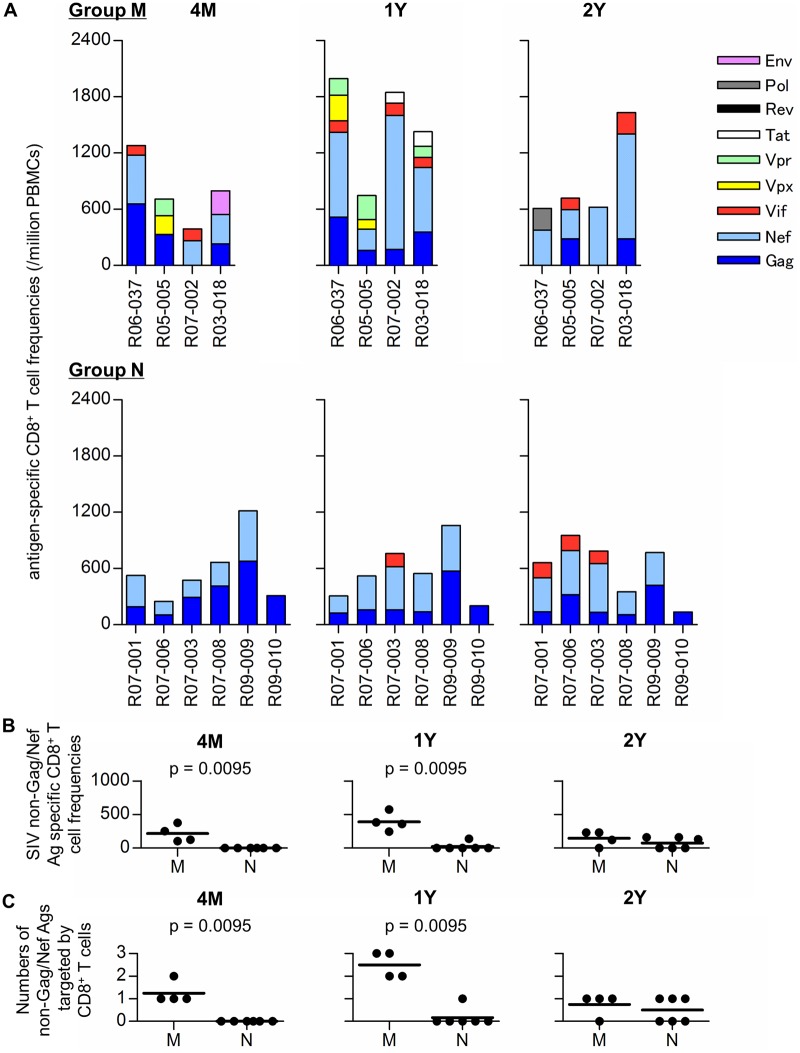
Fig 4. SIV antigen-specific CD8+ T-cell responses in SIV controllers.
(A) Frequencies of CD8+ T cells specific for Gag, Nef, Vif, Vpx, Vpr, Tat, Rev, Pol, and Env in Group M (upper panels) and Group N (lower) at 4 months (4M), 1 year (1Y), and 2 years (2Y) post-infection. Responses were measured by detection of antigen-specific IFN-γ induction using panels of overlapping peptides spanning the entire SIVmac239 Gag, Nef, Vif, Vpx, Vpr, Tat, Rev, Pol, and Env amino acid sequences, respectively. (B) Comparisons of CD8+ T-cell frequencies specific for SIV antigens other than Gag and Nef at 4M, 1Y, and 2Y between Groups M and N. Group M had significantly higher frequencies of SIV non-Gag/Nef antigen-specific CD8+ T cells at 4M (p = 0.0095 by Mann-Whitney U-test) and 1Y (p = 0.0095). (C) Comparisons of the numbers of CD8+ T cell-targeted SIV antigens other than Gag and Nef at 4M, 1Y, and 2Y between Groups M and N. The numbers were significantly higher in Group M at 4M (p = 0.0095 by Mann-Whitney U-test) and 1Y (p = 0.0095).
Fig 5
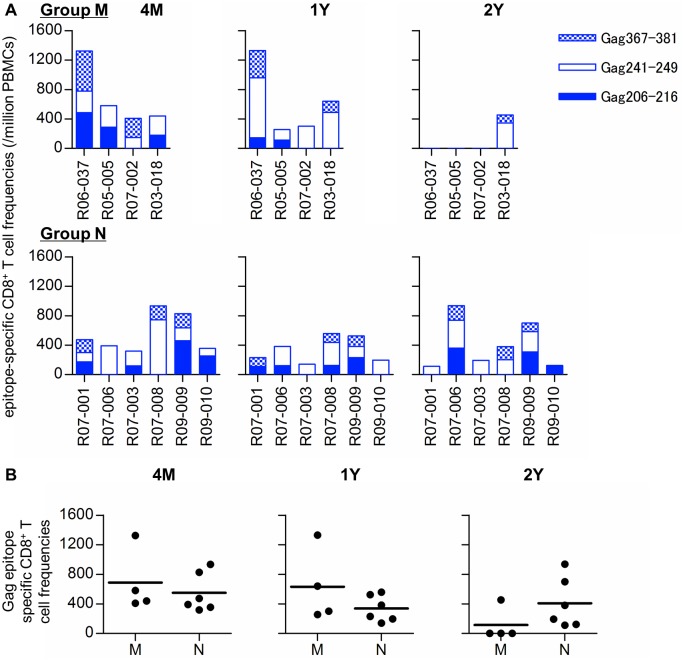
Fig 5. Gag206–216, Gag241–249, and Gag367–381 epitope-specific CD8+ T-cell responses in SIV controllers.
(A) Frequencies of CD8+ T cells specific for SIV Gag206–216, Gag241–249, and Gag367–381 epitopes in Group M (upper panels) and Group N (lower) at 4 months (4M), 1 year (1Y), and 2 years (2Y) post-infection. (B) Comparisons of the sum of Gag206–216-, Gag241–249-, and Gag367–381-specific CD8+ T-cell frequencies at 4M, 1Y, and 2Y between Groups M and N. No significant difference was observed between the groups.
Fig 6
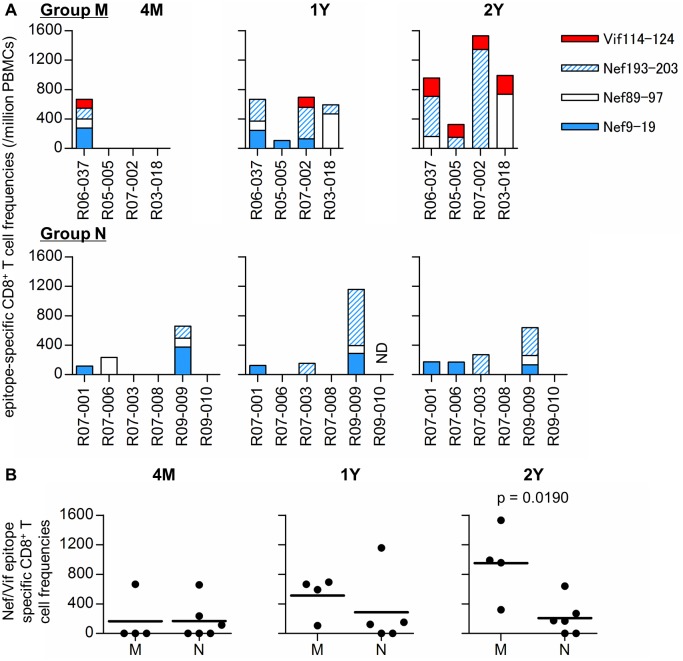
Fig 6. Nef9–19, Nef89–97, Nef193–203, and Vif114–124 epitope-specific CD8+ T-cell responses in SIV controllers.
(A) Frequencies of CD8+ T cells specific for SIV Nef9–19, Nef89–97, Nef193–203, and Vif114–124 epitopes in Group M (upper panels) and Group N (lower) at 4 months (4M), 1 year (1Y), and 2 years (2Y) post-infection. (B) Comparisons of the sum of Nef9–19-, Nef89–97-, Nef193–203-, and Vif114–124-specific CD8+ T-cell frequencies at 4M, 1Y, and 2Y between Groups M and N. The sum of CD8+ T-cell frequencies specific for these epitopes in Group M was significantly higher compared to Group N at 2Y post-infection (p = 0.0190 by Mann-Whitney U-test).
Fig 7
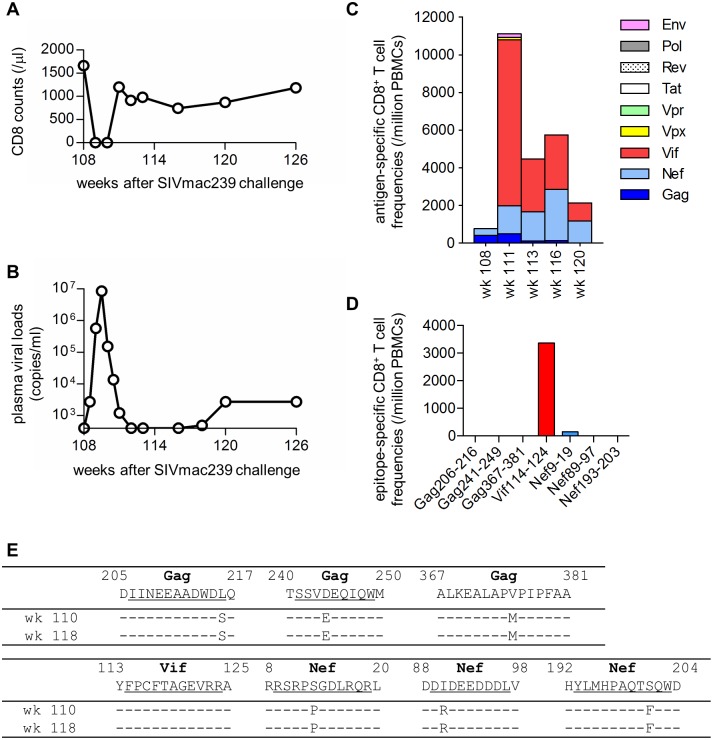
Fig 7. Virological and immunological analyses in macaque R09-009 following CD8+ cell depletion.
(A) Changes in peripheral CD8+ T-cell counts after the initial anti-CD8 antibody administration. Group N macaque, R09-009, was administered anti-CD8 antibody at week 108 post-infection and on days 3, 7, and 10 after the first administration. (B) Changes in plasma viral loads. (C) Changes in CD8+ T-cell responses specific for SIV Gag, Nef, Vif, Vpx, Vpr, Tat, Rev, Pol, and Env. (D) CD8+ T-cell responses specific for SIV Gag206–216, Gag241–249, Gag367–381, Vif114–124, Nef9–19, Nef89–97, and Nef193–203 epitopes at week 113 post-infection. (E) Dominant non-synonymous mutations in plasma viral cDNA regions encoding Gag, Vif, and Nef epitopes. Viral gag, vif, and nef cDNA fragments were amplified from plasma RNA obtained at weeks 110 and 118 post-infection. Amino acid substitutions around SIV Gag206–216, Gag241–249, Gag367–381, Vif114–124, Nef9–19, Nef89–97, and Nef193–203 epitopes are shown.

References

    1. Rosenberg E.S., Altfeld M., Poon S.H., Phillips M.N., Wilkes B.M., Eldridge R.L., Robbins G.K., D'Aquila R.T., Goulder P.J., and Walker B.D. (2000). Immune control of HIV-1 after early treatment of acute infection. Nature 407, 523–526. - PubMed
    1. Ortiz G.M., Wellons M., Brancato J., Vo H.T., Zinn R.L., Clarkson D.E., Van Loon K., Bonhoeffer S., Miralles G.D., Montefiori D., et al. (2001). Structured antiretroviral treatment interruptions in chronically HIV-1-infected subjects. Proc. Natl. Acad. Sci. U. S. A. 98, 13288–13293. - PMC - PubMed
    1. Hocqueloux L., Prazuck T., Avettand-Fenoel V., Lafeuillade A., Cardon B., Viard J.P., and Rouzioux C. (2010). Long-term immunovirologic control following antiretroviral therapy interruption in patients treated at the time of primary HIV-1 infection. AIDS 24, 1598–1601. - PubMed
    1. Saez-Cirion A., Bacchus C., Hocqueloux L., Avettand-Fenoel V., Girault I., Lecuroux C., Potard V., Versmisse P., Melard A., Prazuck T., et al. (2013). Post-treatment HIV-1 controllers with a long-term virological remission after the interruption of early initiated antiretroviral therapy ANRS VISCONTI Study. PLoS Pathog. 9, e1003211 10.1371/journal.ppat.1003211 - DOI - PMC - PubMed
    1. Roederer M., Keele B.F., Schmidt S.D., Mason R.D., Welles H.C., Fischer W., Labranche C., Foulds K.E., Louder M.K., Yang Z.Y., et al. (2014). Immunological and virological mechanisms of vaccine-mediated protection against SIV and HIV. Nature 505, 502–508. 10.1038/nature12893 - DOI - PMC - PubMed

Publication types

MeSH terms