


The prevalence of HLA DQ2 and DQ8 in patients with celiac disease, in family and in general population
- PMID: 26537142
- PMCID: PMC4737358
- DOI: 10.1590/S0102-67202015000300009
The prevalence of HLA DQ2 and DQ8 in patients with celiac disease, in family and in general population
Abstract
Background: Celiac disease is an enteropathy characterized by gluten sensitivity and broad clinical aspect. Has a multifactorial cause and depends on genetic, immunological and environmental factors for its development. The genetic influence is given mostly by the human leukocyte antigens HLA DQ2 and DQ8.
Aim: To evaluate the prevalence of human leukocyte antigens DQ2 and DQ8 in three different groups: patients with celiac disease, first-degree relatives and the general population.
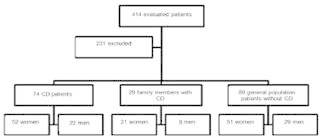
Method: Retrospective analysis that evaluated serologic and endoscopic data of 74 patients with celiac disease and 109 non-celiac, which were subdivided into two subgroups: non-celiac who had first-degree relatives with celiac and non-celiac who did not. All patients underwent laboratory examination for screening genetic sensitivity given by HLA DQ2 and HLA DQ8 by.
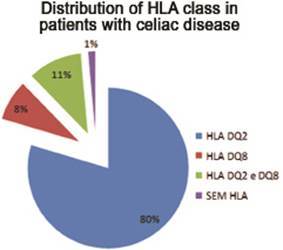
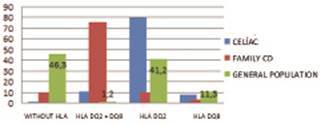
Results: The presence of HLA DQ2 and DQ8 was identified in 98,4% of 74 celiac patients, of which 79,7% had only HLA DQ2; 8,1% had only HLA DQ8 and 10,8% had both antigens histocompatibility. In the group of relatives of celiac patients, were included 29 patients; among them, 89,6% had HLA DQ2 and/or DQ8; 76% only the HLA DQ2, 10,3% only HLA DQ8 and 3,4% presented both human leukocyte antigens (HLA).
Conclusion: HLA DQ2/DQ8 was present in 98,4% of celiac patients; 89,6% relatives of celiac family and in 55,4% of people from the general population without family celiac.
Racional:: A doença celíaca é síndrome disabsortiva, autoimune, caracterizada pela sensibilidade ao glúten. Apresenta quadro clínico amplo e causa multifatorial, incluindo fatores genéticos, imunológicos e ambientais. O fator genético é dado, em sua maioria, pelo antígeno de histocompatibilidade HLA DQ2 e DQ8.
Objetivo:: Avaliar a prevalência do HLA DQ2 e DQ8 em três diferentes grupos: portadores de doença celíaca, em seus familiares de primeiro grau e na população geral.
Método:: Análise retrospectiva a partir de um banco de dados informatizado onde foram avaliados dados sorológicos de 74 pacientes portadores de doença celíaca e 109 não celíacos. Os não celíacos foram subdivididos em dois subgrupos: os que possuíam familiares de primeiro grau com doença celíaca e os que não. Todos foram submetidos à pesquisa de sensibilidade genética dada pelo HLA DQ2 e pelo HLA DQ8.
Resultados:: A presença do HLA DQ2 e DQ8 foi identificada em 98,4% dos 74 pacientes celíacos; destes, 79,7% apresentavam apenas HLA DQ2; 8,1% apenas HLA DQ8 e 10,8% os dois antígenos de histocompatibilidade. No grupo dos familiares de celíacos, foram avaliados 29 pacientes, dentre os quais 89,6% apresentavam o HLA DQ2 e/ou DQ8; destes, 76% apenas o HLA DQ2, 10,3% apenas o HLA DQ8 e 3,4% apresentou os dois antígenos de histocompatibilidade. Na população geral sem familiares celíacos, foram avaliados 80 pacientes; dentre eles, 53,7% apresentaram o antígeno, sendo 41,2% apenas o HLA DQ2, 11,3% apenas o HLA DQ8 e 1,2% tanto o HLA DQ2 quanto o HLA DQ8.
Conclusão:: O alelo HLA DQ2/DQ8 se fez presente em 98,4% dos pacientes celíacos; 89,6% dos familiares de celíacos; e em 55,4% das pessoas da população geral sem familiares celíacos.
Conflict of interest statement
Conflicts of interest: none
Figures
References
-
- Collin P, Reunala T. Recognition and management of the cutaneous manifestations of celiac disease a guide for dermatologists. Am J Clin Dermatol. 2003;4(1):13–20. - PubMed
-
- Fasano A, Berti I, Gerarduzzi T, Not T, Colletti RB, Drago S, Elitsur Y, Green PH, Guandalini S, Hill ID, Pietzak M, Ventura A, Thorpe M, Kryszak D, Fornaroli F, Wasserman SS, Murray JA, Horvath K. Prevalence of celiac disease in at-risk and not-at-risk groups in the United States. J Pediatr Gastroenterol Nutr. 2003;163:286–292. - PubMed
-
- Goldman A. Tratado de medicina interna. Rio de Janeiro: Medci; 2001.
-
- Green PH, Cellier C. Celiac Disease. N Engl J Med. 2007;357:1731–1743. - PubMed
-
- Instituto Brasileiro de Geografia e Estatística . Censo Demográfico 2010: Características da população- Amostra. 2013. [09 abr 2013]. Disponível em: <http://www.ibge.gov.br/estadosat/perfil.php?sigla=pr>.
MeSH terms
Substances
LinkOut - more resources
Full Text Sources
Medical
Research Materials
