. 2015 Nov 5:16:240.
doi: 10.1186/s13059-015-0792-0.

TLE6 mutation causes the earliest known human embryonic lethality

Affiliations

TLE6 mutation causes the earliest known human embryonic lethality

Anas M Alazami et al. Genome Biol. .

Abstract

Background: Embryonic lethality is a recognized phenotypic expression of individual gene mutations in model organisms. However, identifying embryonic lethal genes in humans is challenging, especially when the phenotype is manifested at the preimplantation stage.

Results: In an ongoing effort to exploit the highly consanguineous nature of the Saudi population to catalog recessively acting embryonic lethal genes in humans, we have identified two families with a female-limited infertility phenotype. Using autozygosity mapping and whole exome sequencing, we map this phenotype to a single mutation in TLE6, a maternal effect gene that encodes a member of the subcortical maternal complex in mammalian oocytes. Consistent with the published phenotype of mouse Tle6 mutants, embryos from female patients who are homozygous for the TLE6 mutation fail to undergo early cleavage, with resulting sterility. The human mutation abrogates TLE6 phosphorylation, a step that is reported to be critical for the PKA-mediated progression of oocyte meiosis II. Furthermore, the TLE6 mutation impairs its binding to components of the subcortical maternal complex.

Conclusion: In this first report of a human defect in a member of the subcortical maternal subcritical maternal complex, we show that the TLE6 mutation is gender-specific and leads to the earliest known human embryonic lethality phenotype.


Figures
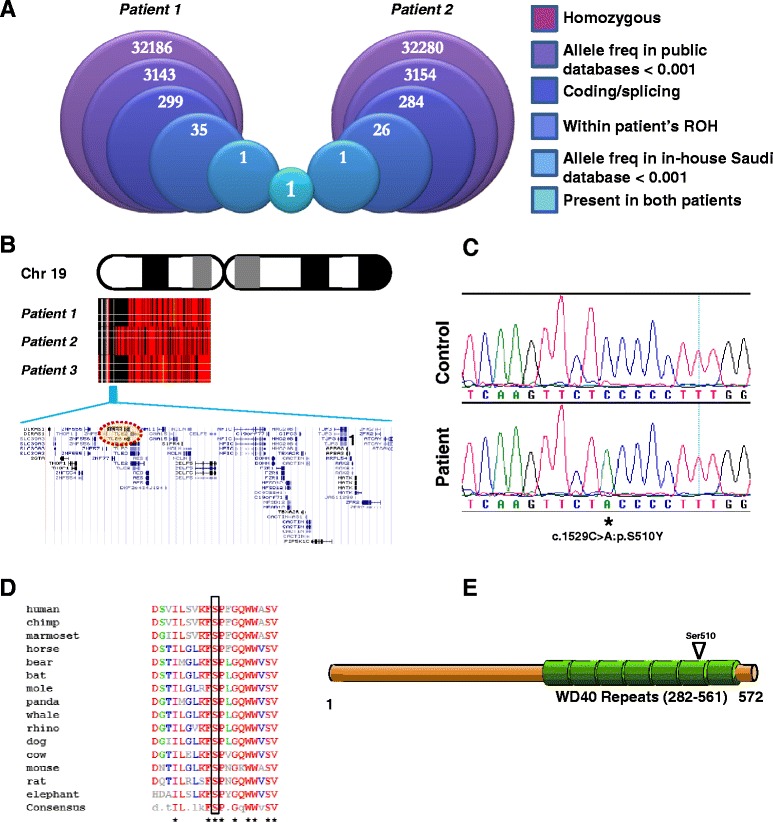
Fig. 1
Fig. 1
Two families with primary infertility link to a mutation in TLE6. a The two affected sisters from Family 1 were separately subjected to whole exome sequencing following the indicated pipeline. Each sister was examined based only on her own regions of homozygosity (ROH), and the only surviving variant was found common to both. b High density genotyping output for chromosome 19p (using AutoSNPa software [10]), with red indicating heterozygosity and black homozygosity. The three affected women share an identical haplotype which encompasses 42 genes, based on UCSC Human Genome Browser data. c DNA chromatogram of the TLE6 mutation, with a normal control sequence for comparison. d TLE6 orthologues appear to be present only in mammals, wherein there is universal conservation of the affected serine residue (boxed). Sequence data were acquired on NCBI-BLAST then collated using Multalin [28]. e Serine 510 is located within a cluster of WD40 domain repeats that make up most of the protein’s C-terminal half
Fig. 2
Fig. 2
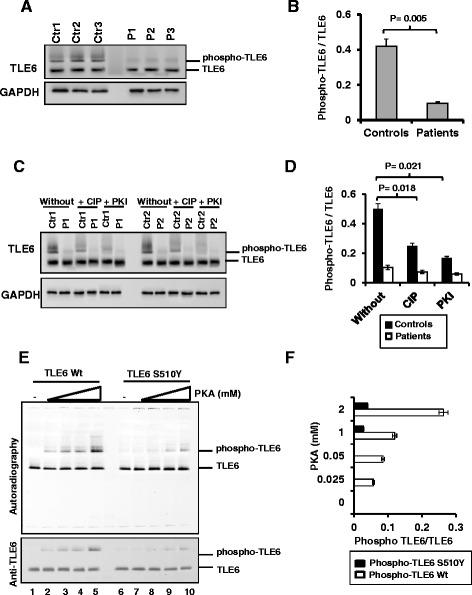
Abrogation of TLE6 protein phosphorylation due to TLE6 missense mutation. a Western blot using phospho-tag acrylamide gels showing a shift of phosphorylated TLE6 and significant reduction of phosphorylated TLE6 in patient lymphocytes compared to normal controls. GAPDH is shown as loading control. b Quantification of A. c Phosphorylation of TLE6 is reduced in control lymphocytes treated with 40 μM calf intestine phosphatase (CIP) and PKA inhibitor (PKI). d Quantification of C from two biological repeats and two technical repeats. e In vitro phosphorylation of wild-type and S510Y TLE6 by PKA in the presence of [γ32P] followed by autoradiography and immunoblotting using anti-TLE6. f Quantification of E from three independent repeats. Ctr: Control cells, P: Patient cells
Fig. 3
Fig. 3
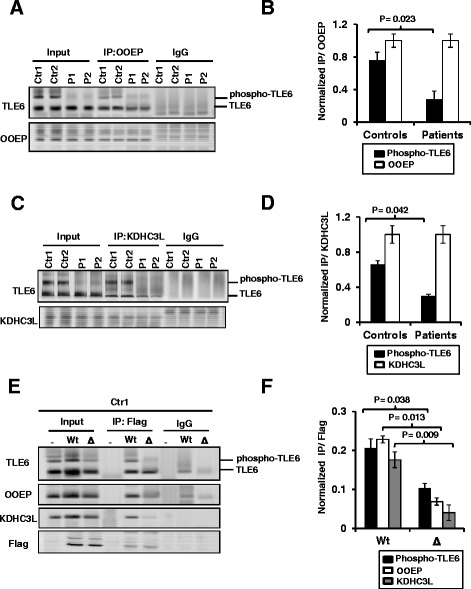
The TLE6 mutation diminishes SCMC protein binding and complex formation. a Interaction of endogenous OOEP protein with TLE6 from control and patients cells after immunoprecipitation with anti-OOEP and IgG antibody followed by immunoblotting. b Quantification of A from two biological repeats and two technical repeats. c Interaction of endogenous KDHC3L protein with TLE6 from control and patient cells after immunoprecipitation with anti-KDHC3L/Ecat1 and IgG antibody followed by immunoblotting. d Quantification of C from two independent experiments. e Immunoprecipitation performed from HEK293 cells expressing wild-type or mutant TLE6 S510Y with anti-Flag beads followed by immunoblotting, showing reduced binding of OOEP and KDHC3L to mutant TLE6. f Quantification of E from two independent repeats

References

    1. Alkuraya FS. Human knockout research: new horizons and opportunities. Trends Genet. 2015;31:108–15. doi: 10.1016/j.tig.2014.11.003. - DOI - PubMed
    1. Shaheen R, Faqeih E, Shamseldin HE, Noche RR, Sunker A, Alshammari MJ, et al. POC1A truncation mutation causes a ciliopathy in humans characterized by primordial dwarfism. Am J Hum Genet. 2012;91:330–6. doi: 10.1016/j.ajhg.2012.05.025. - DOI - PMC - PubMed
    1. Shamseldin HE, Tulbah M, Kurdi W, Nemer M, Alsahan N, Al Mardawi E, et al. Identification of embryonic lethal genes in humans by autozygosity mapping and exome sequencing in consanguineous families. Genome Biol. 2015;16:116. doi: 10.1186/s13059-015-0681-6. - DOI - PMC - PubMed
    1. Khalak HG, Wakil SM, Imtiaz F, Ramzan K, Baz B, Almostafa A, et al. Autozygome maps dispensable DNA and reveals potential selective bias against nullizygosity. Genet Med. 2012;14:515–9. doi: 10.1038/gim.2011.28. - DOI - PubMed
    1. Ayadi A, Birling M-C, Bottomley J, Bussell J, Fuchs H, Fray M, et al. Mouse large-scale phenotyping initiatives: Overview of the European mouse disease clinic (EUMODIC) and of the Wellcome Trust Sanger Institute Mouse Genetics Project. Mamm Genome. 2012;23:600–10. doi: 10.1007/s00335-012-9418-y. - DOI - PMC - PubMed

Publication types

MeSH terms