


Hemodynamic variability and cerebrovascular control after transient cerebral ischemia
- PMID: 26537345
- PMCID: PMC4673632
- DOI: 10.14814/phy2.12602
Hemodynamic variability and cerebrovascular control after transient cerebral ischemia
Abstract
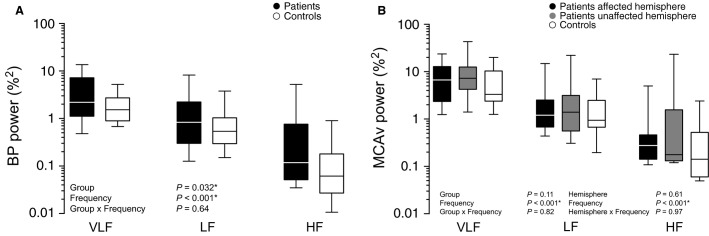
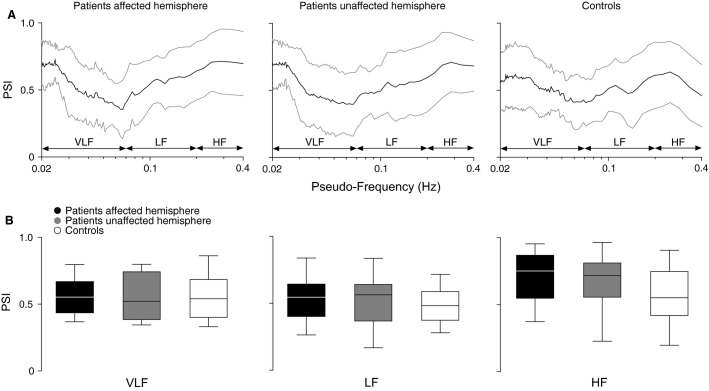
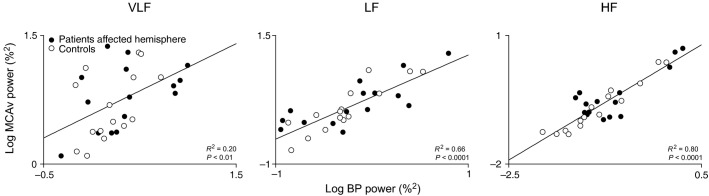
We investigated if hemodynamic variability, cerebral blood flow (CBF) regulation, and their interrelationships differ between patients with transient ischemic attack (TIA) and controls. We recorded blood pressure (BP) and bilateral middle cerebral artery flow velocity (MCAv) in a cohort of TIA patients (n = 17), and age-matched controls (n = 15). Spontaneous fluctuations in BP and MCAv were characterized by spectral power analysis, and CBF regulation was assessed by wavelet phase synchronization analysis in the very low- (0.02-0.07 Hz), low- (0.07-0.20 Hz), and high-frequency (0.20-0.40 Hz) ranges. Furthermore, cerebrovascular CO2 reactivity was assessed as a second metric of CBF regulation by inducing hypercapnia with 8% CO2 inhalation followed by hyperventilation driven hypocapnia. We found that TIA was associated with higher BP power (group effect, P < 0.05), but not MCAv power (P = 0.11). CBF regulation (assessed by wavelet phase synchronization and CO2 reactivity) was intact in patients (all P ≥ 0.075) across both hemispheres (all P ≥ 0.51). Pooled data (controls and affected hemisphere of patients) showed that BP and MCAv power were positively correlated at all frequency ranges (R(2) = 0.20-0.80, all P < 0.01). Furthermore, LF phase synchronization index was a significant determinant of MCAv power (P < 0.05), while VLF and HF phase synchronization index, and TIA were not (all P ≥ 0.50). These results indicate that CBF stability and control is maintained in TIA patients, but BPV is markedly elevated. BPV attenuation may be an important therapeutic strategy for enhancing secondary stroke prevention in patients who suffer a TIA.
Keywords: Blood pressure; cerebral blood flow; cerebral hemodynamics; transient ischemic attack.
© 2015 The Authors. Physiological Reports published by Wiley Periodicals, Inc. on behalf of the American Physiological Society and The Physiological Society.
Figures
References
-
- Ainslie PN. Duffin J. Integration of cerebrovascular CO2 reactivity and chemoreflex control of breathing: mechanisms of regulation, measurement, and interpretation. Am. J. Physiol. Regul. Integr. Comp. Physiol. 2009;296:R1473–R1495. - PubMed
-
- Atkins ER, Brodie FG, Rafelt SE, Panerai RB. Robinson TG. Dynamic cerebral autoregulation is compromised acutely following mild ischaemic stroke but not transient ischaemic attack. Cerebrovasc. Dis. 2010;29:228–235. - PubMed
-
- Budohoski KP, Czosnyka M, Kirkpatrick PJ, Reinhard M, Varsos GV, Kasprowicz M, et al. Bilateral failure of cerebral autoregulation is related to unfavorable outcome after subarachnoid hemorrhage. Neurocrit. Care. 2015;22:65–73. - PubMed
-
- Chappell DC, Varner SE, Nerem RM, Medford RM. Alexander RW. Oscillatory shear stress stimulates adhesion molecule expression in cultured human endothelium. Circ. Res. 1998;82:532–539. - PubMed
LinkOut - more resources
Full Text Sources
Other Literature Sources
Research Materials
Miscellaneous
