. 2015 Nov 5:6:8783.
doi: 10.1038/ncomms9783.

Recombinase-based conditional and reversible gene regulation via XTR alleles

Affiliations

Recombinase-based conditional and reversible gene regulation via XTR alleles

Camila Robles-Oteiza et al. Nat Commun. .

Abstract

Synthetic biological tools that enable precise regulation of gene function within in vivo systems have enormous potential to discern gene function in diverse physiological settings. Here we report the development and characterization of a synthetic gene switch that, when targeted in the mouse germline, enables conditional inactivation, reports gene expression and allows inducible restoration of the targeted gene. Gene inactivation and reporter expression is achieved through Cre-mediated stable inversion of an integrated gene-trap reporter, whereas inducible gene restoration is afforded by Flp-dependent deletion of the inverted gene trap. We validate our approach by targeting the p53 and Rb genes and establishing cell line and in vivo cancer model systems, to study the impact of p53 or Rb inactivation and restoration. We term this allele system XTR, to denote each of the allelic states and the associated expression patterns of the targeted gene: eXpressed (XTR), Trapped (TR) and Restored (R).


Figures
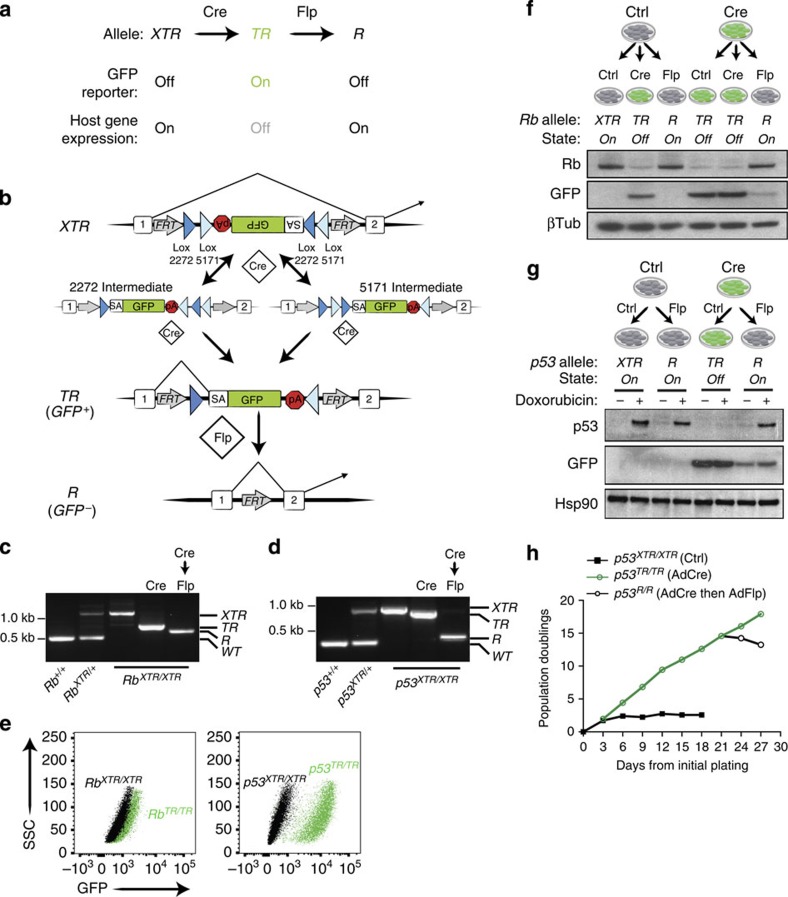
Figure 1
Figure 1. XTR alleles facilitate Cre-mediated inactivation and subsequent Flp-dependent restoration of endogenous genes.
(a) Cre converts XTR alleles to the TR allele, thereby inactivating gene function. Flp restores gene function by conversion to R. (b) Schematic of the XTR allele. Cre drives irreversible inversion of a double-floxed gene trap consisting of a splice acceptor (SA) enhanced GFP complementary DNA and the polyadenylation transcriptional terminator sequence (pA). Inversion can proceed either through sequential action of Cre on Lox2272 sites then Lox5171 sites (2272 intermediate) or Lox5171 then Lox2272 sites (5171 intermediate). Stable inversion accepts splicing from upstream exons in the host gene, reads out GFP expression and then terminates transcription, leading to functional inactivation of the host gene's expression. Flp drives deletion of the gene trap (SA-GFP-pA), thereby restoring normal splicing of the host gene. AdCre and AdCre followed by AdFlpO treatment is indicated (c,d). PCR-based detection of Rb (c) and p53 (d) XTR, TR, R and wild-type (+) alleles in MEFs of the indicated genotype. (e) Detection of GFP reporter expression from TR alleles in RbTR/TR and p53TR/TR MEFs by flow cytometry analysis. Representative of ⩾3 cell lines. (f) Immunoblot analysis of Rb and GFP expression in RbXTR/XTR MEFs treated sequentially with AdCre and/or AdFlpO as indicated. β-Tubulin is a loading control. (g) Immunoblot analysis of p53 and GFP expression in p53XTR/XTR MEFs treated sequentially with AdCre and/or AdFlpO as indicated. Hsp90 is a loading control. (h) 3T3 proliferation assay of p53XTR/XTR MEFs treated sequentially with AdCre (day 3) then AdFlpO (day 21) as indicated. Representative of two p53XTR/XTR cell lines.
Figure 2
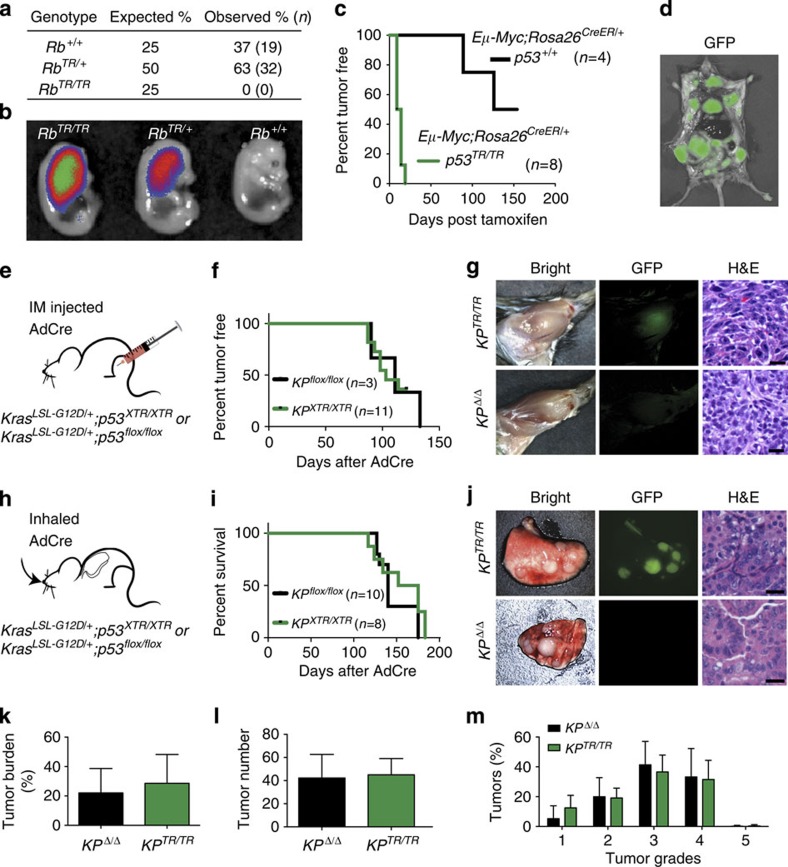
Figure 2. RbTR and p53TR alleles phenocopy conventional floxed and knockout alleles.
(a) Number of Rb+/+, RbTR/+ and RbTR/TR newborn pubs observed in RbTR/+X RbTR/+ crosses. Percentage and number indicated, χ2=12.4, df=2, P=10−4. (b) GFP detection in RbTR/TR, RbTR/+ and Rb+/+ embryonic day 13.5 embryos. (c) Kaplan–Meier analysis of lymphoma onset in tamoxifen-treated Eμ-Myc; p53XTR/XTR; Rosa26CreER/+ and Eμ-Myc; p53+/+; Rosa26CreER/+mice; P=0.0017, log-rank (Mantel–Cox) test. (d) GFP imaging of lymphoma cells in an Eμ-Myc; p53XTR/XTR; Rosa26CreER/+ mouse after lymphoma onset. (e) Initiation of sarcomas by intramuscular (IM) injection of AdCre into the hindlimb of KrasLSL-G12D/+; p53XTR/XTR(KPXTR/XTR) and KrasLSL-G12D/+; p53flox/flox(KPflox/flox) mice. (f) Kaplan–Meier analysis of sarcoma onset in KPXTR/XTR and KPflox/flox mice. (g) Representative sarcomas from KPXTR/XTR (n=11) and KPflox/flox (n=3) mice shown by whole-mount bright-field and fluorescent (GFP) microscopy and also (haematoxylin and eosin) staining of histological sections. (h) Initiation of lung adenocarcinoma by inhalation of AdCre in KPXTR/XTR (n=8) and KPflox/flox (n=10) mice. (i) Kaplan–Meier survival analysis in KPXTR/XTR and KPflox/flox mice after inhalation of AdCre. (j) Representative lungs from KPXTR/XTR and KPflox/flox mice shown by whole-mount bright-field and fluorescent (GFP) microscopy and H&E staining of histological sections. (k,l,m) Comparison of tumour burden (% of lung area), tumour number and tumour grade between KPXTR/XTR and KPflox/floxmice. Scale bars, 25 μm.
Figure 3
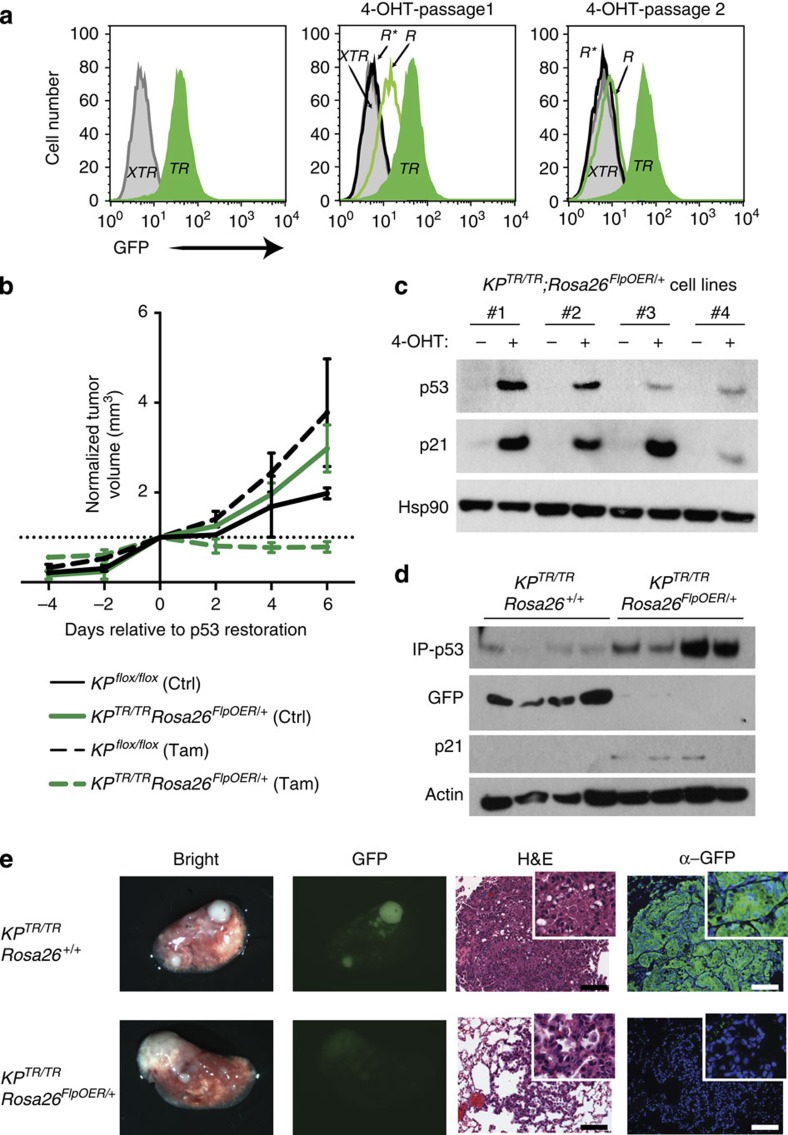
Figure 3. Tamoxifen-regulated FlpO-ER efficiently restores p53TR alleles to p53Rin vitro and in vivo.
(a) GFP detection by flow cytometry analysis of KPXTR/XTR; Rosa26FlpO-ER/+ MEFs. Untreated (p53XTR/XTR: solid grey), AdCre treated (p53TR/TR: solid green), tamoxifen-treated cells previously untreated (p53R*/R*: open black trace) or previously AdCre-treated (p53R/R: open green trace). R*, direct conversion of p53XTR to p53R. (b) Analysis of transformation potential of KPXTR/XTR; Rosa26FlpO-ER/+ MEFs after in vitro AdCre treatment followed by subcutaneous engraftment into nude mice. Tumour growth monitored by caliper measurements at the indicated times. Tamoxifen was administered on day 0, 1 and 2 to all mice. Representative of two cell lines (n=4). (c) Immunoblot analysis of lysates from KPTR/TR; Rosa26FlpO-ER/+ lung tumour-derived cell lines 24 h after addition of 4-hydroxytamoxifen (4-OHT) or vehicle control. (d) Immunoblot analysis of lysates from micro-dissected lung tumours 7 days after tamoxifen delivery. Immune precipitation of p53 was required before western blotting for detection. (e) Microscopic analysis of lung tumours derived from KPXTR/XTR; Rosa26FlpO-ER/+ and KPXTR/XTR; Rosa26+/+ mice 7 days post tamoxifen treatment. From left to right, bright-field and fluorescence stereo microscopy, haematoxylin and eosin staining and immunohistological staining for GFP in representative tumours. Scale bars, 100 μm.

References

    1. Ventura A. et al.. Restoration of p53 function leads to tumour regression in vivo. Nature 445, 661–665 (2007). - PubMed
    1. Feldser D. M. et al.. Stage-specific sensitivity to p53 restoration during lung cancer progression. Nature 468, 572–575 (2010). - PMC - PubMed
    1. Martins C. P., Brown-Swigart L. & Evan G. I. Modeling the therapeutic efficacy of p53 restoration in tumors. Cell 127, 1323–1334 (2006). - PubMed
    1. Junttila M. R. et al.. Selective activation of p53-mediated tumour suppression in high-grade tumours. Nature 468, 567–571 (2010). - PMC - PubMed
    1. Xue W. et al.. Senescence and tumour clearance is triggered by p53 restoration in murine liver carcinomas. Nature 445, 656–660 (2007). - PMC - PubMed

Publication types