. 2015 Nov 4:13:346.
doi: 10.1186/s12967-015-0701-z.

Application of Nanotrap technology for high sensitivity measurement of urinary outer surface protein A carboxyl-terminus domain in early stage Lyme borreliosis

Affiliations

Application of Nanotrap technology for high sensitivity measurement of urinary outer surface protein A carboxyl-terminus domain in early stage Lyme borreliosis

Ruben Magni et al. J Transl Med. .

Abstract

Objectives: Prompt antibiotic treatment of early stage Lyme borreliosis (LB) prevents progression to severe multisystem disease. There is a clinical need to improve the diagnostic specificity of early stage Lyme assays in the period prior to the mounting of a robust serology response. Using a novel analyte harvesting nanotechnology, Nanotrap particles, we evaluated urinary Borrelia Outer surface protein A (OspA) C-terminus peptide in early stage LB before and after treatment, and in patients suspected of late stage disseminated LB.

Method: We employed Nanotrap particles to concentrate urinary OspA and used a highly specific anti-OspA monoclonal antibody (mAb) as a detector of the C-terminus peptides. We mapped the mAb epitope to a narrow specific OspA C-terminal domain OspA236-239 conserved across infectious Borrelia species but with no homology to human proteins and no cross-reactivity with relevant viral and non-Borrelia bacterial proteins. 268 urine samples from patients being evaluated for all categories of LB were collected in a LB endemic area. The urinary OspA assay, blinded to outcome, utilized Nanotrap particle pre-processing, western blotting to evaluate the OspA molecular size, and OspA peptide competition for confirmation.

Results: OspA test characteristics: sensitivity 1.7 pg/mL (lowest limit of detection), % coefficient of variation (CV) = 8 %, dynamic range 1.7-30 pg/mL. Pre-treatment, 24/24 newly diagnosed patients with an erythema migrans (EM) rash were positive for urinary OspA while false positives for asymptomatic patients were 0/117 (Chi squared p < 10(-6)). For 10 patients who exhibited persistence of the EM rash during the course of antibiotic therapy, 10/10 were positive for urinary OspA. Urinary OspA of 8/8 patients switched from detectable to undetectable following symptom resolution post-treatment. Specificity of the urinary OspA test for the clinical symptoms was 40/40. Specificity of the urinary OspA antigen test for later serology outcome was 87.5 % (21 urinary OspA positive/24 serology positive, Chi squared p = 4.072e(-15)). 41 of 100 patients under surveillance for persistent LB in an endemic area were positive for urinary OspA protein.

Conclusions: OspA urinary shedding was strongly linked to concurrent active symptoms (e.g. EM rash and arthritis), while resolution of these symptoms after therapy correlated with urinary conversion to OspA negative.


Figures
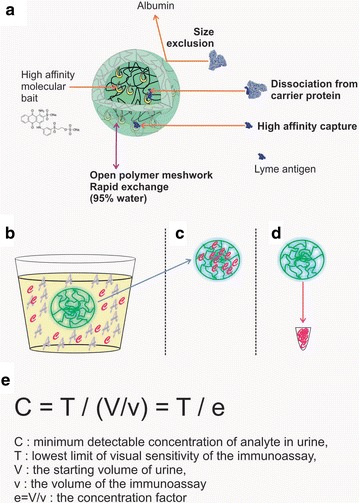
Fig. 1
Fig. 1
Nanotrap particles concentrate and preserve OspA and increase the effective sensitivity of the immunoassay. a Nanotrap particles are covalently functionalized with a high affinity bait that sequesters low abundance low molecular weight antigens. b Nanotrap particles are mixed with urine containing the Lyme antigen (yellowc”) and vast excess of resident proteins (e.g. albumin). Nanotrap particles capture all the solution phase Lyme antigen (redC”) and exclude high abundance resident proteins (grayA”); c Nanotrap particles are separated from the urine. d Lyme antigens captured by the Nanotrap particles are eluted in a small volume (e.g. 0.015 mL). e Nanotrap particle pre-processing step increases the effective sensitivity of any analytical technology by a concentration factor e. Assuming the initial volume of urine is V = 40 mL and the final elution volume is v = 0.015 mL, the concentration factor e = V/v = 40/0.015 = 2,667
Fig. 2
Fig. 2
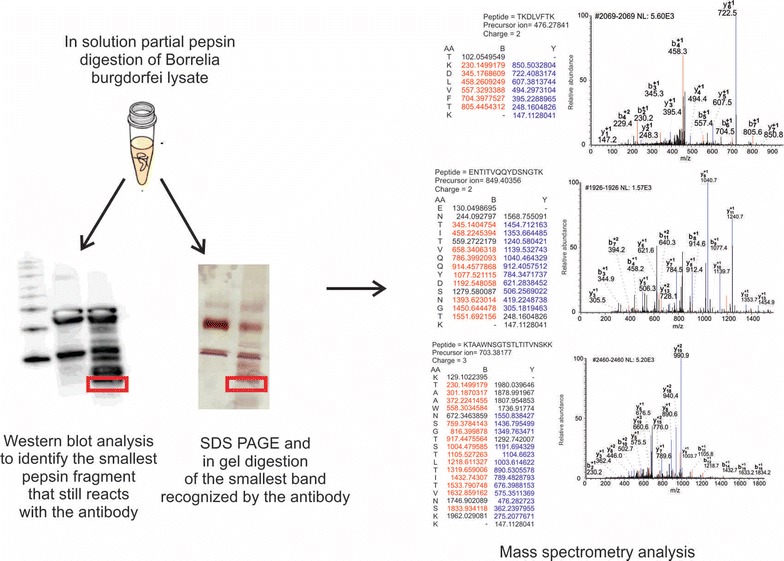
Mapping the OspA antigen epitope. Bb Lyme antigen was partially digested with pepsin and the protease derived fragments were split into two aliquots. One aliquot was analyzed by western blotting with the anti-OspA mAb clone 0551. In parallel, the second aliquot of pepsin fragments was analyzed by SDS PAGE and silver stained. The band in the SDS PAGE mirroring the smallest peptide fragment recognized by the mAb was cut out and processed for mass spectrometry analysis. MS/MS spectra of the smallest peptides that reacted with the mAb are shown
Fig. 3
Fig. 3
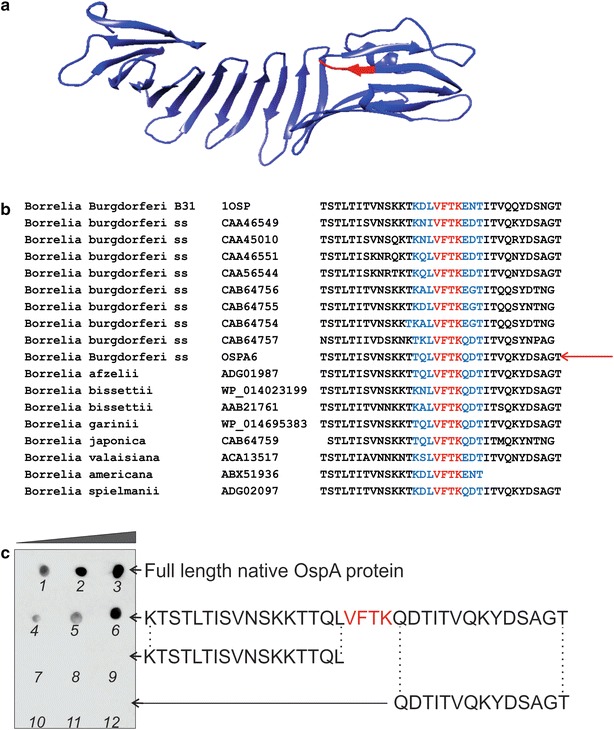
Narrow OspA236-239 region is conserved across different Borrelia species and binds to mAb clone 0551. a Crystallography structure of OspA (Protein Data Bank PDB ID# 1FJ1): the epitope of the mAb is highlighted in red. b BLAST search against different Borrelia strains and species shows that the mAb clone 0551 epitope is highly conserved whereas the flanking regions are variable. c Synthetic peptides mimicking the OspA236-239 region interact with the mAb in a dose dependent manner (dot blot analysis, 1, 2, 3 = Bb Lyme antigen 0.5, 5, and 10 ng, respectively; 4, 5, and 6 = OspA219-253 0.5, 1, and 2 μg, respectively; 7, 8, and 9 = OspA219-235 0.5, 1, and 2 μg, respectively; 10, 11, and 12 = OspA240-253 0.5, 1, and 2 μg, respectively). Negative control peptides (OspA219-235 and OspA240-253) containing flanking regions but lacking the OspA236-239 sequence were devoid of immunoreactivity with the mAb clone 0551
Fig. 4
Fig. 4
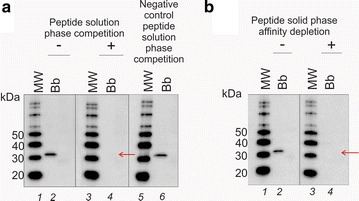
Peptides containing the narrow OspA236-239 region were successfully utilized for antibody competition and immunodepletion. a 600 pg of Bb Lyme antigen Grade 2 were spiked in human urine. Samples were processed through the Nanotrap particles and analyzed by western blot. Lane 2, 4 and 6 were obtained staining the western blot membranes with the mAb clone 0551 alone, the mAb neutralized with OspA219-253 peptide, and the mAb neutralized with a combination of OspA219-235 and OspA240-253, respectively. The peptide containing the OspA236-239 region successfully competed the mAb, whereas peptide missing the OspA236-239 region failed to compete the mAb clone ID 0551. b Peptide OspA219-235 was utilized for solid phase affinity depletion of the mAb clone 0551. The peptide (30 μg) was deposited on ELISA plate wells. The wells were washed and the excess peptide removed. The wells were blocked with PBS supplemented with 0.2 % I-Block, 0.1 % Tween 20. The mAb clone 0551 (3 μg) was incubated with the solid phase adsorbed peptides overnight. After incubation, the supernatant was recovered and brought to a volume of 3 mL in PBS supplemented with 0.2 % I-Block and 0.1 % Tween 20. In parallel, 600 pg of Bb Lyme antigen Grade 2 were spiked in urine and processed through the Nanotrap particles (lane 2 and 4). Lane 2 and 4 were obtained staining the western blot membranes with the mAb alone (3 μg) and the mAb after immunodepletion, respectively. There is no immunoreactivity in the mAb preparation after immunodepletion (lane 4). This is a further confirmation of the absence of non-specific signal in the mAb clone 0551 preparation
Fig. 5
Fig. 5
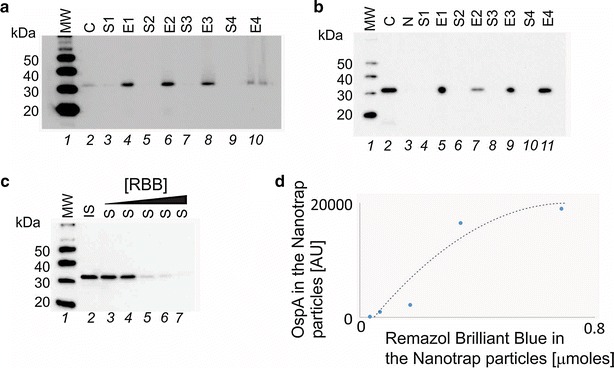
Remazol Brilliant Blue Nanotrap particles show the highest affinity for OspA among the tested dyes. a Nanotrap particles Lyme antigen (1 ng) was spiked in 500 µL of human urine from healthy volunteers and incubated with Nanotrap particles functionalized with different dyes. After Nanotrap particles processing, Lyme antigen is successfully depleted from supernatants (S) and easily detectable in the eluate (E). Lanes 1 ladder; 2 Lyme antigen 0.1 ng; 3 Supernatant Remazol Brilliant Blue Nanotrap 1; 4 Eluate Remazol Brilliant Blue Nanotrap 1; 5 Supernatant Remazol Brilliant Blue Nanotrap 2; 6 Eluate Remazol Brilliant Blue Nanotrap 2; 7 Supernatant Reactive Blue 4 Nanotrap; 8 Eluate Reactive Blue 4 Nanotrap; 9 Supernatant Diamine Green Nanotrap; 10 Eluate Diamine Green Nanotrap. b Nanotrap particles without dye bait can volume sequester some antigen but not concentrate the analyte from the surrounding solvent volume, in absence of affinity capture. The amount of OspA in the dye free particles is approximately 10 % of the control solution reflecting the urine solution/Nanotrap particle volumetric ratio (10:1). Lanes 1 ladder; 2 Lyme antigen 1 ng; 3 Negative control = urine without Bb antigen, 4 Supernatant vinyl phenyl boronic acid Nanotrap 1; 5 Eluate vinyl phenyl boronic acid Nanotrap 2; 6 Supernatant acrylic acid Nanotrap; 7 Eluate acrylic acid Nanotrap; 8 Supernatant allylamine Nanotrap; 9 Eluate allylamine Nanotrap; 10 Supernatant Remazol Brilliant Blue Nanotrap; and 11 Eluate Remazol Brilliant Blue Nanotrap. c Relationship between the Remazol Brilliant Blue in the particles and depletion of the antigen in the supernatant: 100 % antigen depletion from the solution phase and saturation of binding. Lane 1 ladder, lane 2 initial solution, lanes 37 supernatants after incubation of a urine solution containing 0.6 ng of Bb antigen with Nanotrap particles functionalized with increasing concentration of Remazol Briliant blue: 34, 68, 171, 343, 686 n moles, respectively. d ImageJ quantification of the optical density in (c). Y axis: Antigen sequestered in the Nanotrap particles obtained as difference between the initial solution (lane 2) and the supernatants (lanes 3–7) in (c). X axis: μ moles of Remazol Brilliant blue in the Nanotrap particles
Fig. 6
Fig. 6
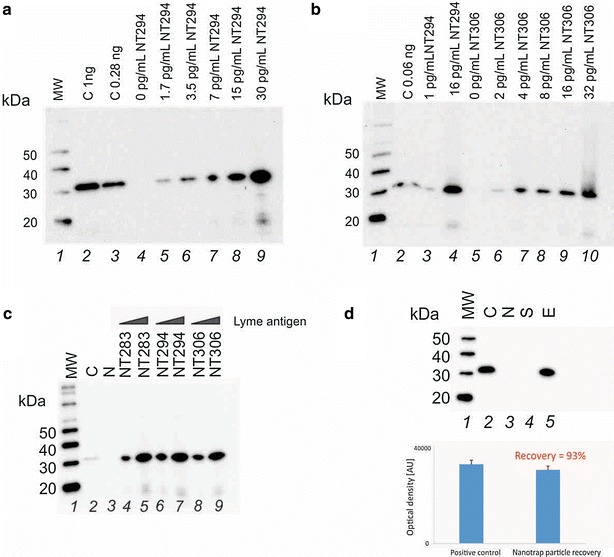
Nanotrap particle batch validation and batch to batch reproducibility. a Nanotrap particles are incubated with increasing amount of Bb Lysate spiked in 40 mL of urine; Lane 1: Ladder; Lane 2: Positive control Bb Lyme antigen Grade 2 1 ng; Lane 3: Positive control Bb Lyme antigen Grade 2 0.28 ng; Lanes 4–9: eluate of Nanotrap particles incubated with increasing concentrations of Bb antigen in 40 mL of urine: 0; 1.7; 3.5; 7; 15; 30 pg/mL, respectively b Performance comparison of two batches of Nanotrap particles, NT294 and NT306. Lane 1: Ladder; Lane 2: Positive control Bb Lyme antigen Grade 2 60 pg; Lane 3: eluate of Nanotrap particles batch NT296 incubated with 1 pg/mL Bb antigen urine solution (40 mL); Lane 4: eluate of Nanotrap particles batch NT296 incubated with 16 pg/mL Bb antigen urine solution (40 mL); Lane 510: eluate of Nanotrap particles batch NT306 incubated with increasing concentrations of Bb antigen urine solution (40 mL) 0; 2; 4; 8; 16; 32, respectively. c Performance comparison of multiple batches of Nanotrap particles (%CV = 9 % and 5 % at 2 pg/mL and 16 pg/mL Bb antigen in 40 mL of urine, respectively). Lane 1: ladder; lane 2: Positive control Bb Lyme antigen Grade 2 16 pg; lane 3: eluate of Nanotrap particles batch NT283 incubated with 40 mL of urine without Bb Lyme antigen Grade 2; lanes 4–5: eluates of Nanotrap particles batch NT283 incubated with 2 and 16 pg/mL Bb Lyme antigen Grade 2 urine solution (40 mL); lanes 6–7: eluates of Nanotrap particles batch NT294 incubated with 2 and 16 pg/mL Bb Lyme antigen Grade 2 urine solution (40 mL); lanes 8–9: eluates of Nanotrap particles batch NT306 incubated with 2 and 16 pg/mL Bb Lyme antigen Grade 2 urine solution (40 mL). d Yield of Nanotrap particle pre-processing is 93 %. Lane 1: ladder; lane 2: Bb antigen 320 pg, lane 3: eluate of Nanotrap particles batch NT283 incubated with 40 mL of urine without Bb Lyme antigen; lane 4: supernatant; lane 5: eluate of Nanotrap particles batch NT283 incubated with 8 pg/mL Bb Lyme antigen Grade 2 urine solution (40 mL)
Fig. 7
Fig. 7
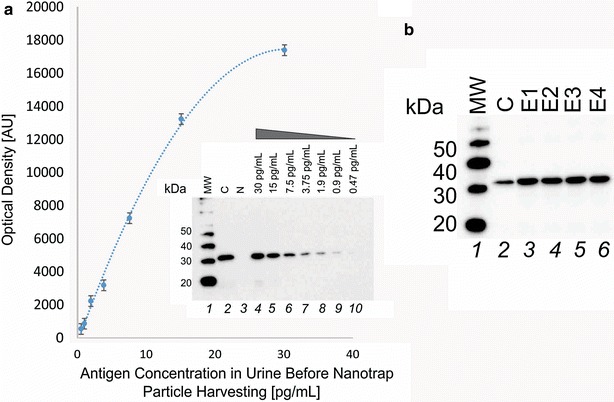
Lower limit of detection/quantitation and reproducibility (%CV = 7 %) of the urinary OspA Lyme test. a Sensitivity studies on three independent replicates: lower limit of detection (LLD) is 1.7 pg/mL. The lower limit of quantitation (LLQ) is 4.2 pg/mL for a 40 mL urine sample input volume. (Background estimate = 1071 AU, standard deviation (SD) = 323 AU. LLD = background + 2*SD, LLQ = background + 10× SD; polynomial equation y = −19.026x2 + 1160x − 248.76, R2 = 0.9971, was used to estimate the corresponding x value (1.7 pg/mL and 4.2 pg/mL, respectively)). Insert: 1 ladder; 2 Bb Lyme antigen control 1000 pg; 3 Eluate from Nanotrap particles incubated with 40 mL of volunteer urine containing no Bb Lyme antigen, negative control; 410 Eluate from Nanotrap particles incubated with 40 mL of volunteer urine containing decreasing concentrations of OspA, 30, 15, 7.5, 3.75, 1.9, 0.9, and 0.47 pg/mL, respectively. b Within run assay %CV is 7 %. Lyme antigen (1200 pg) was spiked in 4 urine aliquots (40 mL) and incubated with 4 mL of Nanotrap particles. Band intensity was measured with Image J. Within run %CV = 7 %. 1 Ladder; 2 OspA Lyme antigen control 200 pg, 36 Replicates of Nanotrap particle processed spike-in samples
Fig. 8
Fig. 8
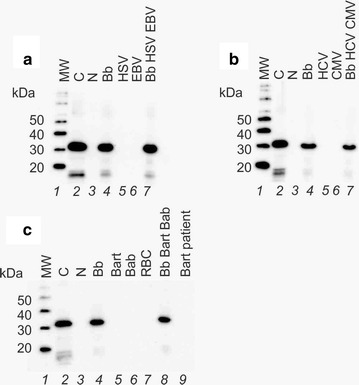
Viral and Lyme disease co-infection pathogens were devoid of immunoreactivity with the mAb clone 0551. Infection with these common non-Lyme pathogens do not generate a false positive for Borrelia in the present Nanotrap test. a Herpes simplex 1 and Epstein Barr viral lysates were mixed with urine in presence and absence of Bb antigen. Samples were processed with Nanotrap particles and analyzed with western blot. Lane 1 ladder, lane 2 Bb antigen 1 ng; lanes 3–7 eluates of Nanotrap particles incubated with urine without Bb antigens (lane 3), 25 pg/mL Bb antigen in urine 40 mL (lane 4), HSV-1 lysate (1 μg in 40 mL of urine) (lane 5), EBV lysate (1 μg in 40 mL of urine) (lane 6), HSV-1 lysate (1 μg in 40 mL of urine) plus EBV lysate (1 μg in 40 mL of urine) plus Bb antigen (1 ng in 40 mL of urine) (lane 7). (B) Hepatitis C and Cytomegalovirus viral lysates were mixed with human urine in presence and absence of Bb antigen. Lane 1: ladder, lane 2 Bb antigen 1 ng; lanes 37: eluates of Nanotrap particles incubated with urine without Bb antigen (lane 3), 25 pg/mL Bb antigen in urine 40 mL (lane 4), HCV lysate (1 μg in 40 mL of urine) (lane 5), CMV lysate (1 μg in 40 mL of urine) (lane 6), HCV lysate (1 μg in 40 mL of urine) plus CMV lysate (1 μg in 40 mL of urine) plus Bb antigen (1 ng in 40 mL of urine) (lane 7). c Bartonella henselae and Babesia microti lysates were spiked in human urine in presence and absence of Bb antigen. Lane 1: ladder, lane 2: Bb antigen 1 ng; lanes 3–9: eluates of Nanotrap particles incubated with urine without Bb antigen (lane 3), 25 pg/mL Bb antigen in urine 40 mL (lane 4), Bartonella lysate (1 ng in 40 mL of urine) (lane 5), Babesia lysate (10 ng in 40 mL of urine) (lane 6), red blood cells (10 ng in 40 mL of urine) (lane 7), Bartonella lysate (10 ng in 40 mL of urine) plus Babesia lysate (10 ng in 40 mL of urine) plus Bb antigen (1 ng in 40 mL of urine) (lane 8), 40 mL of urine of a patients with Bartonella positive and Borrelia negative serology at the time of urine collection (lane 9)
Fig. 9
Fig. 9
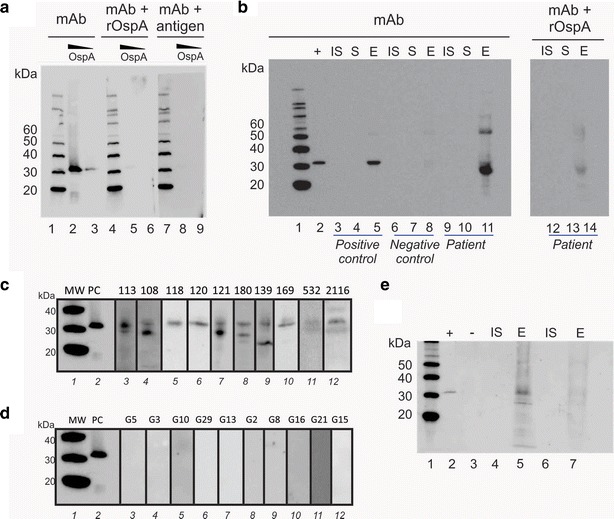
Nanotrap particles are necessary to detect urinary OspA in the urine of acute Lyme patients. Urinary OspA bands reverts to undetectable after successful treatment. Band specificity is assessed through competition assay. a Conditions for an optimal competition assay were established. 1 ng (lanes 2, 5, and 8) and 0.05 ng (lane 3, 6, and 9) of Bb Lyme antigen Grade 2 were spiked in urine. Lanes 2 and 3 were obtained with mAb clone 0551 alone. Lanes 5 and 6 were obtained with mAb neutralized with recombinant OspA. Reduced signal demonstrates high specificity. Lanes 8 and 9 were obtained with the mAb neutralized with Bb Lyme antigen Grade 2. Absence of signal with the neutralized antibody demonstrates specificity to OspA. b Competition assay was performed on all patient samples. Positive test outcomes show minimal or no binding of neutralized mAb to specific bands. Example competition assay for a Lyme disease patient is shown. 1 ladder; 2 Bb Lyme antigen Grade 2 OspA 1 ng; 3 initial Solution positive control (0.5 ng in 40 mL of urine processed through the Nanotrap particles); 4 supernatant positive control (0.5 ng in 40 mL of urine processed through the Nanotrap particles); 5 eluate positive control (0.5 ng in 40 mL of urine processed through the Nanotrap particles); 6 initial solution negative control (40 mL of urine processed through the Nanotrap particles); 7 supernatant negative control (40 mL of urine processed through the Nanotrap particles); 8 eluate negative control (40 mL of urine processed through the Nanotrap particles); 9 initial solution patient 180; 10 supernatant patient 180; 11 Eluate patient 180; 12 initial solution patient 180; 13 supernatant patient 180; 14 eluate patient 180. Membrane containing Lanes 1–11 was probed with the mAb alone, whereas membrane containing lanes 12–14 was probed with the mAb clone 0551 neutralized with recombinant OspA. c Lane 1 ladder, lane 2 Bb antigen 1 ng; Lanes 312: example of patient urine samples demonstrating presence of OspA. Positive OspA bands are normally visible in the 28–30 kDa range although lower molecular bands can be detected and successfully competed suggesting the presence of smaller-than-full-lenght OspA C-terminal domain containing protein fragments in urine. d Nanotrap antigen test results on a representative sub-group of the 117 healthy volunteers (Table 1). Lane 1 ladder, lane 2 Bb antigen 1 ng; Lanes 312 example of patient urine samples demonstrating absence of OspA. e The OspA band is not detectable in the urine of acute stage Lyme patients after successful treatment. Lane 1 ladder; lane 2 Bb Lyme antigen Grade 2 in urine 0.1 ng; lane 3 negative control urine with no OspA; lane 4 Initial solution (=urine without Nanotrap particle pre-processing) of patient 120 before treatment; lane 5 eluate of patient 120 before treatment; lane 6 Initial solution patient 120 after treatment; lane 7 Eluate patient 120 after treatment

References

    1. Murray TS, Shapiro ED. Lyme disease. Clin Lab Med. 2010;30:311–328. doi: 10.1016/j.cll.2010.01.003. - DOI - PMC - PubMed
    1. Bratton RL, Whiteside JW, Hovan MJ, Engle RL, Edwards FD. Diagnosis and treatment of Lyme disease. Mayo Clin Proc. 2008;83:566–571. doi: 10.1016/S0025-6196(11)60731-3. - DOI - PubMed
    1. Bacon R, Kugeler K, Mead P. Centers for Disease Control and Prevention (CDC). Surveillance for Lyme disease—United States, 1992–2006. Morb Mortal Wkly Rep (MMWR) 2008; 57:SS 1-10. - PubMed
    1. Nadelman RB, Nowakowski J, Forseter G, Goldberg NS, Bittker S, Cooper D, Aguero-Rosenfeld M, Wormser GP. The clinical spectrum of early Lyme borreliosis in patients with culture-confirmed erythema migrans. Am J Med. 1996;100:502–508. doi: 10.1016/S0002-9343(95)99915-9. - DOI - PubMed
    1. Reik L, Burgdorfer W, Donaldson JO. Neurologic abnormalities in Lyme disease without erythema chronicum migrans. Am J Med. 1986;81:73–78. doi: 10.1016/0002-9343(86)90185-3. - DOI - PubMed

Publication types

MeSH terms