


Alterations in Lipid Metabolism and Antioxidant Status in Lichen Planus
- PMID: 26538688
- PMCID: PMC4601408
- DOI: 10.4103/0019-5154.159624
Alterations in Lipid Metabolism and Antioxidant Status in Lichen Planus
Abstract
Background: Lichen planus (LP), a T-cell-mediated inflammatory disorder, wherein inflammation produces lipid metabolism disturbances, is linked to increase in cardiovascular (CV) risk with dyslipidemia. Increased reactive oxygen species and lipid peroxides have also been implicated in its pathogenesis.
Aim and objective: The aim of the study was to evaluate the status on lipid disturbances, oxidative stress, and inflammation in LP patients.
Materials and methods: The study was initiated after obtaining Institutional Ethics Committee permission and written informed consent from participants. The study included 125 patients (74 LP patients and 51 age and sex-matched controls) visiting the outpatient clinic in the dermatology department of our hospital. Variables analyzed included lipid profile, C-reactive protein (CRP), malondialdehyde (MDA), and catalase (CAT) activity.
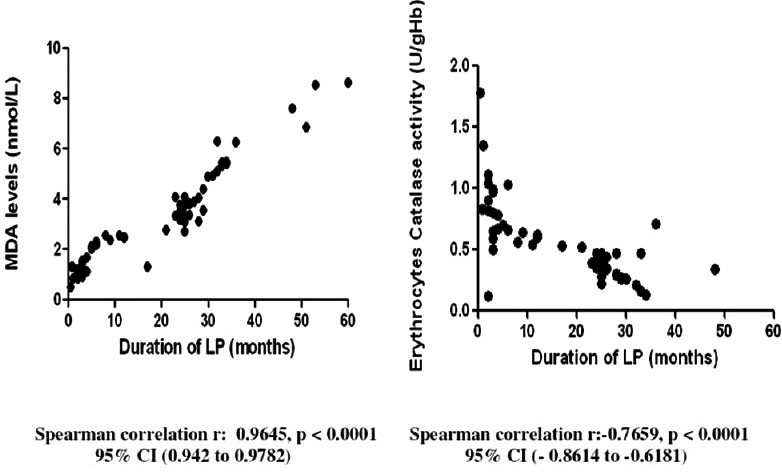
Results: Analysis of lipid parameters revealed significantly higher levels of total cholesterol (TC), triglycerides, and low-density lipoprotein cholesterol (LDL-C) along with decreased levels of high-density lipoprotein cholesterol (HDL-C) in LP patients as compared to their respective controls. LP patients also presented with a significantly higher atherogenic index that is, (TC/HDL-C) and LDL-C/HDL-C ratios than the controls. A significant increase in CRP levels was observed among the LP patients. There was a statistically significant increase in the serum levels of the lipid peroxidation product, MDA and a statistically significant decrease in CAT activity in LP patients as compared to their respective controls. A statistically significant positive correlation (r = 0.96) was observed between serum MDA levels and duration of LP whereas a significantly negative correlation (r = -0.76) was seen between CAT activity and LP duration.
Conclusion: Chronic inflammation in patients with LP may explain the association with dyslipidemia and CV risk. Our findings also suggest that an increase in oxidative stress and imbalance in the antioxidant defense mechanisms in LP may play a role in the pathogenesis of LP.
Keywords: Cardiovascular risk; dyslipidemia; inflammation; lichen planus; oxidative stress.
Conflict of interest statement
Figures
References
-
- Neville BW, Damm DD, Allen CM, Bouquot JE. Dermatological diseases. In: Neville BW, Damm DD, Allen CM, Bouquot JE, editors. Oral and Maxillofacial Pathology. 2nd ed. Philadelphia: Saunders; 2002. pp. 680–5.
-
- Jontell M, Holmstrup P. Red and white lesions of the oral mucosa. In: Green Berg MS, Glick M, Ship JA, editors. Burket's Oral Medicine. 11th ed. Hamilton: BC Decker Inc; 2008. pp. 90–1.
-
- Arias-Santiago S, Buendía-Eisman A, Aneiros-Fernández J, Girón-Prieto MS, Gutiérrez-Salmerón MT, Mellado VG, et al. Cardiovascular risk factors in patients with lichen planus. Am J Med. 2011;124:543–8. - PubMed
-
- Omata N, Tsukahara H, Ito S, Ohshima Y, Yasutomi M, Yamada A, et al. Increased oxidative stress in childhood atopic dermatitis. Life Sci. 2001;69:223–8. - PubMed
LinkOut - more resources
Full Text Sources
Other Literature Sources
Research Materials
Miscellaneous