Review
. 2015 Oct 21:9:381.
doi: 10.3389/fnins.2015.00381. eCollection 2015.

VPS54 and the wobbler mouse

Affiliations
Review

VPS54 and the wobbler mouse

Thomas Schmitt-John. Front Neurosci. .

Abstract

The wobbler mouse is an animal model for human motor neuron disease, such as amyotrophic lateral sclerosis (ALS). The spontaneous, recessive wobbler mutation causes degeneration of upper and lower motor neurons leading to progressive muscle weakness with striking similarities to the ALS pathology. The wobbler mutation is a point mutation affecting Vps54, a component of the Golgi-associated retrograde protein (GARP) complex. The GARP complex is a ubiquitously expressed Golgi-localized vesicle tethering complex, tethering endosome-derived vesicles to the trans Golgi network. The wobbler point mutation leads to a destabilization of the Vps54 protein and thereby the whole GARP complex. This effectuates impairments of the retrograde vesicle transport, mis-sorting of Golgi- and endosome localized proteins and on the long run defects in Golgi morphology and function. It is currently largely unknown how the destabilization of the GARP complex interferes with the pathological hallmarks, reported for the wobbler motor neuron degeneration, like neurofilament aggregation, axonal transport defects, hyperexcitability, mitochondrial dysfunction, and how these finally lead to motor neuron death. However, the impairments of the retrograde vesicle transport and the Golgi-function appear to be critical phenomena in the molecular pathology of the wobbler motor neuron disease.

Keywords: ALS; GARP; Golgi; Vps54; neurodegeneration; vesicle transport; wobbler.


Figures
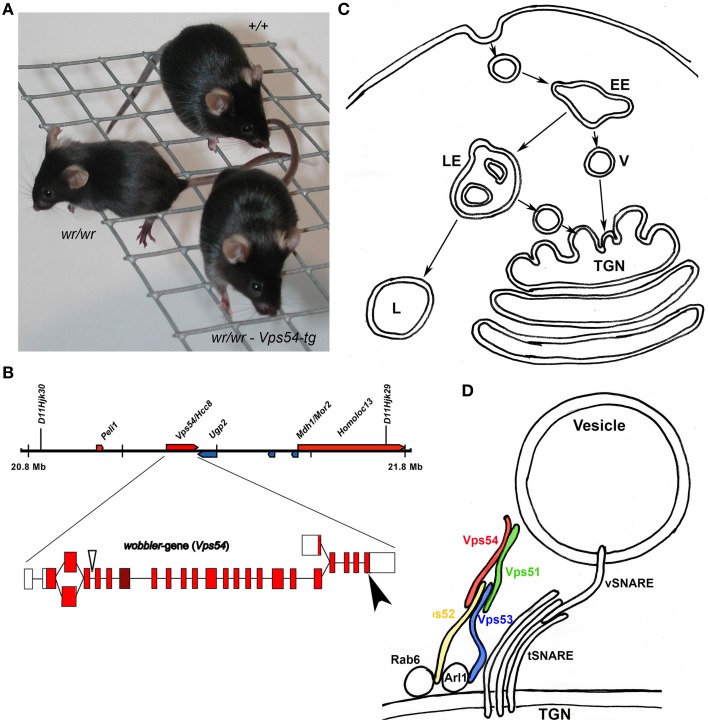
Figure 1
Figure 1
The wobbler loss-of-function mutation of Vps54. The figure summarizes the primary defects of the wobbler mutation. (A) A Wildtype mouse (+/+), a homozygous wobbler (wr/wr) mouse with defects in grid walking due to muscle weakness, predominantly affecting the fore limbs and a Vps54 transgenic wobbler mouse (wr/wr-Vps54-tg) with wild type appearance (Schmitt-John et al., 2005). (B) Vps54 genomic locus on mouse Chr 11, Exon intron structure, the arrow indicates the wobbler point mutation in exon 24. (C) The retrograde vesicle transport route from early (EE), and late endosomes (LE); transport vesicles (V) are tethered to the trans Golgi network (TGN); lysosomes (L). (D) The GARP complex consists of Vps51, −52, −53, and −54 and tethers endosome-derived vesicles (V) and mediates vSNARE–tSNARE dependent fusion of the vesicle- and target membrane. The GARP complex interferes thereby with GTP effector proteins Rab6 and Arl1. However, the exact docking site to the vesicle membrane is still unknown. The wobbler point mutation destabilizes the GARP complex and thus, the wobbler mutation causes impairments of the retrograde vesicle transport, but it is still unclear how these impairments induce motor neuron death.
Figure 2
Figure 2
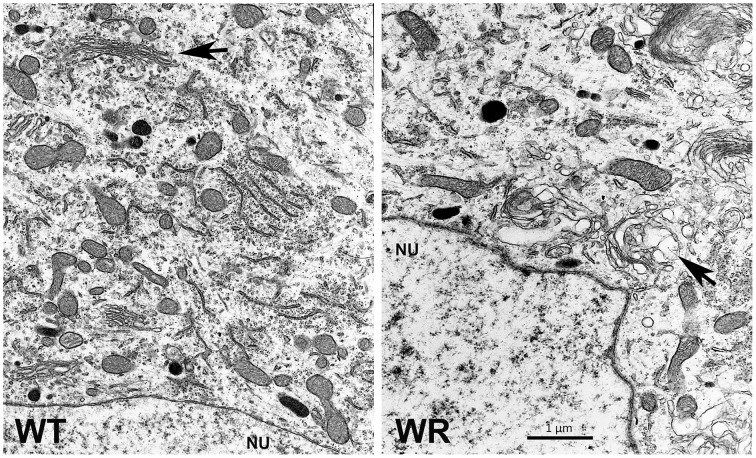
Electron micrograph of spinal motor neurons. Regions near the nucleus (NU) of motor neurons from the cervical spinal cords of wild type (WT) and a symptomatic wobbler mouse (WR) is shown. The normal WT- and morphologically affected WR Golgi are indicated by arrows. The image is a gift from Dr. Peter Heimann and shows swollen areas of the WR Golgi, similar to those published by Palmisano et al. (2011).

References

    1. Andrews J. M., Gardner M. B., Wolfgram F. J., Ellison G. W., Porter D. D., Brandkamp W. W. (1974). Studies on a murine form of spontaneous lower motor neuron degeneration–the wobbler (wa) mouse. Am. J. Pathol. 76, 63–78. - PMC - PubMed
    1. Bonifacino J. S., Hierro A. (2011). Transport according to GARP: receiving retrograde cargo at the trans-Golgi network. Trends Cell Biol. 21, 159–167. 10.1016/j.tcb.2010.11.003 - DOI - PMC - PubMed
    1. Conboy M. J., Cyert M. S. (2000). Luv1p/Rki1p/Tcs3p/Vps54p, a yeast protein that localizes to the late Golgi and early endosome, is required for normal vacuolar morphology. Mol. Biol. Cell 11, 2429–2443. 10.1091/mbc.11.7.2429 - DOI - PMC - PubMed
    1. Conibear E., Cleck J. N., Stevens T. H. (2003). Vps51p mediates the association of the GARP (Vps52/53/54) complex with the late Golgi t-SNARE Tlg1p. Mol. Biol. Cell 14, 1610–1623. 10.1091/mbc.E02-10-0654 - DOI - PMC - PubMed
    1. Conibear E., Stevens T. H. (2000). Vps52p, Vps53p, and Vps54p form a novel multisubunit complex required for protein sorting at the yeast late Golgi. Mol. Biol. Cell 11, 305–323. 10.1091/mbc.11.1.305 - DOI - PMC - PubMed

LinkOut - more resources