


The Long Path of Human Placenta, and Its Derivatives, in Regenerative Medicine
- PMID: 26539433
- PMCID: PMC4609884
- DOI: 10.3389/fbioe.2015.00162
The Long Path of Human Placenta, and Its Derivatives, in Regenerative Medicine
Abstract
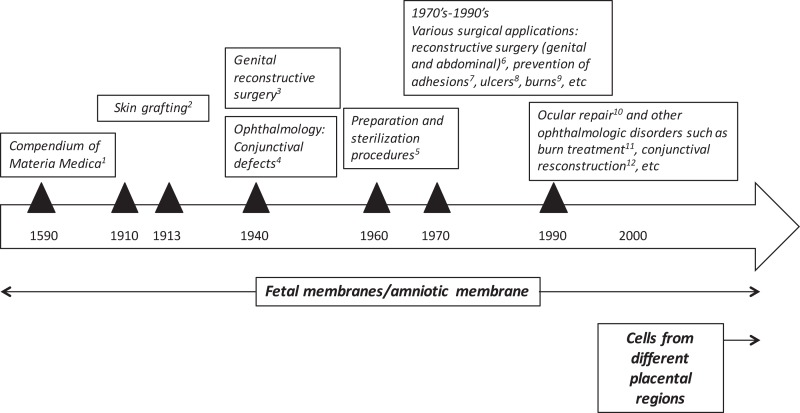
In the 1800s, a baby born with a caul, a remnant of the amniotic sack or fetal membranes, was thought to be lucky, special, or protected. Over time, fetal membranes lost their legendary power and were soon considered nothing more than biological waste after birth. However, placenta tissues have reclaimed their potential and since the early 1900s an increasing body of evidence has shown that these tissues have clinical benefits in a wide range of wound repair and surgical applications. Nowadays, there is a concerted effort to understand the mechanisms underlying the beneficial effects of placental tissues, and, more recently, cells derived thereof. This review will summarize the historical and current clinical applications of human placental tissues, and cells isolated from these tissues, and discuss some mechanisms thought to be responsible for the therapeutic effects observed after tissue and/or cell transplantation.
Keywords: amniotic and chorionic membranes; clinical trials; human term placenta; immunomodulation; paracrine effect; regenerative medicine; stem cells; umbilical cord.
Figures
References
-
- Abomaray F. M., Al Jumah M. A., Kalionis B., AlAskar A. S., Al Harthy S., Jawdat D., et al. (2015). Human chorionic villous mesenchymal stem cells modify the functions of human dendritic cells, and induce an anti-inflammatory phenotype in CD1+ dendritic cells. Stem Cell. Rev. 11, 423–441.10.1007/s12015-014-9562-8 - DOI - PubMed
-
- Abumaree M. H., Al Jumah M. A., Kalionis B., Jawdat D., Al Khaldi A., Abomaray F. M., et al. (2013). Human placental mesenchymal stem cells (pMSCs) play a role as immune suppressive cells by shifting macrophage differentiation from inflammatory M1 to anti-inflammatory M2 macrophages. Stem Cell. Rev. 9, 620–641.10.1007/s12015-013-9455-2 - DOI - PubMed
Publication types
LinkOut - more resources
Full Text Sources
Other Literature Sources
