


Analysis of PIK3CA Mutations and Activation Pathways in Triple Negative Breast Cancer
- PMID: 26540293
- PMCID: PMC4634768
- DOI: 10.1371/journal.pone.0141763
Analysis of PIK3CA Mutations and Activation Pathways in Triple Negative Breast Cancer
Abstract
Background: Triple Negative Breast Cancer (TNBC) accounts for 12-24% of all breast carcinomas, and shows worse prognosis compared to other breast cancer subtypes. Molecular studies demonstrated that TNBCs are a heterogeneous group of tumors with different clinical and pathologic features, prognosis, genetic-molecular alterations and treatment responsivity. The PI3K/AKT is a major pathway involved in the regulation of cell survival and proliferation, and is the most frequently altered pathway in breast cancer, apparently with different biologic impact on specific cancer subtypes. The most common genetic abnormality is represented by PIK3CA gene activating mutations, with an overall frequency of 20-40%. The aims of our study were to investigate PIK3CA gene mutations on a large series of TNBC, to perform a wider analysis on genetic alterations involving PI3K/AKT and BRAF/RAS/MAPK pathways and to correlate the results with clinical-pathologic data.
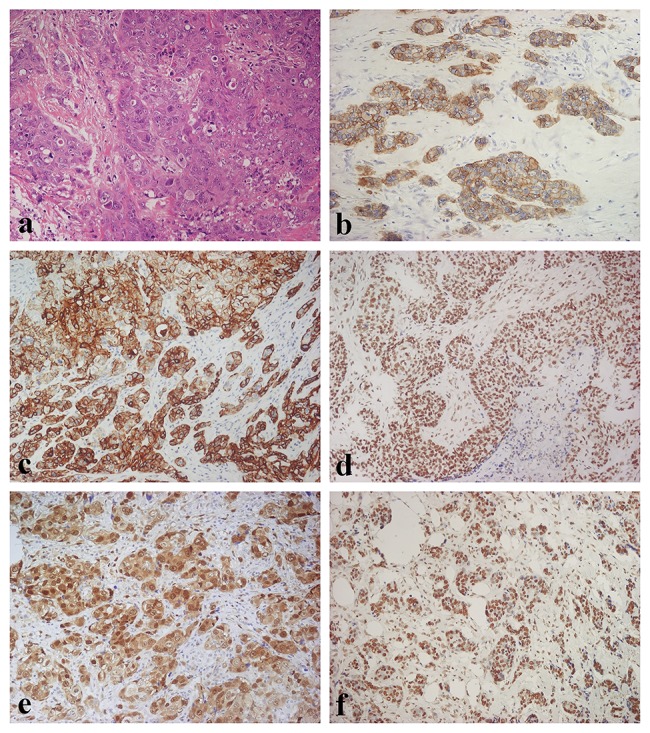
Materials and methods: PIK3CA mutation analysis was performed by using cobas® PIK3CA Mutation Test. EGFR, AKT1, BRAF, and KRAS genes were analyzed by sequencing. Immunohistochemistry was carried out to identify PTEN loss and to investigate for PI3K/AKT pathways components.
Results: PIK3CA mutations were detected in 23.7% of TNBC, whereas no mutations were identified in EGFR, AKT1, BRAF, and KRAS genes. Moreover, we observed PTEN loss in 11.3% of tumors. Deregulation of PI3K/AKT pathways was revealed by consistent activation of pAKT and p-p44/42 MAPK in all PIK3CA mutated TNBC.
Conclusions: Our data shows that PIK3CA mutations and PI3K/AKT pathway activation are common events in TNBC. A deeper investigation on specific TNBC genomic abnormalities might be helpful in order to select patients who would benefit from current targeted therapy strategies.
Conflict of interest statement
Figures
References
-
- Perou CM, Sorlie T, Eisen MB, van de Rijn M, Jeffrey SS, Rees CA, et al. Molecular portraits of human breast tumours. Nature. 2000; 406(6797):747–752. - PubMed
Publication types
MeSH terms
Substances
LinkOut - more resources
Full Text Sources
Other Literature Sources
Medical
Research Materials
Miscellaneous
