


Pleiotropic Effects of Immune Responses Explain Variation in the Prevalence of Fibroproliferative Diseases
- PMID: 26540410
- PMCID: PMC4634921
- DOI: 10.1371/journal.pgen.1005568
Pleiotropic Effects of Immune Responses Explain Variation in the Prevalence of Fibroproliferative Diseases
Abstract
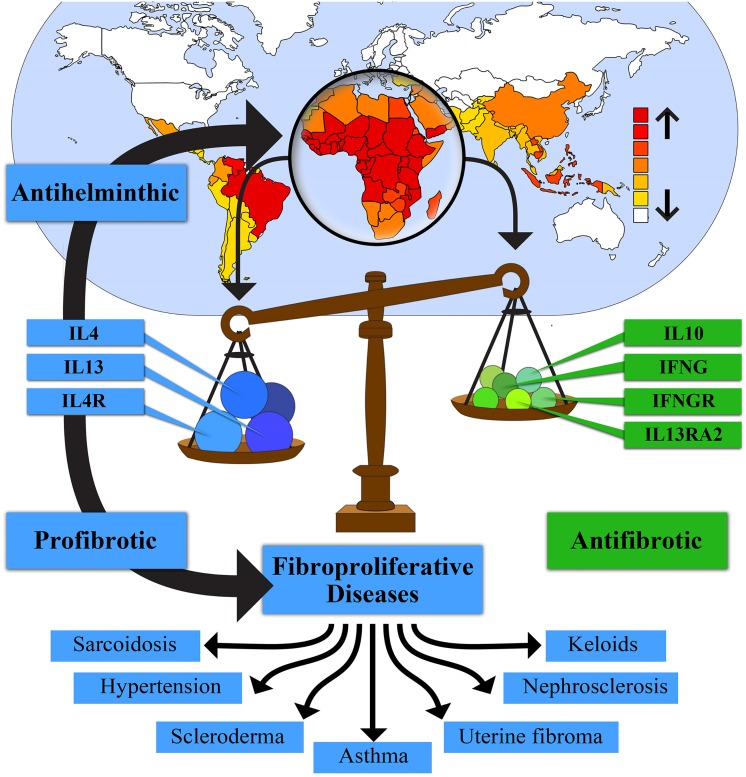
Many diseases are differentially distributed among human populations. Differential selection on genetic variants in ancestral environments that coincidentally predispose to disease can be an underlying cause of these unequal prevalence patterns. Selected genes may be pleiotropic, affecting multiple phenotypes and resulting in more than one disease or trait. Patterns of pleiotropy may be helpful in understanding the underlying causes of an array of conditions in a population. For example, several fibroproliferative diseases are more prevalent and severe in populations of sub-Saharan ancestry. We propose that this disparity is due to selection for an enhanced Th2 response that confers resistance to helminthic infections, and concurrently increases susceptibility to fibrosis due to the profibrotic action of Th2 cytokines. Many studies on selection of Th2-related genes for host resistance to helminths have been reported, but the pleiotropic impact of this selection on the distribution of fibrotic disorders has not been explicitly investigated. We discuss the disproportionate occurrence of fibroproliferative diseases in individuals of African ancestry and provide evidence that adaptation of the immune system has shaped the genetic structure of these human populations in ways that alter the distribution of multiple fibroproliferative diseases.
Conflict of interest statement
The authors have declared that no competing interests exist.
Figures
References
-
- Balloch EA (1893) Relative frequency of fibroid processes in the dark skinned races. News XLVI: 29–35.
-
- Rosser C (1925) Rectal pathology in the Negro. J Am Med Assoc LXXXIV: 93–97.
-
- Rosser C (1923) Proctologic peculiarities of the Negro: the fibroplastic diathesis.Am J Surg 37: 265.
-
- Moehlig RC (1937) The mesoderm of the negro. Amer J of Phys Anthropol XXII: 297–314.
Publication types
MeSH terms
Substances
Grants and funding
LinkOut - more resources
Full Text Sources
Other Literature Sources
