. 2016 Jan;8(1):63-8.
doi: 10.4168/aair.2016.8.1.63. Epub 2015 Aug 21.

Alternaria Induces Production of Thymic Stromal Lymphopoietin in Nasal Fibroblasts Through Toll-like Receptor 2

Affiliations

Alternaria Induces Production of Thymic Stromal Lymphopoietin in Nasal Fibroblasts Through Toll-like Receptor 2

Seung Heon Shin et al. Allergy Asthma Immunol Res. 2016 Jan.

Abstract

Purpose: Chronic rhinosinusitis with nasal polyps is a chronic inflammatory disease with markedly increased eosinophils, Th2-type lymphocytes, fibroblasts, and goblet cells. Fungi are commonly associated with airway inflammatory diseases, and thymic stromal lymphopoietin (TSLP) is important in the development of Th2 inflammatory responses. The aim of this study was to investigate the interaction between airborne fungi and nasal fibroblasts in TSLP mRNA and protein expression.

Methods: Inferior turbinate and nasal polyp fibroblasts were stimulated with Alternaria and Aspergillus, respectively, for 48 hours, and TSLP mRNA and protein expressions were measured. The reverse transcriptase polymerase chain reaction was performed for the Toll-like receptor (TLR) mRNA expression of the nasal fibroblasts. To determine the role of TLR in the induction of TSLP, the fibroblasts were transfected with siRNA against TLR2 and TLR5.

Results: Alternaria induced TSLP mRNA and protein expression in both inferior turbinate and nasal polyp fibroblasts. The nasal polyp fibroblasts responded more strongly to the fungi. TLR2 and TLR5 mRNA expressions were significantly increased with fungal stimulation and TSLP production was significantly inhibited by siRNA against TLR2.

Conclusions: The results of this study show that TSLP expression could be induced in nasal fibroblasts by exposure to Alternaria and that TLR2 may be involved in the process. The promotion of TSLP production in nasal fibroblasts by airborne fungi may facilitate the development or exacerbation of Th2-type nasal inflammation, especially in CRS with nasal polyps.

Keywords: Alternaria; nasal fibroblast; nasal polyp; thymic stromal lymphopoietin; toll like receptor.


Conflict of interest statement

There are no financial or other issues that might lead to conflict of interest.

Figures
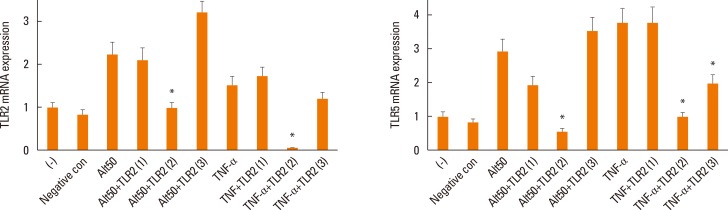
Fig. 1
Fig. 1. Determination of optimal small interfering RNA (siRNA) against toll-like receptors (TLRs) 2 and 5. Fibroblasts were transfected with 3 different kinds of siRNA against TLR2 and TLR5 then stimulated with Alternaria or tumor necrosis factor-α. Second siRNA against TLR2 (target sequence was CUU GUG ACC GCA AUG GUA U) and second siRNA against TLR5 (target sequence was CUG GGA AGU AGU AAG AUA U) most strongly inhibited the expression of TLR2 and TLR5 mRNA from nasal fibroblasts. *P<0.05 compared to Alternaria 50 ug/mL (ALT 50) and TNF-α.
Fig. 2
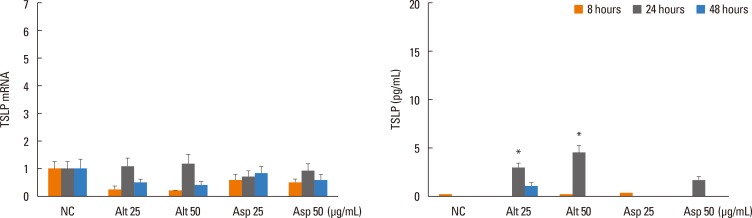
Fig. 2. Effects of fungi on the expression of thymic stromal lymphopoietin (TSLP) from inferior turbinate fibroblasts (A and B) and nasal polyp fibroblasts (C and D). Fibroblasts were stimulated with Alternaria and Aspergillus for 48 hours. When inferior turbinate fibroblasts were stimulated with Alternaria for 24 hours, TSLP protein production was significantly increased (B, P<0.05). However, TSLP mRNA expression was not changed by Alternaria (B). Aspergillus did not influence the expression of TSLP mRNA or the production of TSLP protein from inferior turbinate fibroblasts (A and B). The nasal polyp fibroblasts were stimulated with Alternaria and Aspergillus for 48 hours. When the fibroblasts were stimulated with Alternaria for 24 and 48 hours hours, TSLP mRNA expression and TSLP protein production were significantly increased (C and D, P<0.05). Aspergillus did not influence the expression of TSLP mRNA or the production of TSLP protein from fibroblasts. The values are expressed as the mean±SD of 5 separate experiments. *P<0.05 compared to the negative control. NC, negative control; Alt, Alternaria; Asp, Aspergillus.
Fig. 3
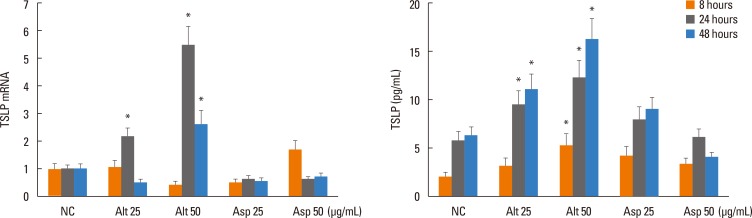
Fig. 3. Effects of fungi on the expression of thymic stromal lymphopoietin (TSLP) from nasal polyp fibroblasts. Fibroblasts were stimulated with Alternaria and Aspergillus for 48 hours. When the fibroblasts were stimulated with Alternaria for 24 and 48 hours hours, TSLP mRNA expression and TSLP protein production were significantly increased. Aspergillus did not influence the expression of TSLP mRNA or the production of TSLP protein from fibroblasts. The values are expressed as the mean±SD of five separate experiments. *P<0.05 compared with the negative control. NC, negative control; Alt, Alternaria; Asp, Aspergillus.
Fig. 4
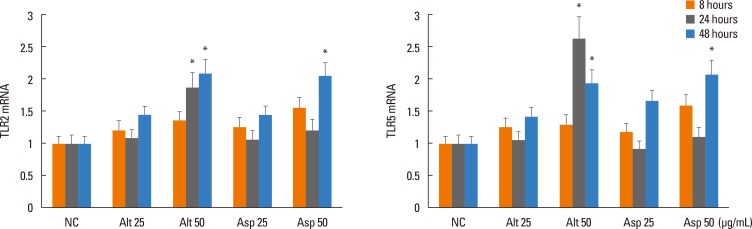
Fig. 4. Quantitative reversee transcription polymerase chain reaction analysis of the expression of toll-like receptors (TLRs) in nasal polyp fibroblasts after simulation with fungi. TLR2 mRNA expression was significantly increased after 24 and 48 hours of stimulation with 50 µg/mL of Alternaria and 48 hours stimulation 50 µg/mL of Aspergillus, and TLR5 mRNA expression was significantly increase after 24 and 48 hours of stimulation with 50 µg/mL of Alternaria and 48 hours stimulation 50 µg/mL of Aspergillus. The values are expressed as the mean±SD of five separate experiments. *P<0.05 compared with the negative control. NC, negative control; Alt, Alternaria; Asp, Aspergillus.
Fig. 5
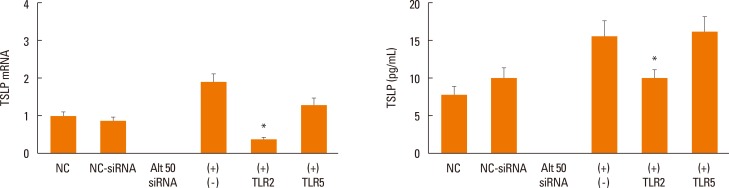
Fig. 5. Effects of siRNA against TLR2 and TLR5 on the expression of thymic stromal lymphopoietin (TSLP) from nasal polyp fibroblasts. Fibroblasts were transfected with siRNA against TLR2, TLR5, or control siRNA for 72 hours then stimulated with Alternaria for 24 hours. TSLP mRNA expression and TSLP protein production were significantly inhibited by siRNA against TLR2. The values are expressed as the mean±SD of five separate experiments. *P<0.05 compared with the non-treated group. NC, negative control; Alt, Alternaria.

References

    1. Zhang K, Shan L, Rahman MS, Unruh H, Halayko AJ, Gounni AS. Constitutive and inducible thymic stromal lymphopoietin expression in human airway smooth muscle cells: role in chronic obstructive pulmonary disease. Am J Physiol Lung Cell Mol Physiol. 2007;293:L375–L382. - PubMed
    1. Ziegler SF. The role of thymic stromal lymphopoietin (TSLP) in allergic disorders. Curr Opin Immunol. 2010;22:795–799. - PMC - PubMed
    1. Liu YJ. Thymic stromal lymphopoietin: master switch for allergic inflammation. J Exp Med. 2006;203:269–273. - PMC - PubMed
    1. Ying S, O'Connor B, Ratoff J, Meng Q, Fang C, Cousins D, et al. Expression and cellular provenance of thymic stromal lymphopoietin and chemokines in patients with severe asthma and chronic obstructive pulmonary disease. J Immunol. 2008;181:2790–2798. - PubMed
    1. Kimura S, Pawankar R, Mori S, Nonaka M, Masuno S, Yagi T, et al. Increased expression and role of thymic stromal lymphopoietin in nasal polyposis. Allergy Asthma Immunol Res. 2011;3:186–193. - PMC - PubMed