Review
doi: 10.1371/journal.ppat.1005087.
eCollection 2015.
Emergence of Pathogenicity in Lagoviruses: Evolution from Pre-existing Nonpathogenic Strains or through a Species Jump?
Affiliations
- PMID: 26540662
- PMCID: PMC4634945
- DOI: 10.1371/journal.ppat.1005087
Item in Clipboard
Review
Emergence of Pathogenicity in Lagoviruses: Evolution from Pre-existing Nonpathogenic Strains or through a Species Jump?
PLoS Pathog.
.
No abstract available
Conflict of interest statement
The authors have declared that no competing interests exist.
Figures
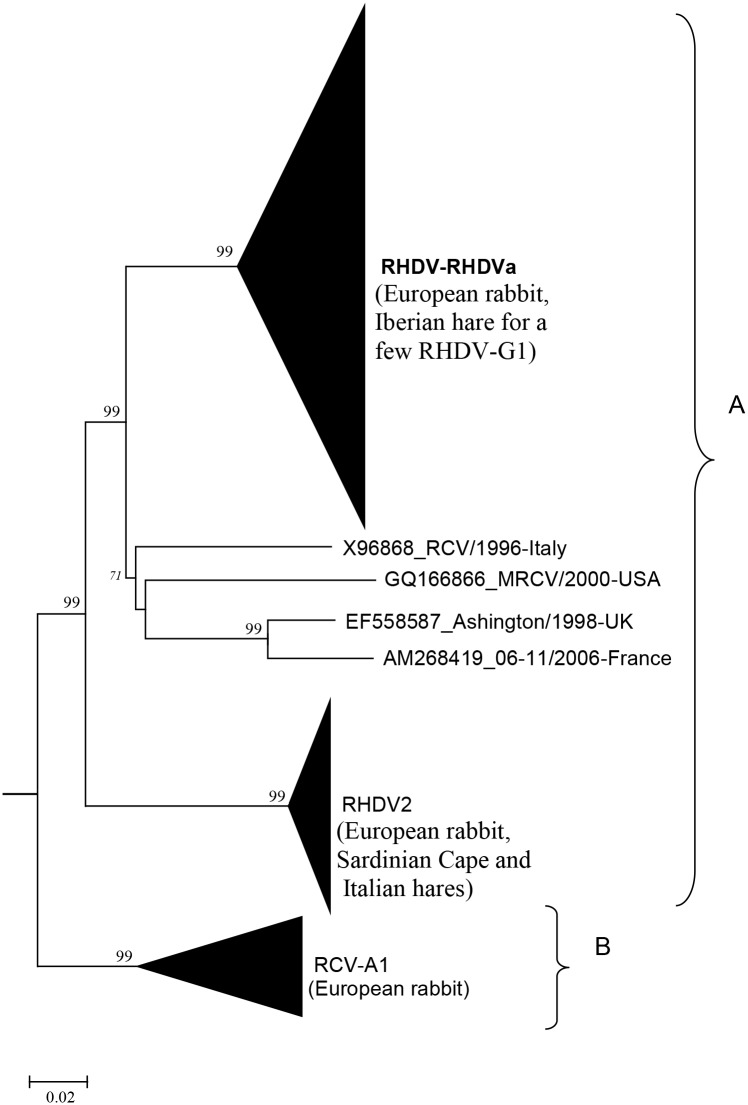
A) Lagoviruses that may share common ancestors following several species jump(s), B) Nonpathogenic viruses that have evolved in European rabbit for a long time. Phylogenetic tree (Neighbor-joining method) derived from 303 rabbit lagovirus sequences of the VP60 gene available on public databases (May 2015). The pathogenic RHDV, RHDVa, RHDV2, and the nonpathogenic RCV-A1 branches are collapsed; the name of the leporid species where these strains were isolated is given in brackets. X96868_RCV/1996-Italy, GQ166866_MRCV/2000-USA, EF558587_Ashington/1998-UK, and AM268419_06-11/2006-France are nonpathogenic strains isolated in the European rabbit. Percentage greater than 70% of replicate trees in which the associated taxa clustered together in the bootstrap test (500 replicates) are given at major branch nodes. The EBHSV strain GD (Z69620) was used as an outgroup to root the tree. Similar clustering was observed in several recent works [63,64,66,70,74].
References
-
- Bengis RG, Leighton FA, Fischer JR, Artois M, Mörner T, Tate CM. The roleof wildlife in emerging and re-emerging zoonoses. Rev Sci Tech. 2004;23: 497–511. - PubMed
-
- Capucci L, Scicluna MT, Lavazza A. Diagnosis of viral haemorrhagic disease of rabbits and the European brown hare syndrome. Rev Sci Tech. 1991;10: 347–370. - PubMed
Publication types
MeSH terms
LinkOut - more resources
Full Text Sources
Other Literature Sources