


Light pollution: the possible consequences of excessive illumination on retina
- PMID: 26541085
- PMCID: PMC4763120
- DOI: 10.1038/eye.2015.221
Light pollution: the possible consequences of excessive illumination on retina
Abstract
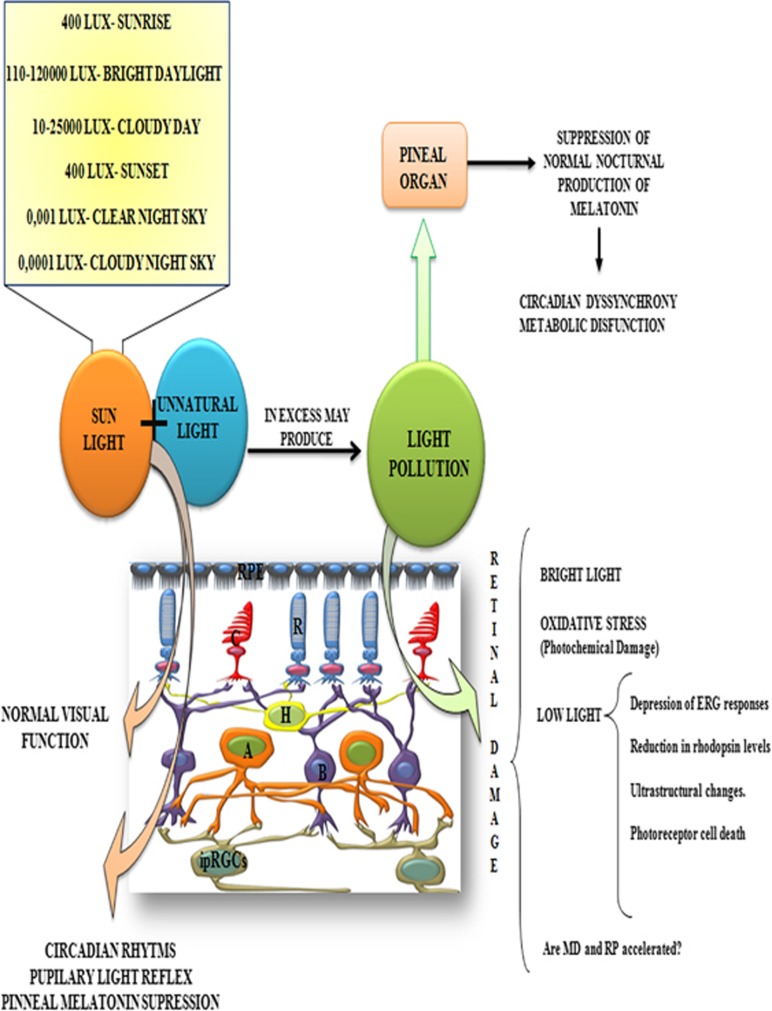
Light is the visible part of the electromagnetic radiation within a range of 380-780 nm; (400-700 on primates retina). In vertebrates, the retina is adapted to capturing light photons and transmitting this information to other structures in the central nervous system. In mammals, light acts directly on the retina to fulfill two important roles: (1) the visual function through rod and cone photoreceptor cells and (2) non-image forming tasks, such as the synchronization of circadian rhythms to a 24 h solar cycle, pineal melatonin suppression and pupil light reflexes. However, the excess of illumination may cause retinal degeneration or accelerate genetic retinal diseases. In the last century human society has increased its exposure to artificial illumination, producing changes in the Light/Dark cycle, as well as in light wavelengths and intensities. Although, the consequences of unnatural illumination or light pollution have been underestimated by modern society in its way of life, light pollution may have a strong impact on people's health. The effects of artificial light sources could have direct consequences on retinal health. Constant exposure to different wavelengths and intensities of light promoted by light pollution may produce retinal degeneration as a consequence of photoreceptor or retinal pigment epithelium cells death. In this review we summarize the different mechanisms of retinal damage related to the light exposure, which generates light pollution.
Figures
References
-
- 1Berson DM, Dunn FA, Takao M. Phototransduction by retinal ganglion cells that set the circadian clock. Science 2002; 295: 1070–1073. - PubMed
-
- 2Guido ME, Garbarino-Pico E, Contin M, Valdez DJ, Nieto PS, Verra DM et al. Inner retinal circadian clocks and non-visual photoreceptors: novel players in the circadian system. Prog Neurobiol 2010; 92: 484–504. - PubMed
-
- 3Grimm NB, Faeth SH, Golubiewski NE, Redman CL, Wu J, Bai X et al. Global change and the ecology of cities. Science 2008; 319: 756–760. - PubMed
-
- 4Navara KJ, Nelson RJ. The dark side of light at night: physiological, epidemiological, and ecological consequences. J Pineal Res 2007; 43: 215–224. - PubMed
-
- 5Shuboni D, Yan L. Nighttime dim light exposure alters the responses of the circadian system. Neuroscience 2010; 170: 1172–1178. - PubMed
Publication types
MeSH terms
LinkOut - more resources
Full Text Sources
Other Literature Sources
