. 2015 Dec;2(1):8.
doi: 10.1186/s40348-015-0019-1. Epub 2015 May 19.

Ciliopathies - from rare inherited cystic kidney diseases to basic cellular function

Affiliations

Ciliopathies - from rare inherited cystic kidney diseases to basic cellular function

Sandra Habbig et al. Mol Cell Pediatr. 2015 Dec.

Abstract

Background: Primary cilia are membrane-bound microtubule-based protuberances of the cell membrane projecting to the extracellular environment. While little attention was paid to this subcellular structure over a long time, recent research has highlighted multiple cellular functions of primary cilia and has brought cilia to the focus of medical and cell biological research.

Findings: Cilia are nowadays considered to be crucial cellular structures controlling diverse intracellular signaling cascades. Dysfunction of cilia leads to a pleiotropic group of diseases ranging from cystic kidney disease via neurologic disorders to metabolic phenotypes and cardiac malformations. According to the underlying cellular pathophysiology, these diverse disorders have been subsumed under the term "ciliopathies".

Conclusions: The work on rare human ciliopathies has strongly deepened our genetic and cell biological understanding of multiple diseases and cellular events thus ultimately leading to clinical trials of novel therapeutic approaches. This review focuses on some of the important developments in ciliopathy research.

Keywords: Cilia; Ciliopathy; Cystic kidney disease; Nephronophthisis; PKD; Rare Genetic Diseases.


Figures
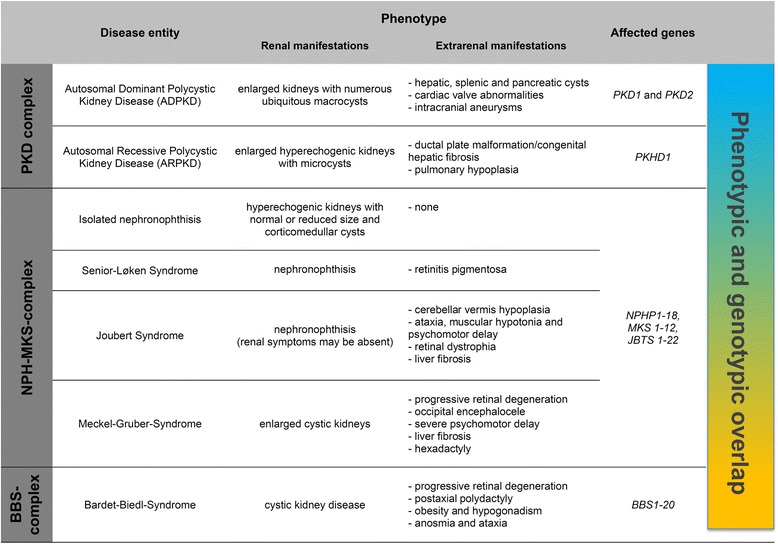
Figure 1
Figure 1
Clinical synopsis of the main disease entities and overview over the affected genes.
Figure 2
Figure 2
Typical radiological findings in children with cystic kidney disease. (a, b) Typical ubiquitous macrocysts and enlarged kidney volumes are found a 15-year-old boy with ADPKD. (c) ARPKD typically presents with hyperechogenic kidney with microcysts as shown in a sonography of a 1-year-old boy. (d) The massively enlarged kidney volume in ARPKD is illustrated on axial abdominal MRI of a 10-month-old girl. (e) Ultrasonography of patients with nephronophthisis often shows small, hyperechogenic kidneys without corticomedullar differentiation. If present, cysts are typically found at the corticomedullar border. (f) Cerebellar vermis asplasia and elongated superior cerebellar peduncles result in the Molar Tooth Sign on axial MRI, which is pathognomonic for Joubert syndrome. ADPKD, autosomal dominant polycystic kidney disease; ARPKD, autosomal recessive polycystic kidney disease.
Figure 3
Figure 3
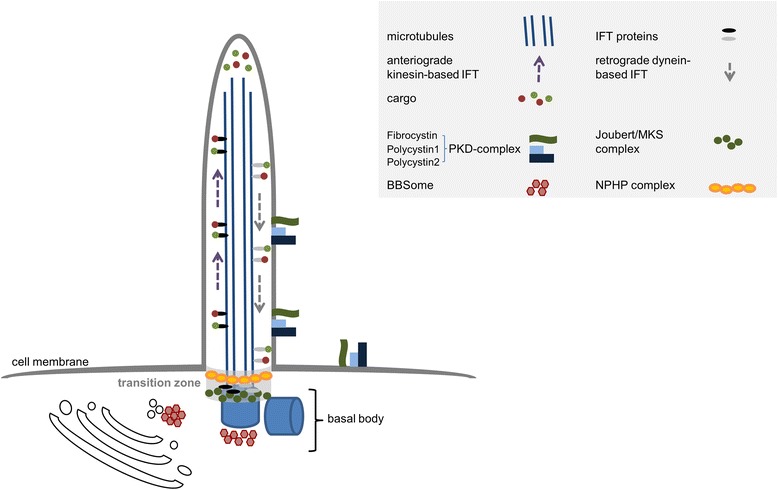
Schematic illustration of cilia and ciliary protein complexes. Gene products affected in different ciliary phenotypes are found in common protein complexes and frequently show functional overlap. Transport into and within a cilium is regulated by kinesin- and dynein-based intraflagellar transport.

References

    1. Hildebrandt F, Benzing T, Katsanis N. Ciliopathies. N Engl J Med. 2011;364:1533–43. doi: 10.1056/NEJMra1010172. - DOI - PMC - PubMed
    1. Gerdes JM, Davis EE, Katsanis N. The vertebrate primary cilium in development, homeostasis, and disease. Cell. 2009;137:32–45. doi: 10.1016/j.cell.2009.03.023. - DOI - PMC - PubMed
    1. Nigg EA, Raff JW. Centrioles, centrosomes, and cilia in health and disease. Cell. 2009;139:663–78. doi: 10.1016/j.cell.2009.10.036. - DOI - PubMed
    1. Pazour GJ. Intraflagellar transport and cilia-dependent renal disease: the ciliary hypothesis of polycystic kidney disease. J Am Soc Nephrol JASN. 2004;15:2528–36. doi: 10.1097/01.ASN.0000141055.57643.E0. - DOI - PubMed
    1. Fliegauf M, Benzing T, Omran H. When cilia go bad: cilia defects and ciliopathies. Nat Rev Mol Cell Biol. 2007;8:880–93. doi: 10.1038/nrm2278. - DOI - PubMed

LinkOut - more resources