. 2016 Feb;161(2):307-16.
doi: 10.1007/s00705-015-2660-3. Epub 2015 Nov 5.

Amino acid residues at positions 222 and 227 of the hemagglutinin together with the neuraminidase determine binding of H5 avian influenza viruses to sialyl Lewis X

Affiliations

Amino acid residues at positions 222 and 227 of the hemagglutinin together with the neuraminidase determine binding of H5 avian influenza viruses to sialyl Lewis X

Takahiro Hiono et al. Arch Virol. 2016 Feb.

Abstract

Influenza viruses isolated from ducks are rarely able to infect chickens; it is therefore postulated that these viruses need to adapt in some way to be able to be transmitted to chickens in nature. Previous studies revealed that sialyl Lewis X (3'SLeX), which is fucosylated α2,3 sialoside, was predominantly detected on the epithelial cells of the chicken trachea, whereas this glycan structure is not found in the duck intestinal tract. To clarify the mechanisms of the interspecies transmission of influenza viruses between ducks and chickens, we compared the receptor specificity of low-pathogenic avian influenza viruses isolated from these two species. Glycan-binding analysis of the recombinant hemagglutinin (HA) of a chicken influenza virus, A/chicken/Ibaraki/1/2005 (H5N2), revealed a binding preference to α1,3 fucosylated sialosides. On the other hand, the HA of a duck influenza virus, A/duck/Mongolia/54/2001 (H5N2) (Dk/MNG), particularly bound to non-fucosylated α2,3 sialosides such as 3'-sialyllactosamine (3'SLacNAc). Computational analysis along with binding analysis of the mutant HAs revealed that this glycan-binding specificity of the HA was determined by amino acid residues at positions 222 and 227. Inconsistent with the glycan-binding specificity of the recombinant HA protein, virions of Dk/MNG bound to both 3'SLacNAc and 3'SLeX. Glycan-binding analysis in the presence of a neuraminidase (NA) inhibitor revealed that the NA conferred binding to 3'SLeX to virions of Dk/MNG. The present results reveal the molecular basis of the interaction between fucosylated α2,3 sialosides and influenza viruses.


Figures
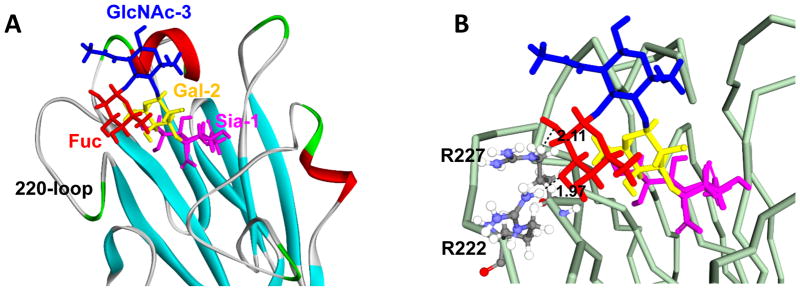
Fig. 1
Fig. 1
Structure model of sialyl Lewis X (3′SLeX) bound to the hemagglutinin (HA) of Ck/IBR, which was taken from snapshot at 5 ns. The receptor binding site of the HA of Ck/IBR is shown in either a ribbon (A) or line (B) cartoon representation. In the glycan structure, N-acetylneuraminic acid (Sia) is shown in purple, galactose (Gal) is shown in yellow, N-acetylglucosamine (GlcNAc) is shown in blue and fucose (Fuc) is shown in red. In (B), dash lines indicate hydrogen bonds and the numbers indicate the predicted length of each hydrogen bond.
Fig. 2
Fig. 2
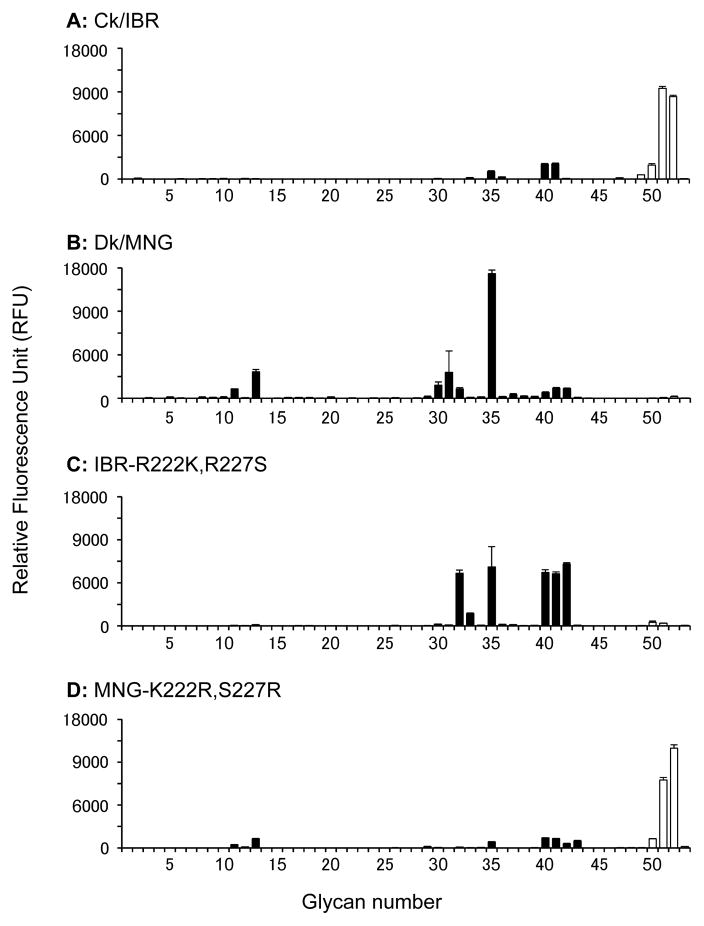
Glycan-binding specificity of the soluble trimeric recombinant hemagglutinins (rHAs). The glycan-binding specificity of rHA of Ck/IBR (A), Dk/MNG (B), IBR-R222K,R227S (C) and MNG-K222R,S227R (D) was analyzed by glycan microarray. Non-sialylated controls are shown as grey bars (#1–10), non-fucosylated α2,3 sialylated glycans are presented as black bars (#11–46) and fucosylated and α2,3 sialylated glycans are shown in white bars (#47–53). Each bar represents the mean signal minus background for each glycan sample and error bars are the SE value. Glycans imprinted on the array are listed in Table S1.
Fig. 3
Fig. 3
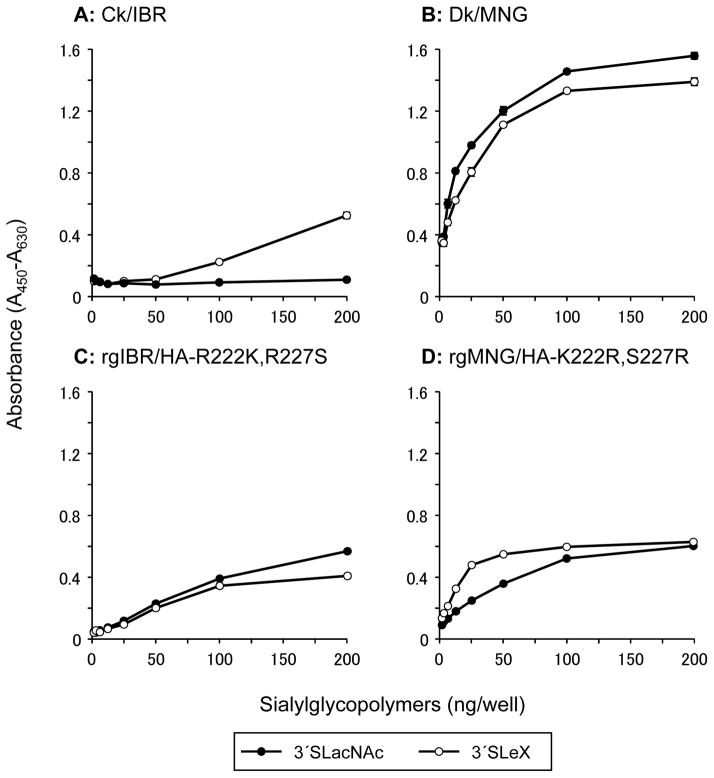
Glycan-binding specificity of virions. The glycan-binding specificity of Ck/IBR (A), Dk/MNG (B), rgIBR/HA-R222K,R227S (C) and rgMNG/HA-K222R,S227R (D) to sialylglycopolymers containing 3′sialyllactosamine (3′SLacNAc, black circles) and sialyl Lewis X (3′SLeX, white circles) was investigated using a solid-phase direct binding assays. The data are presented as the mean ± SE of triplicate experiments.
Fig. 4
Fig. 4
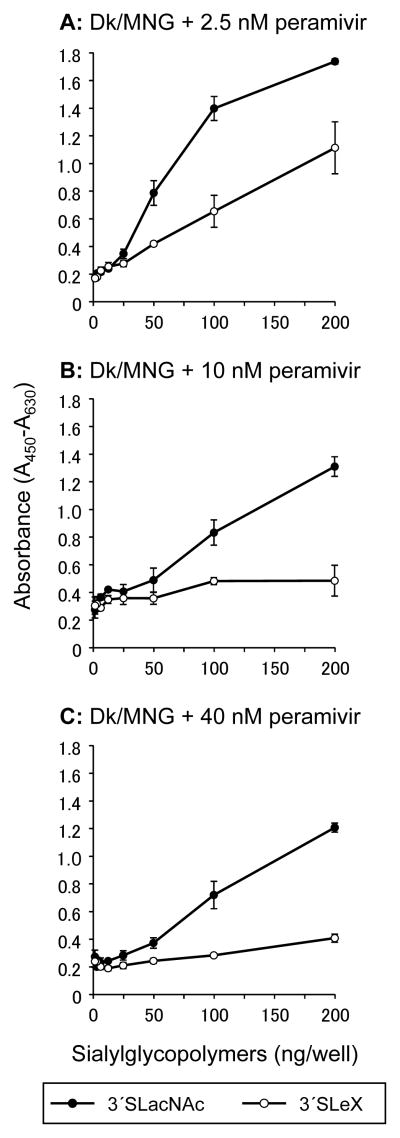
Glycan-binding specificity of virions of Dk/MNG in the presence of peramivir. The glycan-binding specificity of virions of Dk/MNG to sialylglycopolymers containing 3′sialyllactosamine (3′SLacNAc, black circles) and sialyl Lewis X (3′SLeX, white circles) was investigated in the presence of either 2.5 (A), 10 (B) or 40 (C) nM of a neuraminidase inhibitor peramivir. The data are presented as the mean ± SE of triplicate experiments.
Fig. 5
Fig. 5
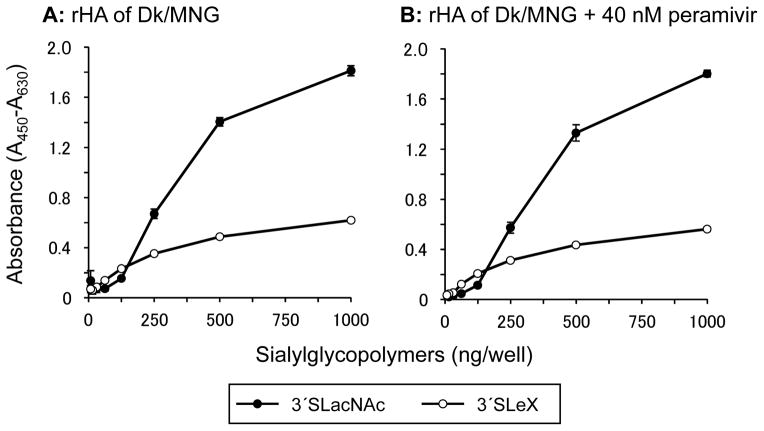
Glycan-binding specificity of the rHA of Dk/MNG in the presence of peramivir. The glycan-binding specificity of the rHA of Dk/MNG to sialylglycopolymers containing 3′sialyllactosamine (3′SLacNAc, black circles) and sialyl Lewis X (3′SLeX, white circles) was investigated in the absence (A) or presence (B) of a neuraminidase inhibitor peramivir. The data are presented as the mean ± SE of triplicate experiments.
Fig. 6
Fig. 6
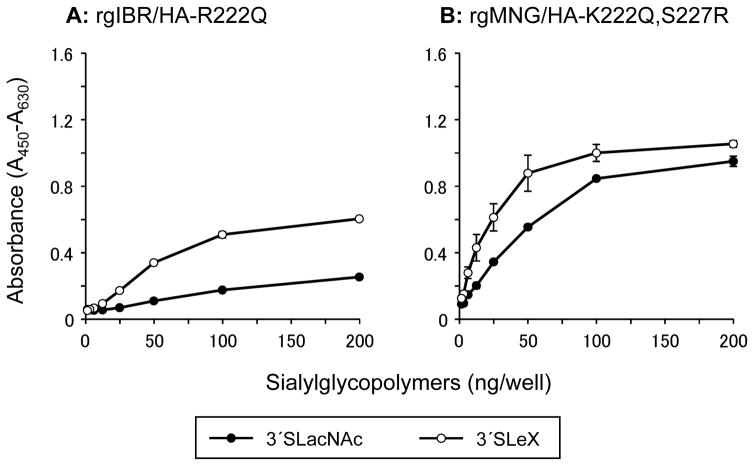
Glycan-binding specificity of rgIBR/HA-R222Q and rgMNG/HA-K222Q,S227R. Glycan-binding specificity of virions of rgIBR/HA-R222Q (A) and rgMNG/HA-K222Q,S227R (B) to sialylglycopolymers containing 3′sialyllactosamine (3′SLacNAc, black circles) and sialyl Lewis X (3′SLeX, white circles) was investigated using a solid-phase direct binding assays. The data are presented as the mean ± SE of triplicate experiments.

References

    1. Kida H. Ecology of influenza viruses in nature, birds, and humans. Global Environmental Research. 2008;12:9–14.
    1. Herfst S, Schrauwen EJ, Linster M, Chutinimitkul S, de Wit E, Munster VJ, Sorrell EM, Bestebroer TM, Burke DF, Smith DJ, Rimmelzwaan GF, Osterhaus AD, Fouchier RA. Airborne transmission of influenza A/H5N1 virus between ferrets. Science. 2012;336:1534–1541. - PMC - PubMed
    1. Imai M, Watanabe T, Hatta M, Das SC, Ozawa M, Shinya K, Zhong G, Hanson A, Katsura H, Watanabe S, Li C, Kawakami E, Yamada S, Kiso M, Suzuki Y, Maher EA, Neumann G, Kawaoka Y. Experimental adaptation of an influenza H5 HA confers respiratory droplet transmission to a reassortant H5 HA/H1N1 virus in ferrets. Nature. 2012;486:420–428. - PMC - PubMed
    1. Yamada S, Shinya K, Takada A, Ito T, Suzuki T, Suzuki Y, Le QM, Ebina M, Kasai N, Kida H, Horimoto T, Rivailler P, Chen LM, Donis RO, Kawaoka Y. Adaptation of a duck influenza A virus in quail. J Virol. 2012;86:1411–1420. - PMC - PubMed
    1. Paulson JC, de Vries RP. H5N1 receptor specificity as a factor in pandemic risk. Virus Res. 2013;178:99–113. - PMC - PubMed

Publication types

Substances

LinkOut - more resources