Longitudinal Change in Mammographic Density among ER-Positive Breast Cancer Patients Using Tamoxifen
- PMID: 26545407
- PMCID: PMC4713329
- DOI: 10.1158/1055-9965.EPI-15-0412
Longitudinal Change in Mammographic Density among ER-Positive Breast Cancer Patients Using Tamoxifen
Abstract
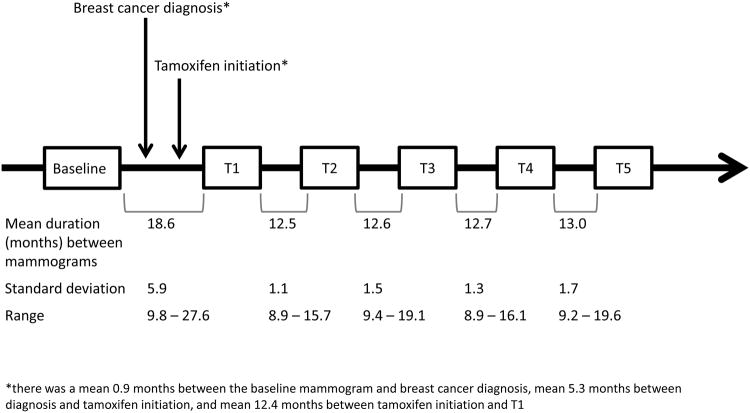
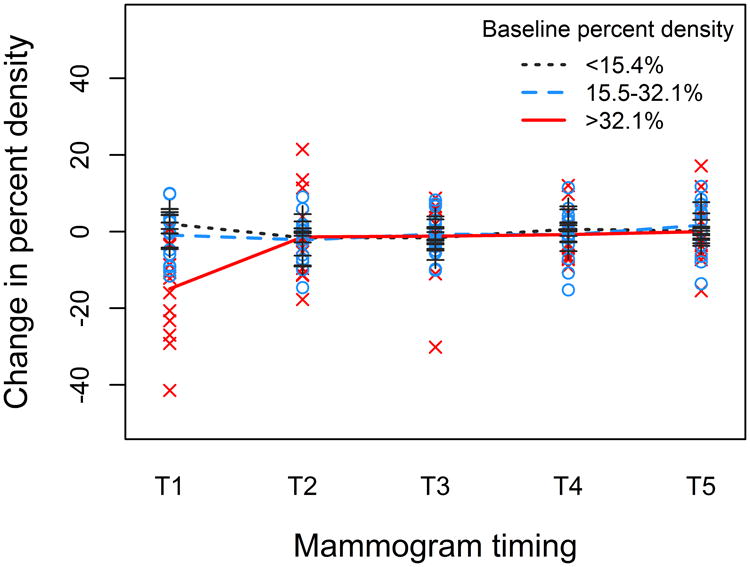
Tamoxifen-associated mammographic density (MD) reductions are linked to improved breast cancer survival. We evaluated MD at six time points to determine the timing of greatest reduction following tamoxifen initiation. We sampled 40 Kaiser Permanente Northwest estrogen receptor (ER)-positive breast cancer patients from a prior study of MD change, according to tamoxifen use duration and age at diagnosis: <4 years tamoxifen and ≤50 years (N = 6) or >50 years (N = 10) old; ≥4 years tamoxifen and ≤50 years (N = 13) or >50 years (N = 11) old. A single reader evaluated percent MD in the contralateral breast on baseline (pre-diagnosis) and five approximately yearly post-diagnostic (T1 to T5) mammograms. Mean MD change was calculated. Interactions with age (≤50 and >50 years), tamoxifen duration (<4 and ≥4 years), and baseline MD (tertiles) were tested in linear regression models. Overall, the largest MD decline occurred by T1 (mean 4.5%) with little additional decline by T5. Declines differed by tertile of baseline MD (Pinteraction < 0.01). In the highest tertile, the largest reduction occurred by T1 (mean 14.9%), with an additional reduction of 3.6% by T5. Changes were smaller in the middle and lowest baseline MD tertiles, with cumulative reductions of 3.0% and 0.4% from baseline to T5, respectively. There were no differences by age (Pinteraction = 0.36) or tamoxifen duration (Pinteraction = 0.42). Among ER-positive patients treated with tamoxifen and surviving ≥5 years, most of the MD reduction occurred within approximately 12 months of tamoxifen initiation, suggesting that MD measurement at a single time point following tamoxifen initiation can identify patients with substantial density declines.
©2015 American Association for Cancer Research.
Conflict of interest statement
Conflict of Interest: The authors declare that they have no competing interests.
Figures
References
-
- Cuzick J, Warwick J, Pinney E, Warren RML, Duffy SW. Tamoxifen and breast density in women at increased risk of breast cancer. J Natl Cancer Inst. 2004;96:621–8. - PubMed
-
- Ko KL, Shin IS, You JY, Jung SY, Ro J, Lee ES. Adjuvant tamoxifen-induced mammographic breast density reduction as a predictor for recurrence in estrogen receptor-positive premenopausal breast cancer patients. Breast Cancer Res Treat. 2013;142:559–67. - PubMed
-
- Son HJ, Oh KK. Significance of follow-up mammography in estimating the effect of tamoxifen in breast cancer patients who have undergone surgery. AJR Am J Roentgenol. 1999;173:905–9. - PubMed
Publication types
MeSH terms
Substances
Grants and funding
LinkOut - more resources
Full Text Sources
Medical