


ATP-binding cassette transporters in reproduction: a new frontier
- PMID: 26545808
- PMCID: PMC4755438
- DOI: 10.1093/humupd/dmv049
ATP-binding cassette transporters in reproduction: a new frontier
Abstract
Background: The transmembrane ATP-binding cassette (ABC) transporters actively efflux an array of clinically relevant compounds across biological barriers, and modulate biodistribution of many physiological and pharmacological factors. To date, over 48 ABC transporters have been identified and shown to be directly and indirectly involved in peri-implantation events and fetal/placental development. They efflux cholesterol, steroid hormones, vitamins, cytokines, chemokines, prostaglandins, diverse xenobiotics and environmental toxins, playing a critical role in regulating drug disposition, immunological responses and lipid trafficking, as well as preventing fetal accumulation of drugs and environmental toxins.
Methods: This review examines ABC transporters as important mediators of placental barrier functions and key reproductive processes. Expression, localization and function of all identified ABC transporters were systematically reviewed using PubMed and Google Scholar websites to identify relevant studies examining ABC transporters in reproductive tissues in physiological and pathophysiological states. Only reports written in English were incorporated with no restriction on year of publication. While a major focus has been placed on the human, extensive evidence from animal studies is utilized to describe current understanding of the regulation and function of ABC transporters relevant to human reproduction.
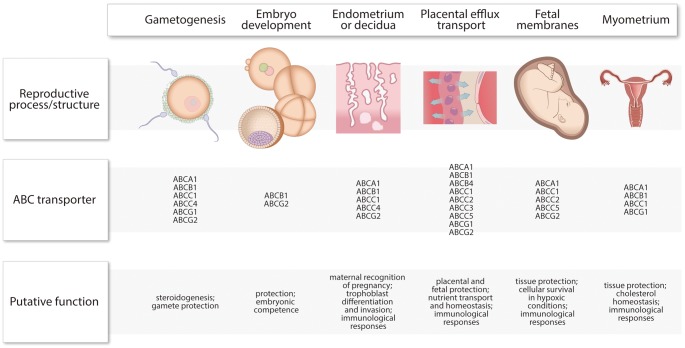
Results: ABC transporters are modulators of steroidogenesis, fertilization, implantation, nutrient transport and immunological responses, and function as 'gatekeepers' at various barrier sites (i.e. blood-testes barrier and placenta) against potentially harmful xenobiotic factors, including drugs and environmental toxins. These roles appear to be species dependent and change as a function of gestation and development. The best-described ABC transporters in reproductive tissues (primarily in the placenta) are the multidrug transporters p-glycoprotein and breast cancer-related protein, the multidrug resistance proteins 1 through 5 and the cholesterol transporters ABCA1 and ABCG1.
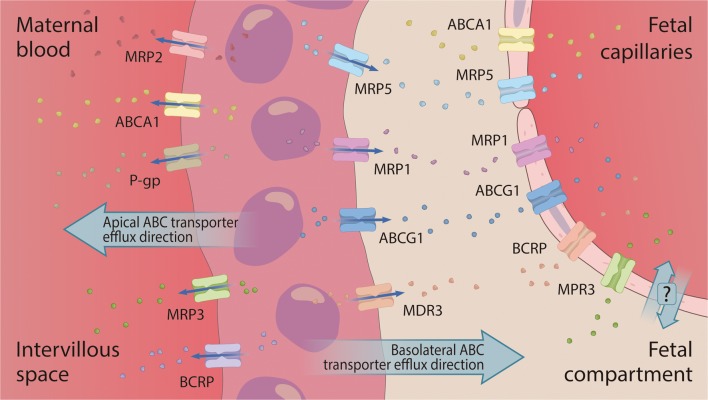
Conclusions: The ABC transporters have various roles across multiple reproductive tissues. Knowledge of efflux direction, tissue distribution, substrate specificity and regulation of the ABC transporters in the placenta and other reproductive tissues is rapidly expanding. This will allow better understanding of the disposition of specific substrates within reproductive tissues, and facilitate development of novel treatments for reproductive disorders as well as improved approaches to protecting the developing fetus.
Keywords: ABC transporters; breast cancer-related protein; decidua; fetal membranes; multidrug resistance-associated proteins; myometrium; ovary; p-glycoprotein; placenta; testes.
© The Author 2015. Published by Oxford University Press on behalf of the European Society of Human Reproduction and Embryology. All rights reserved. For Permissions, please email: journals.permissions@oup.com.
Figures
References
-
- Agassandian M, Mathur SN, Zhou J, Field FJ, Mallampalli RK. Oxysterols trigger ABCA1-mediated basolateral surfactant efflux. Am J Respir Cell Mol Biol 2004;31:227–233. - PubMed
-
- Alam SM, Konno T, Dai G, Lu L, Wang D, Dunmore JH, Godwin AR, Soares MJ. A uterine decidual cell cytokine ensures pregnancy-dependent adaptations to a physiological stressor. Development 2007;134:407–415. - PubMed
-
- Albrecht C, Soumian S, Tetlow N, Patel P, Sullivan MH, Lakasing L, Nicolaides K, Williamson C. Placental ABCA1 expression is reduced in primary antiphospholipid syndrome compared to pre-eclampsia and controls. Placenta 2007;28:701–708. - PubMed
-
- Albrecht C, Nikitina L, Wenger F, Baumann M, Surbek D, Korner M. Localisation of ABCA1 in first trimester and term placental tissues. Placenta 2010;31:741–742. - PubMed
-
- Augustine LM, Markelewicz RJ Jr, Boekelheide K, Cherrington NJ. Xenobiotic and endobiotic transporter mRNA expression in the blood-testis barrier. Drug Metab Dispos 2005;33:182–189. - PubMed
Publication types
MeSH terms
Substances
LinkOut - more resources
Full Text Sources
Other Literature Sources
