


Toxicity profile and early clinical outcome for advanced head and neck cancer patients treated with simultaneous integrated boost and volumetric modulated arc therapy
- PMID: 26545871
- PMCID: PMC4636817
- DOI: 10.1186/s13014-015-0535-0
Toxicity profile and early clinical outcome for advanced head and neck cancer patients treated with simultaneous integrated boost and volumetric modulated arc therapy
Abstract
Background: Shortening the overall treatment time without increasing acute reactions is one of the major aims in radiotherapy for head and neck cancer (HNC). Volumetric modulated arc therapy (VMAT) with Simultaneous Integrated Boost (SIB) showed improvements in outcome and pattern of toxicity. Patients with stage III-IV HNC treated with VMAT-SIB have been analysed, and doses were correlated to limiting structures and toxicity.
Methods: One hundred two patients treated from December 2008 to August 2014 were analysed. Patients were treated with VMAT (RapidArc) and SIB in 33 fractions for a total dose of 69.96 and 54.45Gy, respectively. For organs at risk, D1/3 V, D1/2 V, D2/3 V, the mean dose, VD with D = 10,20,30,40,50,70 Gy were analysed. For targets, D98%, D2%, and V95%, V107%, conformity and homogeneity indexes were calculated. Toxicity was graded according to CTCAE3.
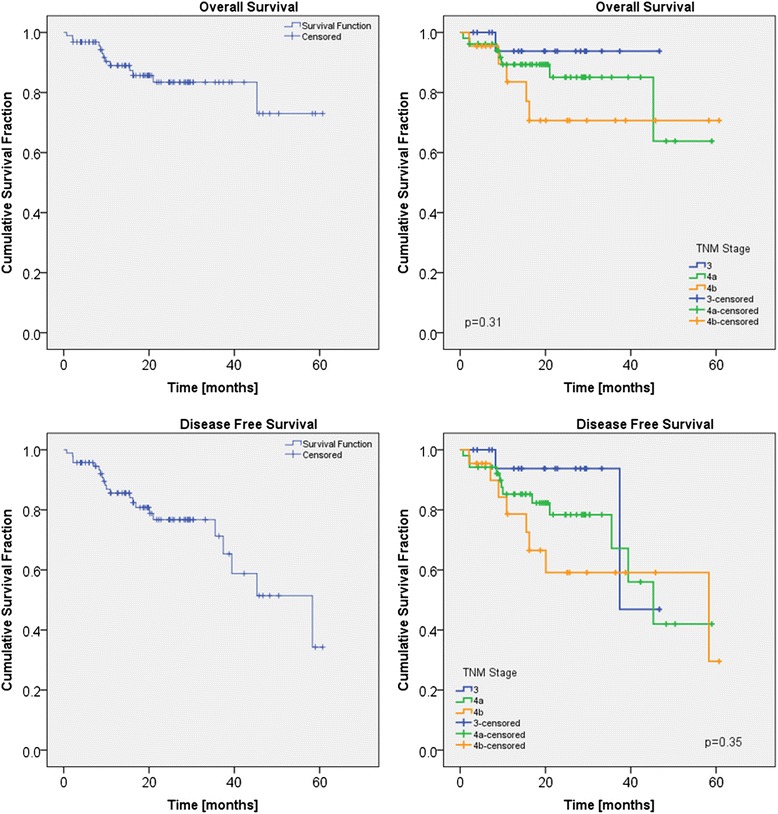
Results: Oral cavity V30Gy, V40Gy, and V70Gy, were found correlated with mucosal toxicity grading. Concerning salivary glands, significant was only D2/3V for one of the two parotids. Almost all analysed parameters of the inferior constrictor muscle were significant while no correlations were found for middle and superior constrictors. With median follow-up of 19 months, Overall Survival (OS) at 3 and 5 years was 83 % ± 4 % and 73 % ± 10 %. Mean OS was 51 ± 3 months. Disease Free Survival (DFS) at 3 and 5 years was 71 % ± 7 %, and 34 % ± 16 %. Mean DFS was 43 ± 3 months.
Conclusions: RapidArc technology and SIB with 1.65 and 2.12Gy/fraction for 33 fractions showed a good toxicity profile and encouraging trend for OS and DFS for patients with stage III-IV HNC.
Figures

References
-
- Fallai C, Giostra A, Olmi P, Orlandi E, Palazzi M, Pignoli E, et al. Radiobiological basis and clinical results of the simultaneous integrated boost (SIB) in intensity modulated radiotherapy (IMRT) for head and neck cancer: a review. Crit Rev Oncol Hematol. 2010;73:111. doi: 10.1016/j.critrevonc.2009.03.003. - DOI - PubMed
-
- Fogliata A, Ghosh-Laskar S, Agarwal JP, Vanetti E, Clivio A, Nicolini G, et al. Volumetric modulated arc radiotherapy for carcinomas of the oro-pharynx, hypo-pharynx and larynx: a treatment planning comparison with fixed field IMRT. Radiother Oncol. 2009;92:111–117. doi: 10.1016/j.radonc.2008.12.008. - DOI - PubMed
-
- Verbakel WF, Cuijpers JP, Hoffmans D, Bieker M, Slotman BJ, Senan S. Volumetric intensity-modulated arc therapy vs. conventional IMRT in head-and-neck cancer: a comparative planning and dosimetric study. Int J Radiat Oncol Biol Phys. 2009;74:252–259. doi: 10.1016/j.ijrobp.2008.12.033. - DOI - PubMed
-
- Liu T, Chen J, Gong G, Zhang G, Bai T, Sun T, et al. Radiation therapy for nasopharyngeal carcinoma using simultaneously integrated boost (SIB) protocol: a comparison planning study between intensity modulated arc radiotherapy vs. intensity modulated radiotherapy. Technol Cancer Res Treat. 2012;11:415–420. - PubMed
MeSH terms
LinkOut - more resources
Full Text Sources
Other Literature Sources
Medical
