


Small cell carcinoma of the ovary-hypercalcemic type (SCCOHT): A review of 47 cases
- PMID: 26546963
- PMCID: PMC5990049
- DOI: 10.1016/j.ygyno.2015.11.004
Small cell carcinoma of the ovary-hypercalcemic type (SCCOHT): A review of 47 cases
Abstract
Objective: Small cell carcinoma of the ovary-hypercalcemic type (SCCOHT) is a rare disease with a poor prognosis. SCCOHT has recently been shown to be associated with SMARCA4 gene mutations as well as molecular and genetic similarities to malignant rhabdoid tumors (MRT). The objective of our study is to describe the clinical characteristics, treatment modalities and outcomes of 47 patients with SCCOHT.
Methods: We performed a retrospective analysis of 47 patients with SCCOHT evaluated at MD Anderson Cancer Center between 1990 and 2014. Medical records were reviewed for demographic information, pathologic findings, treatment regimens and outcomes.
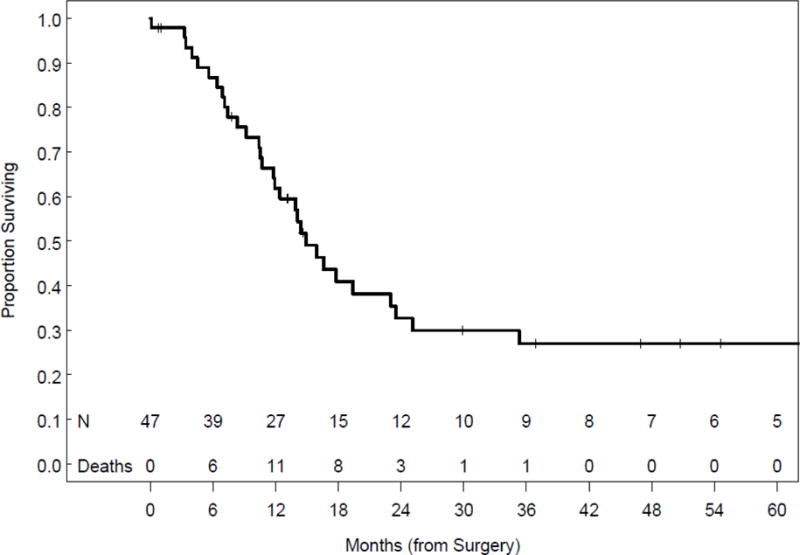
Results: Median age at diagnosis was 30 years (range 5-46). All patients underwent surgery with unilateral salpingo-oophorectomy (USO) performed in 26 patients (55%), and hysterectomy with bilateral salpingooophorectomy (BSO) in 21 patients (45%). Sixteen patients (34.0%) had stage I disease, six (12.8%) stage II, 23 (48.9%) stage III, and two patients (4.3%) had stage IV disease. Information on adjuvant treatment was available for 43 patients: 83.3% received chemotherapy alone, 9.5% chemotherapy followed by radiotherapy, 2.4% chemoradiation, and 4.8% did not receive any adjuvant therapy. Median follow-up was 13.2 months (range, 0.1 to 210.7) with a median overall survival of 14.9 months. Multi-agent chemotherapy and radiotherapy were associated with a better prognosis.
Conclusion: Our findings suggest that aggressive therapy including multi-agent chemotherapy and possibly radiotherapy may extend survival. Further study is needed to improve outcomes in these patients including the adoption of systemic therapies used in MRT as well as the development of novel agents targeting specific mutations.
Keywords: Hypercalcemic type; Malignant rhabdoid tumor; Radiotherapy; SMARCA4; Small cell carcinoma of the ovary; VPCBAE.
Copyright © 2015 Elsevier Inc. All rights reserved.
Conflict of interest statement
The authors declare that there are no conflicts of interest.
References
-
- Young RH, Oliva E, Scully RE. Small cell carcinoma of the ovary, hypercalcemic type. A clinicopathological analysis of 150 cases. Am J Surg Pathol. 1994;18:1102–16. - PubMed
-
- Estel R, Hackethal A, Kalder M, et al. Small cell carcinoma of the ovary of the hypercalcaemic type: an analysis of clinical and prognostic aspects of a rare disease on the basis of cases published in the literature. Arch Gynecol Obstet. 2011;284:1277–82. - PubMed
-
- Florell SR, Bruggers CS, Matlak M, et al. Ovarian small cell carcinoma of the hypercalcemic type in a 14 month old: the youngest reported case. Med Pediatr Oncol. 1999;32:304–7. - PubMed
-
- Shrimali RK, Correa PD, Reed NS. Dose-dense and dose-intense chemotherapy for small cell ovarian cancer: 2 cases and review of literature. Med Oncol. 2011;28:766– 70. - PubMed
-
- Dykgraaf RH, de Jong D, van Veen M, et al. Clinical management of ovarian small- cell carcinoma of the hypercalcemic type: a proposal for conservative surgery in an advanced stage of disease. Int J Gynecol Cancer. 2009;19:348–53. - PubMed
Publication types
MeSH terms
Grants and funding
LinkOut - more resources
Full Text Sources
Other Literature Sources
Medical
Miscellaneous
