


Trends in Coronary Atherosclerosis: A Tale of Two Population Subgroups
- PMID: 26551982
- PMCID: PMC4755914
- DOI: 10.1016/j.amjmed.2015.10.032
Trends in Coronary Atherosclerosis: A Tale of Two Population Subgroups
Abstract
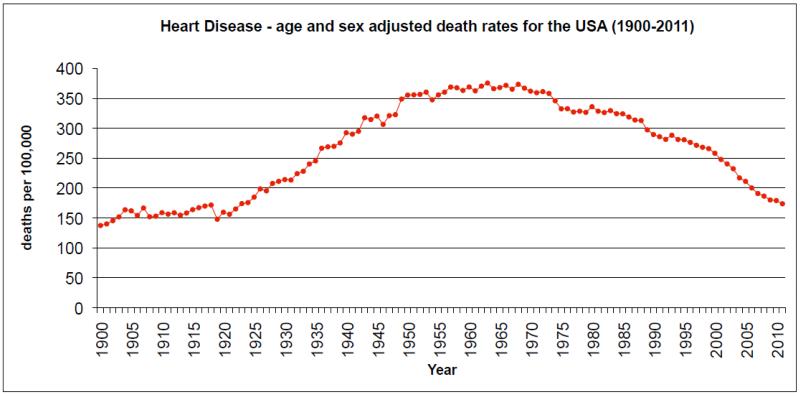
Background: We previously investigated trends in subclinical coronary artery disease and associated risk factors among autopsied non-elderly adults who died from nonnatural causes. Although grade of atherosclerosis declined from 1981 through 2009, the trend was nonlinear, ending in 1995, concurrent with increasing obesity/diabetes in this population. The previous study used linear regression and examined trends for all 4 major epicardial coronary arteries combined. The present investigation of coronary artery disease trends for the period 1995 through 2012 was prompted by a desire for more detailed examination of more recent coronary artery disease trends in light of reports that the epidemics of obesity and diabetes have slowed and are perhaps ending.
Methods: This population-based series of cross-sectional investigations identified all Olmsted County, Minnesota residents aged 16-64 years who died 1995 through 2012 (N = 2931). For decedents with nonnatural manner of death, pathology reports were reviewed for grade of atherosclerosis assigned each major epicardial coronary artery. Using logistic regression, we estimated calendar-year trends in grade (unadjusted and age- and sex-adjusted) for each artery, initially as an ordinal measure (range, 0-4); then, based on evidence of nonproportional odds, as a dichotomous variable (any atherosclerosis, yes/no) and as an ordinal measure for persons with atherosclerosis (range, 1-4).
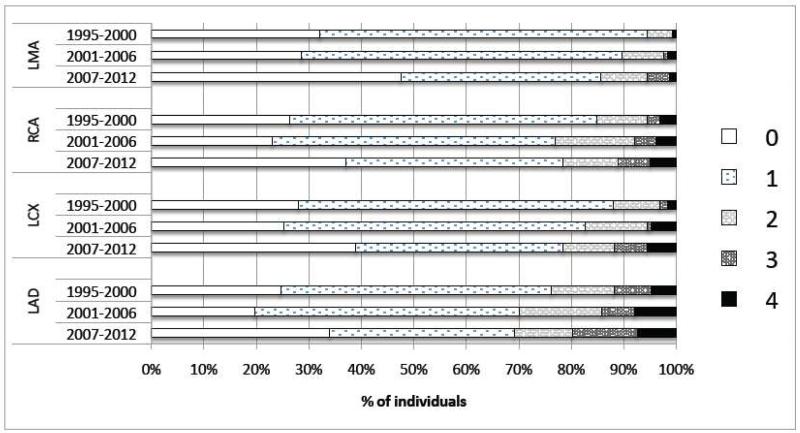
Results: Of 474 nonnatural deaths, 453 (96%) were autopsied; 426 (90%) had coronary stenosis graded. In the ordinal-logistic model for trends in coronary artery disease grade (range, 0-4), the proportional odds assumption did not hold. In subsequent analysis as a dichotomous outcome (grades 0 vs 1-4), each artery exhibited a significant temporal decline in the proportion with any atherosclerosis. Conversely, for subjects with coronary artery disease grade 1-4, age- and sex-adjusted ordinal regression revealed no change over time in 2 arteries and statistically significant temporal increases in severity in 2 arteries.
Conclusions: Findings suggest that efforts to prevent coronary artery disease onset have been relatively successful. However, statistically significant increases in the grade of atherosclerosis in 2 arteries among persons with coronary artery disease may be indicative of a major public health challenge.
Keywords: Atherosclerosis; Cardiovascular disease; Subclinical coronary artery disease; Time trends.
Copyright © 2016 Elsevier Inc. All rights reserved.
Figures
References
-
- National Center for Health Statistics . Age-adjusted death rates for selected causes, death registration states, 1900-32, and United States, 1933-1998. National Center for Health Statistics. National Vital Statistics System; Hyattsville, MD: [Accessed May 5, 2015]. http://www.cdc.gov/nchs/nvss/mortality/hist293.htm.
-
- National Center for Health Statistics. National Vital Statistics Reports . Deaths: Final Data. Miscellaneous years, 1999-2010. National Center for Health Statistics; Hyattsville, MD:
-
- National Center for Health Statistics . National Vital Statistics Report (NVSR) Deaths: Final Data for 2011. 3. Vol. 63. National Center for Health Statistics; Hyattsville, MD: [Accessed May 5, 2015]. http://www.cdc.gov/nchs/data_access/Vitalstatsonline.htm.
-
- Towfighi A, Markovic D, Ovbiagele B. National gender-specific trends in myocardial infarction hospitalization rates among patients aged 35 to 64 years. Am J Cardiol. 2011;108:1102–1107. - PubMed
-
- Arciero TJ, Jacobsen SJ, Reeder GS, et al. Temporal trends in the incidence of coronary disease. Am J Med. 2004;117(4):228–33. - PubMed
Publication types
MeSH terms
Grants and funding
LinkOut - more resources
Full Text Sources
Other Literature Sources
Medical
