


Ketamine for prehospital trauma analgesia in a low-resource rural trauma system: a retrospective comparative study of ketamine and opioid analgesia in a ten-year cohort in Iraq
- PMID: 26552691
- PMCID: PMC4640304
- DOI: 10.1186/s13049-015-0176-1
Ketamine for prehospital trauma analgesia in a low-resource rural trauma system: a retrospective comparative study of ketamine and opioid analgesia in a ten-year cohort in Iraq
Abstract
Background: Opioid analgesics are used in most trauma systems, and only a few studies report on the use of ketamine for prehospital analgesia. In a low-cost rural trauma system in Iraq paramedics have been using prehospital ketamine analgesia for ten years. This study aims to evaluate the effects of prehospital analgesia on physiologic trauma severity indicators and compare the effect of ketamine and pentazocine on those indicators.
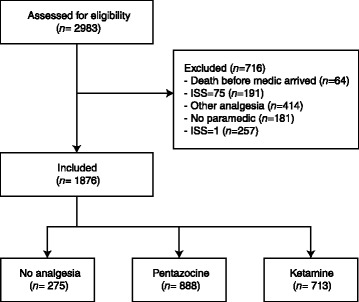
Methods: The investigation was conducted as a retrospective cohort study with parallel group design. Three subsamples of trauma patients were compared: no analgesia (n = 275), pentazocine analgesia (n = 888), and ketamine analgesia (n = 713). Physiologic severity scores were calculated based on rated values for respiratory rate, blood pressure, and consciousness. The associations between outcomes and explanatory variables were assessed using a generalized linear model.
Results: Paramedic administration of analgesia was associated with a better physiologic severity score (PSS) outcome (p = 0.01). In the two subsamples receiving analgesia significantly better outcomes were observed for respiration (p < 0.0001) and systolic blood pressure (p < 0.0001). In patients with Injury Severity Score >8 ketamine was associated with a significantly better effect on the systolic blood pressure compared to opioid analgesia (p = 0.03).
Conclusion: Prehospital analgesia for trauma victims improves physiologic severity indicators in a low-resource trauma system. Compared to pentazocine, ketamine was associated with improved blood pressure for patients with serious injuries. In a low-resource setting, ketamine seems to be a good choice for prehospital analgesia in trauma patients.
References
-
- Nanayakkara B. Maintenance of oxygenation during total intravenous anaesthesia with ketamine while breathing air. Ceylon Med J. 1994;39(4):160–162. - PubMed
-
- Tran KP, Nguyen Q, Truong XN, Le V, Le VP, Mai N, Husum H, Losvik OK. A comparison of ketamine and morphine analgesia in prehospital trauma care: a cluster randomized clinical trial in rural Quang Tri province, Vietnam. Prehosp Emerg Care. 2014;18:257–264. doi: 10.3109/10903127.2013.851307. - DOI - PubMed
Publication types
MeSH terms
Substances
LinkOut - more resources
Full Text Sources
Other Literature Sources
Medical
