


Improving rates of maternal immunization: Challenges and opportunities
- PMID: 26552807
- PMCID: PMC4962946
- DOI: 10.1080/21645515.2015.1101524
Improving rates of maternal immunization: Challenges and opportunities
Abstract
Objectives: An increasing number of vaccines are recommended or are being developed for use during pregnancy to protect women, fetuses, and/or newborns. For vaccines that are already recommended, vaccine uptake is variable and well below desired target. We reviewed the literature related to factors that affect a healthcare provider's recommendation and a woman's willingness to be vaccinated during pregnancy.
Design: A scoping review of published literature from 2005 to 2015 was undertaken and all relevant articles were abstracted, summarized, and organized thematically.
Results: Barriers and facilitators were identified that either decreased or increased the likelihood of a healthcare provider offering and a pregnant woman accepting vaccination during pregnancy. Concern about the safety of vaccines given during pregnancy was the most often cited barrier among both the public and healthcare providers. Other barriers included doubt about the effectiveness of the vaccine, lack of knowledge about the burden of disease, and not feeling oneself to be at risk of the infection. Major facilitators for maternal immunization included specific safety information about the vaccine in pregnant women, strong national recommendations, and healthcare providers who both recommended and provided the vaccine to their patients. Systems barriers such as inadequate facilities and staffing, vaccine purchase and storage, and reimbursement for vaccination were also cited. Evidence-based interventions were few, and included text messaging reminders, chart reminders, and standing orders.
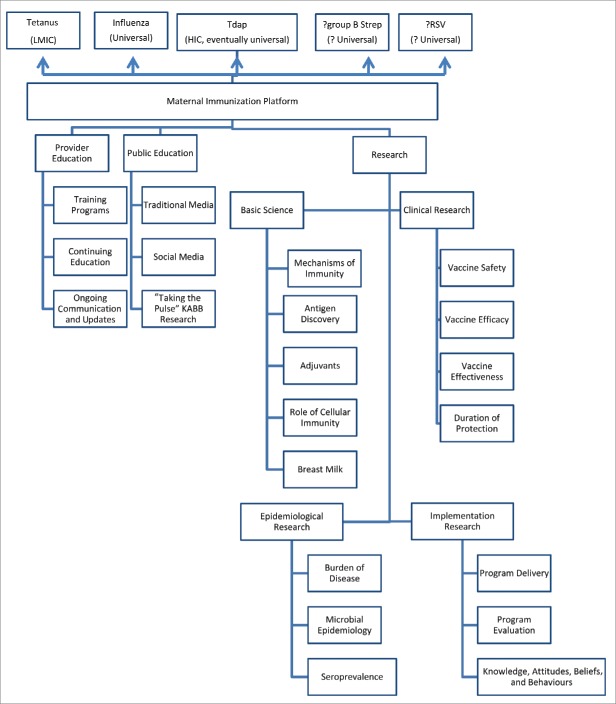
Conclusions: In order to have an effective vaccination program, improvements in the uptake of recommended vaccines during pregnancy are needed. A maternal immunization platform is required that normalizes vaccination practice among obstetrical care providers and is supported by basic and continuing education, communication strategy, and a broad range of research.
Keywords: Barriers; maternal immunization; opportunities.
Figures
References
-
- Lichty JA, Slavin B, Bradford WL. An attempt to increase resistance to pertussis in newborn infants by immunizing their mothers during pregnancy. J Clin Invest 1938; 17(5):613-21; PMID:16694606; http://dx.doi.org/ 10.1172/JCI100987 - DOI - PMC - PubMed
-
- Adams JM, Kimball AC, Adams FH. Early immunization against pertussis. Am J Dis Child 1947; 74(1):10-8; PMID:20258316; http://dx.doi.org/ 10.1001/archpedi.1947.02030010017002 - DOI - PubMed
-
- Cohen P, Schneck H, Dubow E. Prenatal multiple immunization. J Pediatr 1951; 38(6):696-704; PMID:14841572; http://dx.doi.org/ 10.1016/S0022-3476(51)80131-8 - DOI - PubMed
-
- Schofield FD, Tucker VM, Westbrook GR. Neonatal tetanus in New Guinea. Effect of active immunization in pregnancy. Br Med J 1961; 2(5255):785-9; PMID:13748431; http://dx.doi.org/ 10.1136/bmj.2.5255.785 - DOI - PMC - PubMed
MeSH terms
Substances
LinkOut - more resources
Full Text Sources
Other Literature Sources
Medical
