


Inhibition of Calcium-Dependent Protein Kinase 1 (CDPK1) In Vitro by Pyrazolopyrimidine Derivatives Does Not Correlate with Sensitivity of Cryptosporidium parvum Growth in Cell Culture
- PMID: 26552986
- PMCID: PMC4704151
- DOI: 10.1128/AAC.01915-15
Inhibition of Calcium-Dependent Protein Kinase 1 (CDPK1) In Vitro by Pyrazolopyrimidine Derivatives Does Not Correlate with Sensitivity of Cryptosporidium parvum Growth in Cell Culture
Abstract
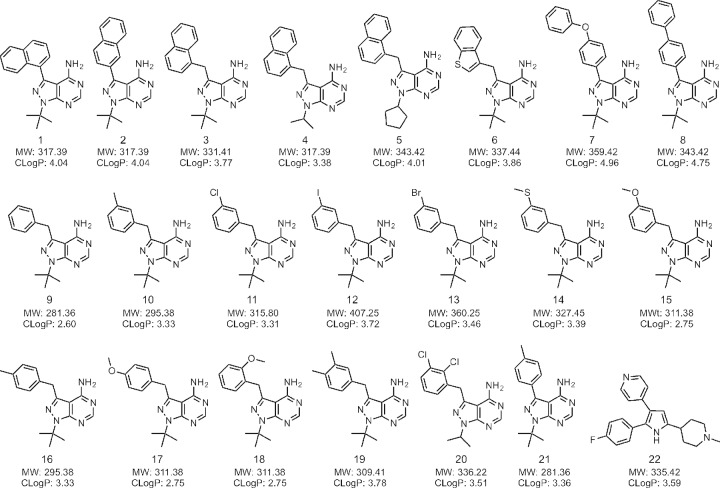
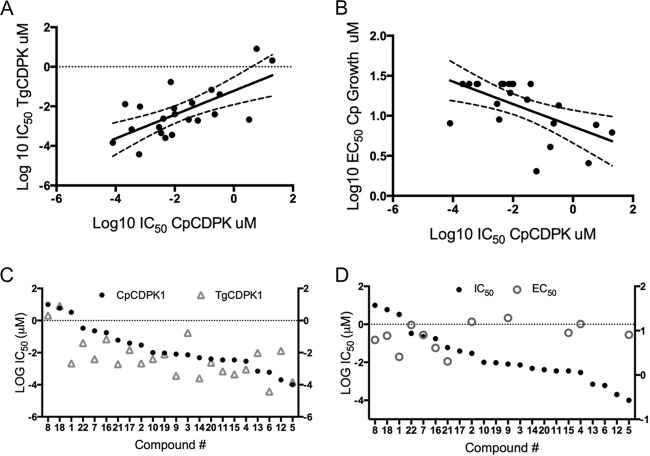
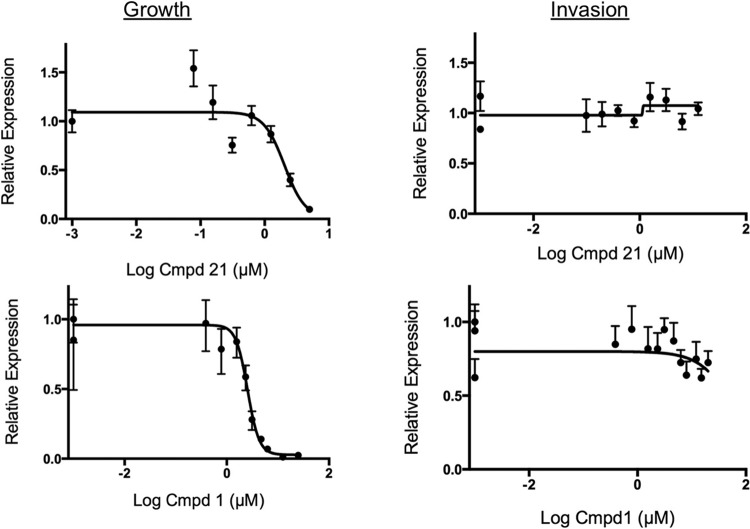
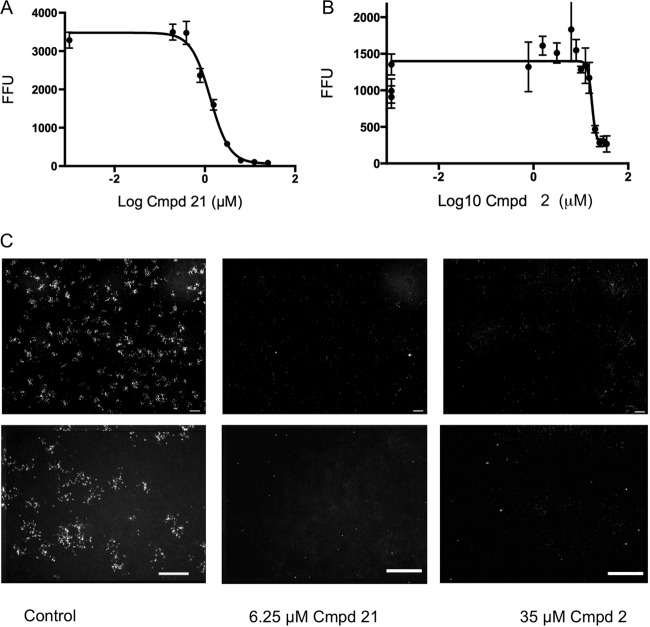
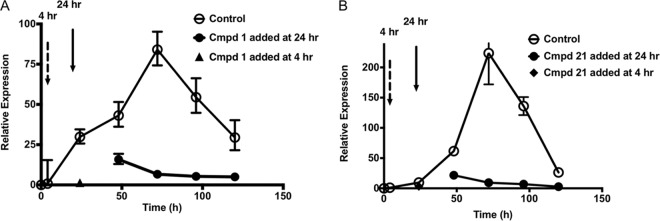
Cryptosporidiosis is a serious diarrheal disease in immunocompromised patients and malnourished children, and treatment is complicated by a lack of adequate drugs. Recent studies suggest that the natural occurrence of a small gatekeeper residue in serine threonine calcium-dependent protein kinase 1 (CDPK1) of Cryptosporidium parvum might be exploited to target this enzyme and block parasite growth. Here were explored the potency with which a series of pyrazolopyrimidine analogs, which are selective for small gatekeeper kinases, inhibit C. parvum CDPK1 and block C. parvum growth in tissue culture in vitro. Although these compounds potently inhibited kinase activity in vitro, most had no effect on parasite growth. Moreover, among those that were active against parasite growth, there was a very poor correlation with their 50% inhibitory concentrations against the enzyme. Active compounds also had no effect on cell invasion, unlike the situation in Toxoplasma gondii, where these compounds block CDPK1, prevent microneme secretion, and disrupt cell invasion. These findings suggest that CPDK1 is not essential for C. parvum host cell invasion or growth and therefore that it is not the optimal target for therapeutic intervention. Nonetheless, several inhibitors with low micromolar 50% effective concentrations were identified, and these may affect other essential targets in C. parvum that are worthy of further exploration.
Copyright © 2015, American Society for Microbiology. All Rights Reserved.
Figures
References
-
- Checkley W, White AC Jr, Jaganath D, Arrowood MJ, Chalmers RM, Chen XM, Fayer R, Griffiths JK, Guerrant RL, Hedstrom L, Huston CD, Kotloff KL, Kang G, Mead JR, Miller M, Petri WA Jr, Priest JW, Roos DS, Striepen B, Thompson RC, Ward HD, Van Voorhis WA, Xiao L, Zhu G, Houpt ER. 2015. A review of the global burden, novel diagnostics, therapeutics, and vaccine targets for cryptosporidium. Lancet Infect Dis 15:85–94. doi: 10.1016/S1473-3099(14)70772-8. - DOI - PMC - PubMed
-
- Kotloff KL, Nataro JP, Blackwelder WC, Nasrin D, Farag TH, Panchalingam S, Wu Y, Sow SO, Sur D, Breiman RF, Faruque AS, Zaidi AK, Saha D, Alonso PL, Tamboura B, Sanogo D, Onwuchekwa U, Manna B, Ramamurthy T, Kanungo S, Ochieng JB, Omore R, Oundo JO, Hossain A, Das SK, Ahmed S, Qureshi S, Quadri F, Adegbola RA, Antonio M, Hossain MJ, Akinsola A, Mandomando I, Nhampossa T, Acacio S, Biswas K, O'Reilly CE, Mintz ED, Berkeley LY, Muhsen K, Sommerfelt H, Robins-Browne RM, Levine MM. 2013. Burden and aetiology of diarrhoeal disease in infants and young children in developing countries (the Global Enteric Multicenter Study, GEMS): a prospective, case-control study. Lancet 382:209–222. doi: 10.1016/S0140-6736(13)60844-2. - DOI - PubMed
-
- Barta JR, Thompson RC. 2006. What is Cryptosporidium? Reappraising its biology and phylogenetic affinities. Trends Parasitol 22:463–468. - PubMed
Publication types
MeSH terms
Substances
Grants and funding
LinkOut - more resources
Full Text Sources
Other Literature Sources
