. 2016 Jan 8;291(2):630-9.
doi: 10.1074/jbc.M115.671545. Epub 2015 Nov 10.

Structure of UBE2Z Enzyme Provides Functional Insight into Specificity in the FAT10 Protein Conjugation Machinery

Affiliations

Structure of UBE2Z Enzyme Provides Functional Insight into Specificity in the FAT10 Protein Conjugation Machinery

Julien Schelpe et al. J Biol Chem. .

Abstract

FAT10 conjugation, a post-translational modification analogous to ubiquitination, specifically requires UBA6 and UBE2Z as its activating (E1) and conjugating (E2) enzymes. Interestingly, these enzymes can also function in ubiquitination. We have determined the crystal structure of UBE2Z and report how the different domains of this E2 enzyme are organized. We further combine our structural data with mutational analyses to understand how specificity is achieved in the FAT10 conjugation pathway. We show that specificity toward UBA6 and UBE2Z lies within the C-terminal CYCI tetrapeptide in FAT10. We also demonstrate that this motif slows down transfer rates for FAT10 from UBA6 onto UBE2Z.

Keywords: FAT10; UBE2Z; UBL conjugation; crystal structure; post-translational modification (PTM); ubiquitin; ubiquitin-conjugating enzyme (E2 enzyme); ubiquitylation (ubiquitination).


Figures

FIGURE 1.
FIGURE 1.
Structural organization of UBE2Z. A, schematic view of E2 enzyme constructs. The core UBC domain is colored in blue, N-terminal extensions are in silicon, and C-terminal extensions are in orange. Construct boundaries as well as the positions for loops LA, LB, LC, and LD are indicated. B, sequence alignment between UBE2Z, BIRC6 and UBE2D3. Residues are colored according to the ClustalX coloring scheme. The secondary structure of UBE2Z, calculated using DSSP, is indicated above the alignment. C, schematic view of the structure of UBE2Z with a similar color scheme as in A. Two orientations are presented corresponding to a 180° rotation around the y axis. The N-terminal extension (residues 1–99) is not visible in this structure and is represented as a dotted line. The catalytic Cys-188 residue is represented as sticks.
FIGURE 2.
FIGURE 2.
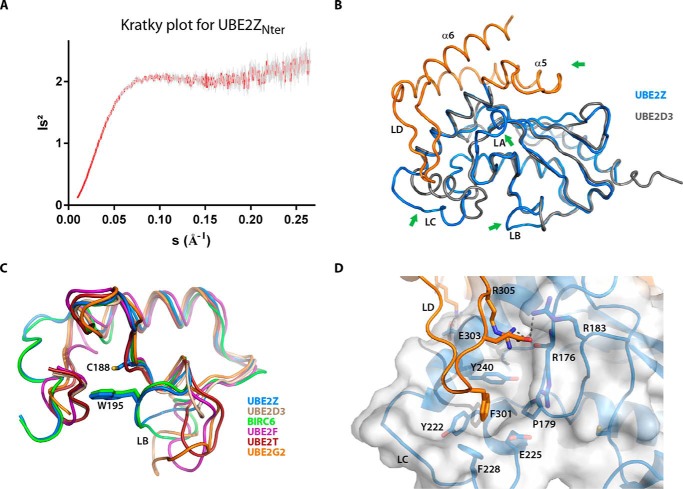
Analysis of UBE2Z loop regions and N-terminal extension. A, Kratky plot (Is2 v/s s) for small angle x-ray scattering data acquired on UBE2ZNter (residues 1–93) indicating that the protein is unfolded. Data points are in red, and error bars are in gray. B, superposition of UBE2D3 lacking a C-terminal extension (gray) on UBE2Z (colored blue for its core UBC domain and orange for its C-terminal extension). Divergence between the structures for the two proteins is indicated by green arrows. C, close-up schematic view of the UBE2Z LB loop region (blue), with the catalytic Cys-188 and LB loop Trp-195 shown as sticks. The superposition of E2 enzymes UBE2D3, BIRC6, UBE2F, UBE2T, and UBE2G2 (PDB codes 1X23, 3CEG, 3FN1, 4CCG, and 2CYX, respectively) on UBE2Z is also represented. BIRC6 Trp-4645 corresponding to UBE2Z Trp-195 is shown as sticks. D, schematic representation for the interaction between UBE2Z C-terminal extension loop LD (orange) and the UBE2Z core UBC domain (blue). The surface of the UBC domain is represented in transparency, and residues involved in the interaction with tip of loop LD are shown as sticks.
FIGURE 3.
FIGURE 3.
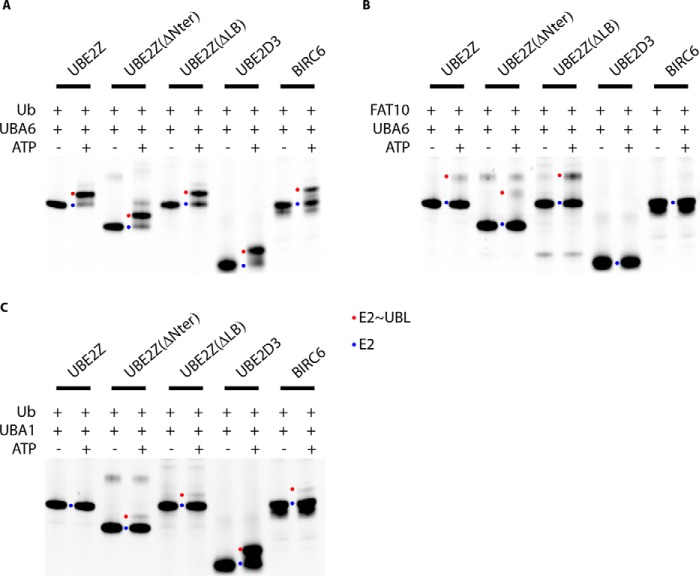
Specificity in UBL charging on E2 variants. E2-loading assays are represented using UBA6 and ubiquitin (A) or FAT10 (B) and using UBA1 and ubiquitin (C). Each assay was performed without or with ATP, and uncharged E2s are indicated with a blue dot, whereas UBL-loaded E2s are indicated with a red dot. Cy5-labeled E2 variants were used in this assay and specifically allow visualization of the unloaded and loaded E2s under non-reducing conditions.
FIGURE 4.
FIGURE 4.
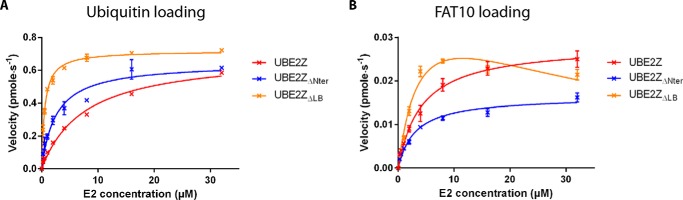
Enzyme kinetics for UBL loading on UBE2Z variants. Fits of kinetic data for E2-thioester formation assays are shown for UBE2Z (red), UBE2ZΔNter (blue), and UBE2ZΔLB (orange) variants using ubiquitin (A) or FAT10 (B) and UBA6 as the E1 enzyme.
FIGURE 5.
FIGURE 5.
Specificity toward E1 and E2 enzymes lies in the UBL C-terminal tail. A, sequence alignment between the C-terminal residues of ubiquitin, NEDD8, ISG15, and FAT10. Sequence limits are indicated for each protein. The C-terminal LXLR motif is highlighted by a red rectangle. Residues are colored according to conservation, with dark blue-colored residues highly conserved. B, Coomassie stained gel showing E1 charging of UBA1 (left) and UBA6 (right) by different UBL variants as indicated under non-reducing conditions. Asterisks (*) indicate nonspecific bands likely corresponding to disulfide-bridged E1-UBL complexes. Unloaded E1s are indicated with a purple dot, whereas UBL-loaded E1s are indicated with a green dot. Bands above those corresponding to the UBL-loaded E1s likely correspond to the auto-ubiquitinated or auto-fatylated species of the E1 enzyme as applicable. C, E2 loading assays using FAT10LRLR and UBA6 on different E2 variants. Cy5-labeled E2 variants were used in this assay and specifically allow visualization of the unloaded (blue dots) and loaded E2s (red dots) under non-reducing conditions.
FIGURE 6.
FIGURE 6.
Enzyme kinetics for loading of UBL variants on UBE2Z. A, Michaelis-Menten fits for E2-thioester formation assays are shown for ubiquitin (red), FAT10 (blue), and UbCYCI (purple) on UBE2Z and for FAT10LRLR and on UBE2Z (green). B, the expanded view of fits for FAT10 and UbCYCI loading onto UBE2Z are shown in the same colors as previously. C, histogram summarizing kinetic parameters apparent Km and apparent Vmax for the loading of different UBL and UBL mutants onto UBE2Z variants.

References

    1. Liu Y. C., Pan J., Zhang C., Fan W., Collinge M., Bender J. R., and Weissman S. M. (1999) A MHC-encoded ubiquitin-like protein (FAT10) binds noncovalently to the spindle assembly checkpoint protein MAD2. Proc. Natl. Acad. Sci. U.S.A. 96, 4313–4318 - PMC - PubMed
    1. Raasi S., Schmidtke G., and Groettrup M. (2001) The ubiquitin-like protein FAT10 forms covalent conjugates and induces apoptosis. J. Biol. Chem. 276, 35334–35343 - PubMed
    1. van der Veen A. G., and Ploegh H. L. (2012) Ubiquitin-like proteins. Annu. Rev. Biochem. 81, 323–357 - PubMed
    1. Pelzer C., and Groettrup M. (2010) FAT10: activated by UBA6 and functioning in protein degradation. Subcell. Biochem. 54, 238–246 - PubMed
    1. Schmidtke G., Aichem A., and Groettrup M. (2014) FAT10ylation as a signal for proteasomal degradation. Biochim. Biophys. Acta 1843, 97–102 - PubMed

Publication types

MeSH terms