Review
. 2014:2014:487903.
doi: 10.1155/2014/487903. Epub 2014 Jun 15.

Treatment Alternatives to Negotiate Peri-Implantitis

Affiliations
Review

Treatment Alternatives to Negotiate Peri-Implantitis

Eli E Machtei. Adv Med. 2014.

Abstract

Peri-implant diseases are becoming a major health issue in dentistry. Despite the magnitude of this problem and the potential grave consequences, commonly acceptable treatment protocols are missing. Hence, the present paper reviews the literature treatment of peri-implantitis in order to explore their benefits and limitations. Treatment of peri-implantitis may include surgical and nonsurgical approaches, either individually or combined. Nonsurgical therapy is aimed at removing local irritants from the implants' surface with or without surface decontamination and possibly some additional adjunctive therapies agents or devices. Systemic antibiotics may also be incorporated. Surgical therapy is aimed at removing any residual subgingival deposits and additionally reducing the peri-implant pockets depth. This can be done alone or in conjunction with either osseous respective approach or regenerative approach. Finally, if all fails, explantation might be the best alternative in order to arrest the destruction of the osseous structure around the implant, thus preserving whatever is left in this site for future reconstruction. The available literature is still lacking with large heterogeneity in the clinical response thus suggesting possible underlying predisposing conditions that are not all clear to us. Therefore, at present time treatment of peri-implantitis should be considered possible but not necessarily predictable.


Figures
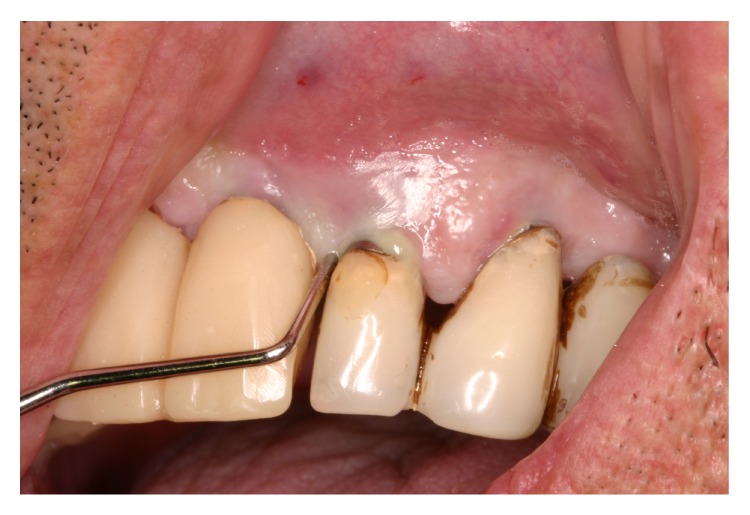
Figure 1
Figure 1
Peri-implantitis with suppuration.
Figure 2
Figure 2
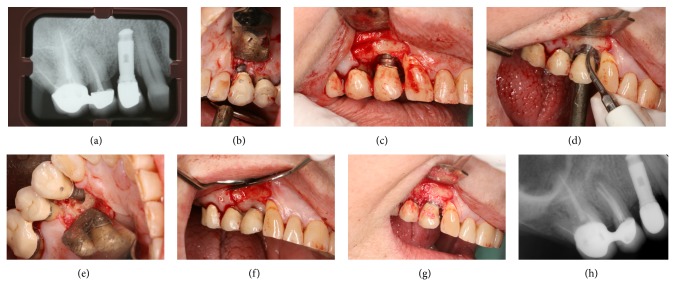
Treatment of peri-implantitis using a regenerative approach. (a) Preop, note the severe bone loss on implant at position #14. (b) Upon reflection of the flaps, note the granulation tissue but also excess cementum on the crown's margin. (c) Following degranulation, demonstrating the extent of bone loss. (d) Excess cement was removed and the implant surface was debrided using hand instruments and ultrasonic scaler. (e) Decortication was performed using diamond burs. (f) Surface decontamination was supplemented with the application of 24% EDTA for 3 minutes. (g) The defect was grafted with bovine derived Xenograft (BioOss). (h) 3 years later, complete resolution of the radiographic defect is evident.
Figure 3
Figure 3
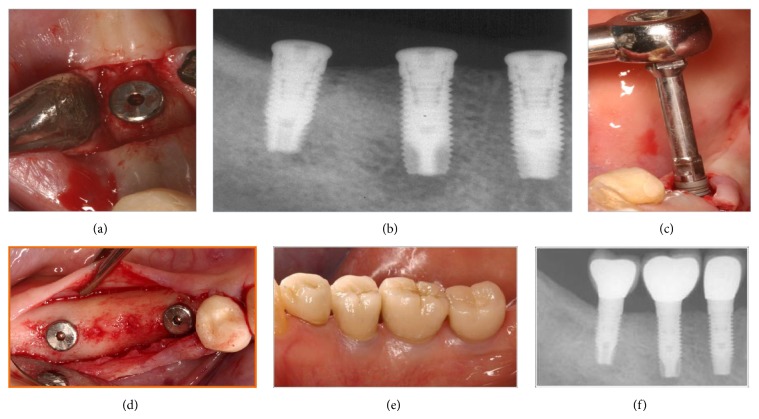
Explantation of dental implant.

References

    1. http://www.idataresearch.com/research-categories/dental/dental-implants-...
    1. Zitzmann N. U., Berglundh T. Definition and prevalence of peri-implant diseases. Journal of Clinical Periodontology. 2008;35(8, supplement):286–291. doi: 10.1111/j.1600-051X.2008.01274.x. - DOI - PubMed
    1. Mombelli A., Müller N., Cionca N. The epidemiology of peri-implantitis. Clinical Oral Implants Research. 2012;23(supplement 6):67–76. doi: 10.1111/j.1600-0501.2012.02541.x. - DOI - PubMed
    1. Atieh M. A., Alsabeeha N. H., Faggion C. M., Jr., Duncan W. J. The frequency of peri-implant diseases: a systematic review and meta-analysis. Journal of Periodontology. 2013;84(11):1586–1598. doi: 10.1902/jop.2012.120592. - DOI - PubMed
    1. Rinke S., Ohl S., Ziebolz D., Lange K., Eickholz P. Prevalence of periimplant disease in partially edentulous patients: a practice-based cross-sectional study. Clinical Oral Implants Research. 2011;22(8):826–833. doi: 10.1111/j.1600-0501.2010.02061.x. - DOI - PubMed

LinkOut - more resources