


Aerobic scope explains individual variation in feeding capacity
- PMID: 26556902
- PMCID: PMC4685545
- DOI: 10.1098/rsbl.2015.0793
Aerobic scope explains individual variation in feeding capacity
Abstract
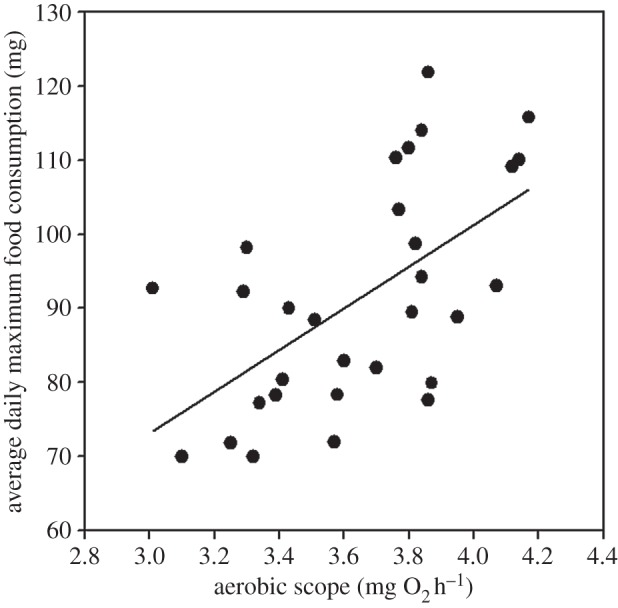
Links between metabolism and components of fitness such as growth, reproduction and survival can depend on food availability. A high standard metabolic rate (SMR; baseline energy expenditure) or aerobic scope (AS; the difference between an individual's maximum and SMR) is often beneficial when food is abundant or easily accessible but can be less important or even disadvantageous when food levels decline. While the mechanisms underlying these context-dependent associations are not well understood, they suggest that individuals with a higher SMR or AS are better able to take advantage of high food abundance. Here we show that juvenile brown trout (Salmo trutta) with a higher AS were able to consume more food per day relative to individuals with a lower AS. These results help explain why a high aerobic capacity can improve performance measures such as growth rate at high but not low levels of food availability.
Keywords: Salmo trutta; energy metabolism; fitness; food intake; maximum metabolic rate; standard metabolic rate.
© 2015 The Authors.
Figures
References
-
- Auer SK, Salin K, Rudolf AM, Anderson GJ, Metcalfe NB. 2015. The optimal combination of standard metabolic rate and aerobic scope for somatic growth depends on food availability. Funct. Ecol. 29, 479–486. ( 10.1111/1365-2435.12396) - DOI
-
- Reidy S, Kerr S, Nelson J. 2000. Aerobic and anaerobic swimming performance of individual Atlantic cod. J. Exp. Biol. 203, 347–357. - PubMed
Publication types
MeSH terms
LinkOut - more resources
Full Text Sources
Other Literature Sources
Research Materials
