. 2015 Oct 12:9:263.
doi: 10.3389/fnbeh.2015.00263. eCollection 2015.

Infant attachment predicts bodily freezing in adolescence: evidence from a prospective longitudinal study

Affiliations

Infant attachment predicts bodily freezing in adolescence: evidence from a prospective longitudinal study

Hannah C M Niermann et al. Front Behav Neurosci. .

Abstract

Early life-stress, particularly maternal deprivation, is associated with long-lasting deviations in animals' freezing responses. Given the relevance of freezing for stress-coping, translational research is needed to examine the relation between insecure infant-parent attachment and bodily freezing-like behavior in humans. Therefore, we investigated threat-related reductions in body sway (indicative of freezing-like behavior) in 14-year-old adolescents (N = 79), for whom attachment security was earlier assessed in infancy. As expected, insecure (vs. secure) attachment was associated with less body sway for angry vs. neutral faces. This effect remained when controlling for intermediate life events. These results suggest that the long-lasting effects of early negative caregiving experiences on the human stress and threat systems extend to the primary defensive reaction of freezing. Additionally, we replicated earlier work in adults, by observing a significant correlation (in adolescents assessed as securely attached) between subjective state anxiety and reduced body sway in response to angry vs. neutral faces. Together, this research opens venues to start exploring the role of freezing in the development of human psychopathology.

Keywords: adolescent; attachment; freezing; infant; longitudinal.


Figures
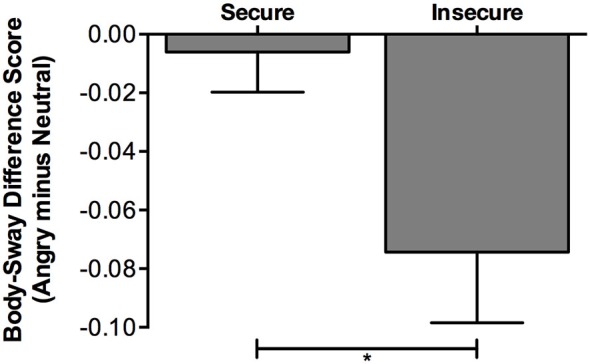
Figure 1
Figure 1
Differences in log-transformed body-sway variability while viewing angry compared to neutral faces, separately for insecurely and securely attached participants. Body sway is expressed in standard deviation from participants’ center-of-pressure (COP) in the anterior-posterior direction (SD-AP). Larger negative difference scores (SD-AP for angry faces minus SD-AP for neutral faces) reflect stronger freezing-like reactions in response to angry compared to neutral faces. Error bars represent standard errors. *p < 0.05; Secure: 95% CI [−0.03, 0.02]; Insecure: 95% CI [−0.12, −0.03].
Figure 2
Figure 2
The scatter plot (with best-fitting regression line) illustrates the correlation between change in heart rate variability (in beats per minute) and change in body-sway variability (in mm) while participants viewed angry compared to neutral faces. Change in heart rate variability was calculated by subtracting heart rate of the neutral-faces block from the same measure of the angry-faces block. The same calculation was applied to conduct body-sway variability.
Figure 3
Figure 3
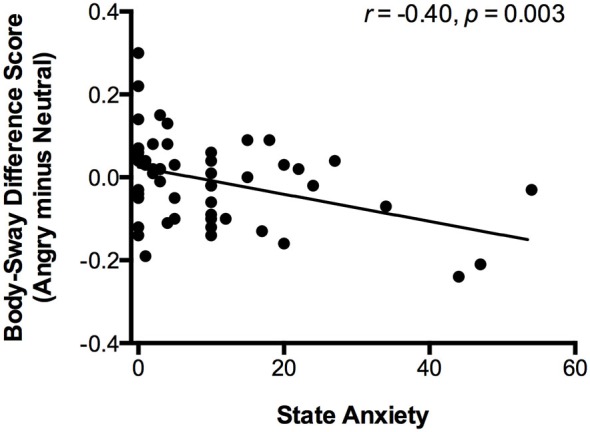
The scatter plot (with best-fitting regression line) shows the correlation between state anxiety and change in body-sway variability (in mm) of angry vs. neutral faces. Change in body-sway variability was calculated by subtracting log-transformed body sway of the neutral-faces block from log-transformed body sway of the angry-faces block.

References

    1. Abela J. R. Z. (2001). The hopelessness theory of depression: a test of the diathesis-stress and causal mediation components in third and seventh grade children. J. Abnorm. Child Psychol. 29, 241–254. 10.1023/A:1010333815728 - DOI - PubMed
    1. Ainsworth M. D. S., Blehar M. C., Waters E., Wall S. (1978). Patterns of Attachment: A Psychological Study of the Strange Situation. Hillsdale, NJ: Erlbaum.
    1. Anokhin A. P., Golosheykin S. (2010). Startle modulation by affective faces. Biol. Psychol. 83, 37–40. 10.1016/j.biopsycho.2009.10.001 - DOI - PMC - PubMed
    1. Azevedo T. M., Volchan E., Imbiriba L. A., Rodrigues E. C., Oliveira J. M., Oliveira L. F., et al. . (2005). A freezing-like posture to pictures of mutilation. Psychophysiology 42, 255–260. 10.1111/j.1469-8986.2005.00287.x - DOI - PubMed
    1. Blanchard R. J., Flannelly K. J., Blanchard D. C. (1986). Defensive behavior of laboratory and wild rattus norvegicus. J. Comp. Psychol. 100, 101–107. 10.1037/0735-7036.100.2.101 - DOI - PubMed