


Prevalence of eosinophilic oesophagitis in adults presenting with oesophageal food bolus obstruction
- PMID: 26558158
- PMCID: PMC4635164
- DOI: 10.4292/wjgpt.v6.i4.244
Prevalence of eosinophilic oesophagitis in adults presenting with oesophageal food bolus obstruction
Abstract
Aim: To look at the relationship between eosinophilic oesophagitis (EO) and food bolus impaction in adults.
Methods: We retrospectively analysed medical records of 100 consecutive patients who presented to our hospital with oesophageal food bolus obstruction (FBO) between 2012 and 2014. In this cohort, 96 were adults (64% male), and 4 paediatric patients were excluded from the analysis as our centre did not have paediatric gastroenterologists. Eighty-five adult patients underwent emergency gastroscopy. The food bolus was either advanced into the stomach using the push technique or retrieved using a standard retrieval net. Biopsies were obtained in 51 patients from the proximal and distal parts of the oesophagus at initial gastroscopy. All biopsy specimens were assessed and reviewed by dedicated gastrointestinal pathologists at the Department of Pathology, University Hospital Geelong. The diagnosis of EO was defined and established by the presence of the following histological features: (1) peak eosinophil counts > 20/hpf; (2) eosinophil microabscess; (3) superficial layering of eosinophils; (4) extracellular eosinophil granules; (5) basal cell hyperplasia; (6) dilated intercellular spaces; and (7) subepithelial or lamina propria fibrosis. The histology results of the biopsy specimens were accessed from the pathology database of the hospital and recorded for analysis.
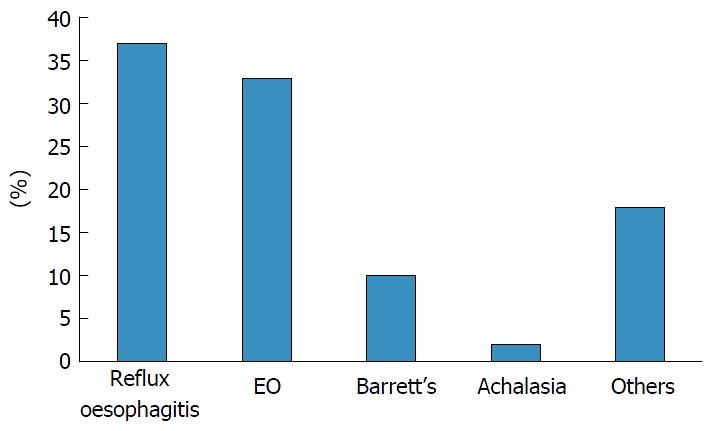
Results: Our cohort had a median age of 60. Seventeen/51 (33%) patients had evidence of EO on biopsy findings. The majority of patients with EO were male (71%). Classical endoscopic features of oesophageal rings, furrows or white plaques and exudates were found in 59% of patients with EO. Previous episodes of FBO were present in 12/17 patients and 41% had a history of eczema, hay fever or asthma. Reflux oesophagitis and benign strictures were found in 20/34 patients who did not have biopsies.
Conclusion: EO is present in approximately one third of patients who are admitted with FBO. Biopsies should be performed routinely at index endoscopy in order to pursue this treatable cause of long term morbidity.
Keywords: Dysphagia; Endoscopy; Eosinophilia; Food bolus obstruction; Oesophagitis.
Figures
References
-
- Kerlin P, Jones D, Remedios M, Campbell C. Prevalence of eosinophilic esophagitis in adults with food bolus obstruction of the esophagus. J Clin Gastroenterol. 2007;41:356–361. - PubMed
-
- Chauvin A, Viala J, Marteau P, Hermann P, Dray X. Management and endoscopic techniques for digestive foreign body and food bolus impaction. Dig Liver Dis. 2013;45:529–542. - PubMed
-
- Ikenberry SO, Jue TL, Anderson MA, Appalaneni V, Banerjee S, Ben-Menachem T, Decker GA, Fanelli RD, Fisher LR, Fukami N, et al. Management of ingested foreign bodies and food impactions. Gastrointest Endosc. 2011;73:1085–1091. - PubMed
-
- Desai TK, Stecevic V, Chang CH, Goldstein NS, Badizadegan K, Furuta GT. Association of eosinophilic inflammation with esophageal food impaction in adults. Gastrointest Endosc. 2005;61:795–801. - PubMed
LinkOut - more resources
Full Text Sources
Other Literature Sources
