


Thyroid Growth and Cancer
- PMID: 26558233
- PMCID: PMC4637514
- DOI: 10.1159/000437263
Thyroid Growth and Cancer
Abstract
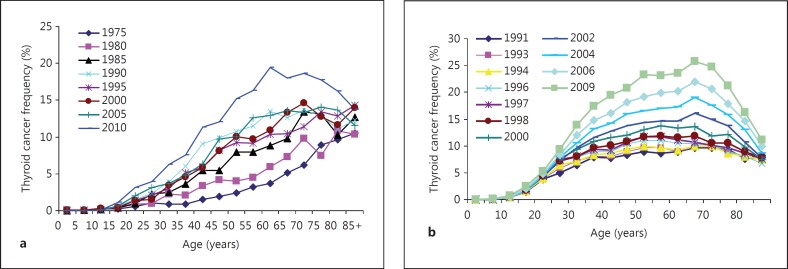
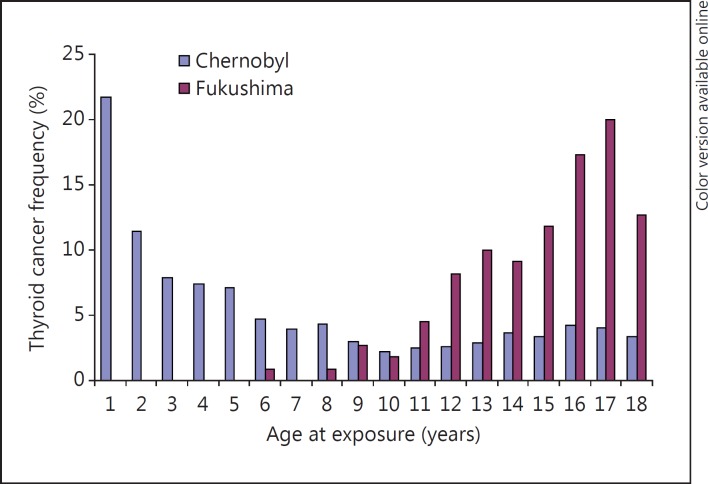
It is proposed that most papillary thyroid cancers originate in infancy and childhood, based on the early rise in sporadic thyroid carcinoma incidence, the pattern of radiation-induced risk (highest in those exposed as infants), and the high prevalence of sporadic papillary thyroid cancers in children and adolescents (ultrasound screening after the Fukushima accident). The early origin can be linked to the growth pattern of follicular cells, with a high mitotic rate in infancy falling to very low replacement levels in adult life. The cell of origin of thyroid cancers, the differentiated follicular cell, has a limited growth potential. Unlike cancers originating in stem cells, loss of the usually tight link between differentiation and replicative senescence is required for immortalisation. It is suggested that this loss distinguishes larger clinically significant papillary thyroid cancers from micro-papillary thyroid cancers of little clinical significance. Papillary carcinogenesis can then be divided into 3 stages: (1) initiation, the first mutation in the carcinogenic cascade, for radiation-induced papillary thyroid cancers usually a RET rearrangement, (2) progression, acquisition of the additional mutations needed for low-grade malignancy, and (3) escape, further mutations giving immortality and a higher net growth rate. Most papillary thyroid cancers will not have achieved full immortality by adulthood, and remain as so-called micro-carcinomas with a very low growth rate. The use of the term 'cancer' to describe micro-papillary thyroid cancers in older patients encourages overtreatment and alarms patients. Invasive papillary thyroid tumours show a spectrum of malignancy, which at its lowest poses no threat to life. The treatment protocols and nomenclature for small papillary carcinomas need to be reconsidered in the light of the new evidence available, the continuing discovery of smaller lesions, and the model of thyroid carcinogenesis proposed.
Keywords: Chernobyl; Fukushima; Papillary microcarcinoma; Thyroid cancer pathogenesis; Thyroid growth.
Figures
References
-
- Davies L, Welch HG. Current thyroid cancer trends in the United States. JAMA Otolaryngol Head Neck Surg. 2014;140:317–322. - PubMed
-
- Harach HR, Franssila KO, Wasenius VM. Occult papillary carcinoma of the thyroid: a ‘normal' finding in Finland. Cancer. 1985;56:531–538. - PubMed
-
- Kazakov VS, Demidchik EP, Astakhova LN. Thyroid cancer after Chernobyl. Nature. 1992;359:21. - PubMed
Publication types
LinkOut - more resources
Full Text Sources
Other Literature Sources
