


Nitroglycerin for management of retained placenta
- PMID: 26558329
- PMCID: PMC8498020
- DOI: 10.1002/14651858.CD007708.pub3
Nitroglycerin for management of retained placenta
Abstract
Background: Retained placenta affects 0.5% to 3% of women following delivery, with considerable morbidity if left untreated. Use of nitroglycerin (NTG), either alone or in combination with uterotonics, may be of value to minimise the need for manual removal of the placenta in theatre under anaesthesia.
Objectives: To evaluate the benefits and harms of NTG as a tocolytic, either alone or in addition to uterotonics, in the management of retained placenta.
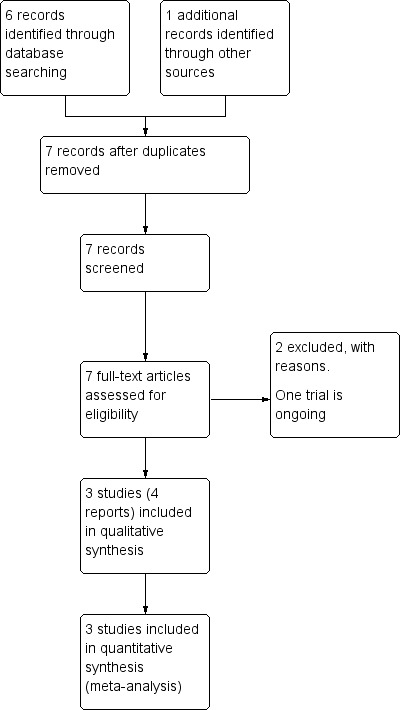
Search methods: We searched the Cochrane Pregnancy and Childbirth Group's Trials Register (14 January 2015), reference lists of retrieved studies and contacted experts in the field.
Selection criteria: Any adequately randomised controlled trial (RCT) comparing the use of NTG, either alone or in combination with uterotonics, with no intervention or with other interventions in the management of retained placenta. All women having a vaginal delivery with a retained placenta, regardless of the management of the third stage of labour (expectant or active). We included all trials with haemodynamically stable women in whom the placenta was not delivered at least within 15 minutes after delivery of the baby.
Data collection and analysis: Two review authors independently assessed trials for inclusion and risk of bias, extracted data and checked them for accuracy.
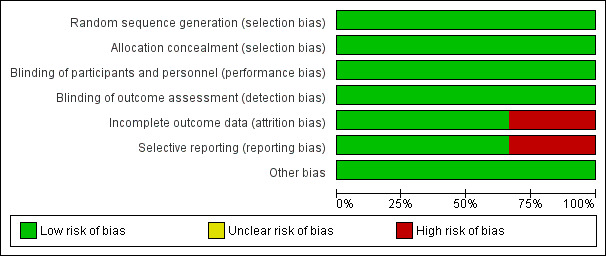
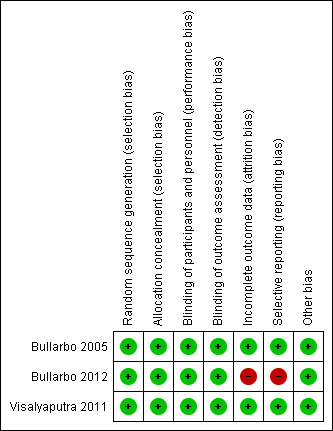
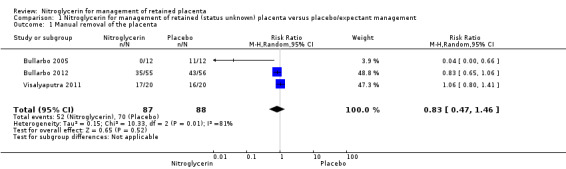
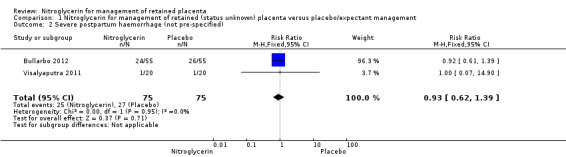
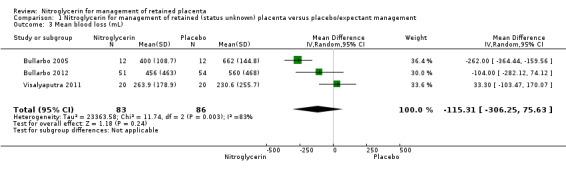
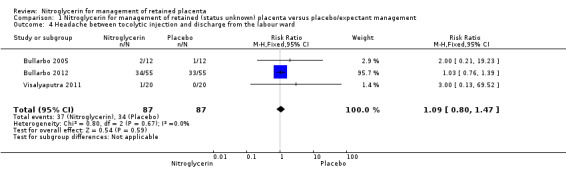
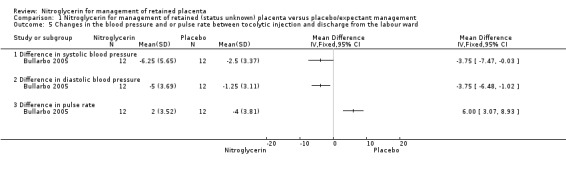
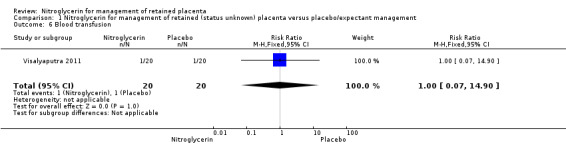
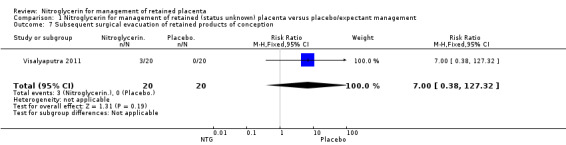
Main results: We included three randomised controlled trials (RCTs) with 175 women. The three published RCTs compared NTG alone versus placebo. The detachment status of retained placenta was unknown in all three RCTs. Collectively, among the three included trials, two were judged to be at low risk of bias and the third trial was judged to be at high risk of bias for two domains: incomplete outcome data and selective reporting. The three trials reported seven out of 23 of the review's pre-specified outcomes.The primary outcome "manual removal of the placenta" was reported in all three studies. No differences were seen between NTG and placebo for manual removal of the placenta (average risk ratio (RR) 0.83, 95% confidence interval (CI) 0.47 to 1.46; women = 175; I² = 81%). A random-effects model was used because of evidence of substantial heterogeneity in the analysis. There were also no differences between groups for risk of severe postpartum haemorrhage (RR 0.93, 95% CI 0.62 to 1.39; women = 150; studies = two; I² = 0%). Blood transfusion was only reported in one study (40 women) and again there was no difference between groups (RR 1.00, 95% CI 0.07 to 14.90; women = 40; I² = 0%). Mean blood loss (mL) was reported in the three studies and no differences were observed (mean difference (MD) -115.31, 95% CI -306.25 to 75.63; women = 169; I² = 83%). Nitroglycerin administration was not associated with an increase in headaches (RR 1.09, 95% CI 0.80 to 1.47; women = 174; studies = three; I² = 0%). However, nitroglycerin administration was associated with a significant, though mild, decrease in systolic and diastolic blood pressure and a significant increase in pulse rate (MD -3.75, 95% CI -7.47 to -0.03) for systolic blood pressure, and (MD 6.00, 95% CI 3.07 to 8.93) for pulse rate (beats per minute) respectively (reported by only one study including 24 participants). Maternal mortality and addition of therapeutic uterotonics were not reported in any study.
Authors' conclusions: In cases of retained placenta, currently available data showed that the use of NTG alone did not reduce the need for manual removal of placenta. This intervention did not increase the incidence of severe postpartum haemorrhage nor the need for blood transfusion. Haemodynamically, NTG had a significant though mild effect on both pulse rate and blood pressure.
Conflict of interest statement
None known.
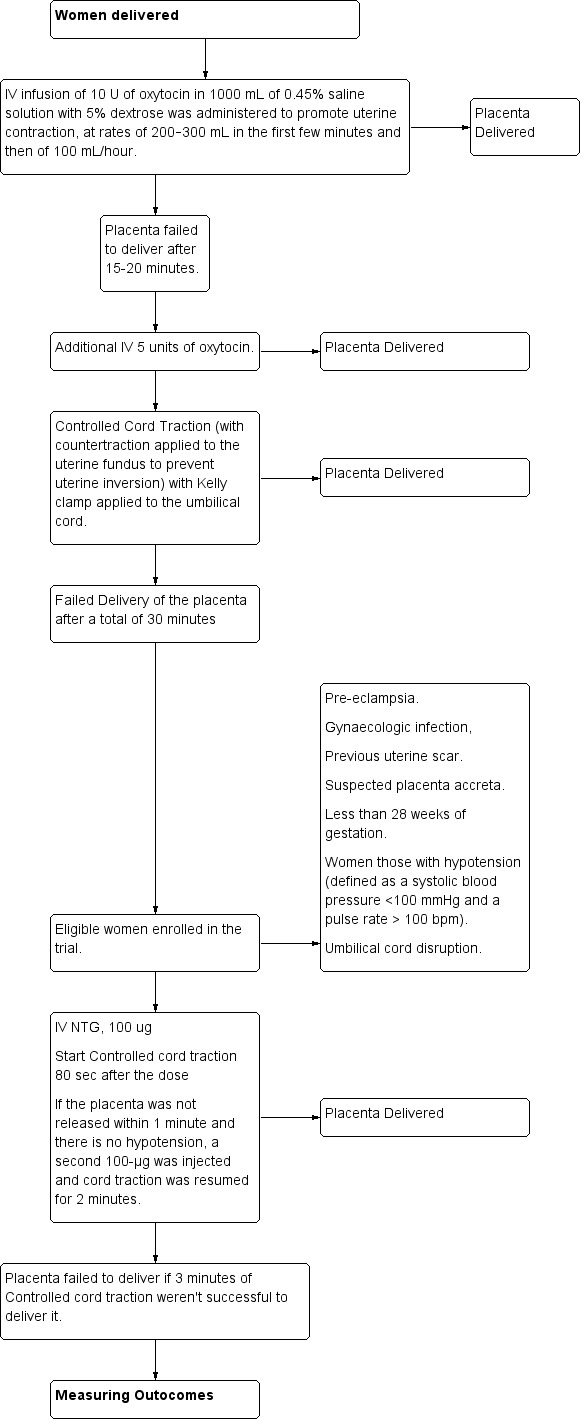
Figures
Update of
-
Tocolysis for management of retained placenta.Cochrane Database Syst Rev. 2011 Jan 19;(1):CD007708. doi: 10.1002/14651858.CD007708.pub2. Cochrane Database Syst Rev. 2011. Update in: Cochrane Database Syst Rev. 2015 Nov 12;(11):CD007708. doi: 10.1002/14651858.CD007708.pub3. PMID: 21249693 Updated.
References
References to studies included in this review
Bullarbo 2005 {published data only}
-
- Bullarbo M, Tjugum J, Ekerhovd E. Sublingual nitroglycerin for management of retained placenta. International Journal of Gynecology & Obstetrics 2005;91:228‐32. - PubMed
Bullarbo 2012 {published data only}
-
- Bullarbo M. Medical treatment with nitroglycerin for management of retained placenta: a multicentre trial. http://www.controlled‐trials.com/ISRCTN34755982 [accessed 11.05.2012] 2008.
Visalyaputra 2011 {published data only}
-
- Visalyaputra S, Prechapanich J, Suwanvichai S, Yimyam S, Permpolprasert L, Suksopee P. Intravenous nitroglycerin for controlled cord traction in the management of retained placenta. International Journal of Gynecology & Obstetrics 2011;112(2):103‐6. - PubMed
References to studies excluded from this review
Farrag 2009 {published data only}
-
- Farrag MA. Sublingual versus intravenous nitroglycerin for management of retained placenta. Benha Medical Journal 2009;26(2):221‐30.
Ross 1994 {published data only}
-
- Ross A. Nitroglycerin and uterine relaxation. Anaesthesia and Intensive Care 1994;22:494.
References to ongoing studies
Denison 2014 {published data only}
-
- Denison FC. GOT‐IT Trial: Glyceryl trinitrate for retained placenta. ClinicalTrials.gov (http://clinicaltrials.gov/) [accessed 20 March 2014] 2014.
Additional references
Altabef 1992
-
- Altabef KM, Spencer JT, Zinberg S. Intravenous nitroglycerin for uterine relaxation for an inverted uterus. American Journal of Obstetrics and Gynecology 1992;166:1237‐8. - PubMed
Axemo 1998
-
- Axemo P, Fu X, Lindberg B, Ulmsten U, Wessen A. Intravenous nitroglycerin for rapid uterine relaxation. Acta Obstetricia et Gynecologica Scandinavica 1998;77:503. - PubMed
Barnes 1881
Belfort 1993
-
- Belfort MA. Intravenous nitroglycerin as a tocolytic agent for intrapartum external cephalic version. South African Medical Journal 1993;83:656. - PubMed
Chedraui 2003
-
- Chedraui PA, Insuasti DF. Intravenous nitroglycerine in the management of retained placenta. Gynecologic and Obstetric Investigation 2003;56:61‐4. - PubMed
Combs 1991
-
- Combs CA, Laros RK. Prolonged third stage of labour:morbidity and risk factors. Obstetrics and Gynecology 1991;77:863‐7. - PubMed
Desimone 1990
-
- Desimone CA, Norris MC, Leighton BL. Intravenous nitroglycerin aids manual extraction of a retained placenta. Anesthesiology 1990;73:787. - PubMed
Dufour 1997a
-
- Dufour P, Vinatier D, Orazi G, Ducloy AS. The use of intravenous nitroglycerin for emergency cervico‐uterine relaxation. Acta Obstetricia et Gynecologica Scandinavica 1997;76:287‐8. - PubMed
Dufour 1997b
-
- Dufour P, Vinatier D, Puech F. The use of intravenous nitroglycerin for cervico‐uterine relaxation: a review of the literature. Archives of Gynecology and Obstetrics 1997;261(1):1‐7. - PubMed
Ekerhovd 2008
-
- Ekerhovd E, Bullarbo M. Sublingual nitroglycerin seems to be effective in the management of retained placenta. Acta Obstetricia et Gynecologica Scandinavica 2008;87(2):222‐5. - PubMed
Farley 2004
-
- Farley AE, Graham CH, Smith GN. Contractile properties of human anchoring villi. American Journal of Physiology 2004;287(3):R680‐R684. - PubMed
Ghag 2014
-
- Ghag K, Bahl R. Recurrence rate of manual removal of placenta and associated postpartum haemorrhage. Archives of Disease in Childhood. Fetal and Neonatal Edition 2014;99(Suppl 1):A111.
Herman 1993
-
- Herman A, Weinraub Z, Bukovsky I, Arieli S, Zabow P, Caspi E. Dynamic ultrasonographic imaging of the third stage of labor: new perspectives into third‐stage mechanisms. American Journal of Obstetrics and Gynecology 1993;168:1496‐9. - PubMed
Higgins 2011
-
- Higgins JPT, Green S, editors. Cochrane Handbook for Systematic Reviews of Interventions Version 5.1.0 [updated March 2011]. The Cochrane Collaboration, 2011. Available from www.cochrane‐handbook.org.
Jensen 1994
-
- Jensen KM, Dahl JB. Plasma concentrations of glyceryl trinitrate and its dinitrate metabolites after sublingual administration to volunteers. Simultaneous determination of glyceryl trinitrate and its dinitrate metabolites. Arzneimittel‐Forschung 1994;44:9514. - PubMed
Jha 2003
-
- Jha S, Chiu JW, Yeo IS. Intravenous nitro‐glycerine versus general anaesthesia for placental extraction‐‐a sequential comparison. Medical Science Monitor 2003;9(7):CS63‐CS66. - PubMed
Krapp 2000
-
- Krapp M, Baschat AA, Hankeln M, Gembruch U. Grayscale and color Doppler sonography in the third stage of labor for early detection of failed placental separation. Ultrasound in Obstetrics and Gynecology 2000;15(2):138‐42. - PubMed
Laufen 1987
Mayer 1992
-
- Mayer DC, Weeks SK. Antepartum uterine relaxation with nitroglycerin at caesarean delivery. Canadian Journal of Anaesthesia 1992;39:166‐9. - PubMed
NCCWCH 2007
-
- National Collaborating Centre for Women’s and Children’s Health (NCCWCH). Intrapartum Care. Care of Healthy Women and Their Babies During Childbirth. London: RCOG Press, 2007. - PubMed
Peng 1989
-
- Peng ATC, Gorman RS, Shulman SM, Demarchis E, Nyunt K, Blancato LS. Intravenous nitroglycerin for uterine relaxation in the postpartum patient with retained placenta. Anesthesiology 1989;71:172‐3. - PubMed
Percival 1980
-
- Percival R. Holland and Brews Manual of Obstetrics. 14th Edition. English Language Book Society and Churchill Livingstone,Edinburgh, 1980.
RevMan 2014 [Computer program]
-
- The Nordic Cochrane Centre, The Cochrane Collaboration. Review Manager (RevMan). Version 5.3. Copenhagen: The Nordic Cochrane Centre, The Cochrane Collaboration, 2014.
Rodgers 2013
Rolbin 1991
-
- Rolbin SH, Hew EM, Bernstein A. Uterine relaxation can be life saving. Canadian Journal of Anaesthesia 1991;38(7):939‐40. - PubMed
Ticconi 2004
-
- Ticconi C, Zicari A, Realacci M, Vito M, Denora P, Narcisi M. Oxytocin modulates nitric oxide generation by human fetal membranes at term pregnancy. American Journal of Reproductive Immunology 2004;52(3):185‐91. - PubMed
Urner 2014
Weeks 2002
-
- Weeks AD, Mirembe FM. The retained placenta‐new insights into an old problem. European Journal of Obstetrics & Gynecology and Reproductive Biology 2002;102(2):109‐10. - PubMed
Weeks 2005
-
- Weeks AD. The retained placenta. Progress in Obstetrics and Gynaecology 2005;16:133‐54.
Wessen 1995
-
- Wessen A, Elowsson P, Axemo P, Lindberg B. The use of intravenous nitroglycerin for emergency cervico‐uterine relaxation. Acta Anaesthesiologica Scandinavica 1995;39:847‐9. - PubMed
Publication types
MeSH terms
Substances
LinkOut - more resources
Full Text Sources
