The National Consortium on Alcohol and NeuroDevelopment in Adolescence (NCANDA): A Multisite Study of Adolescent Development and Substance Use
- PMID: 26562597
- PMCID: PMC4712659
- DOI: 10.15288/jsad.2015.76.895
The National Consortium on Alcohol and NeuroDevelopment in Adolescence (NCANDA): A Multisite Study of Adolescent Development and Substance Use
Abstract
Objective: During adolescence, neurobiological maturation occurs concurrently with social and interpersonal changes, including the initiation of alcohol and other substance use. The National Consortium on Alcohol and NeuroDevelopment in Adolescence (NCANDA) is designed to disentangle the complex relationships between onset, escalation, and desistance of alcohol use and changes in neurocognitive functioning and neuromaturation.
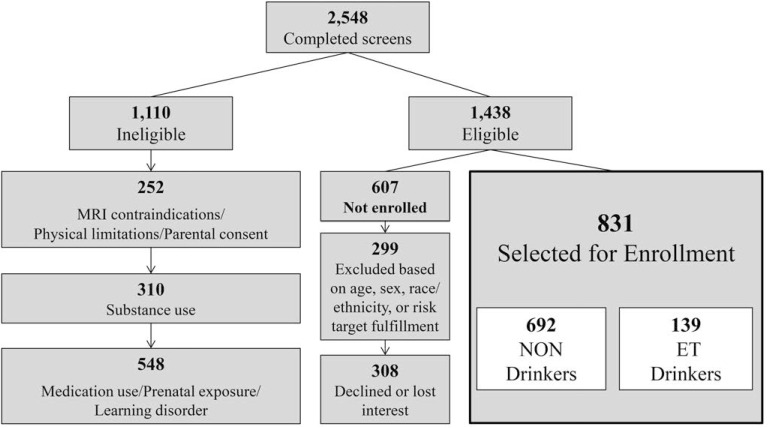
Method: A sample of 831 youth, ages 12-21 years, was recruited at five sites across the United States, oversampling those at risk for alcohol use problems. Most (83%) had limited or no history of alcohol or other drug use, and a smaller portion (17%) exceeded drinking thresholds. A comprehensive assessment of biological development, family background, psychiatric symptomatology, and neuropsychological functioning-in addition to anatomical, diffusion, and functional brain magnetic resonance imaging-was completed at baseline.
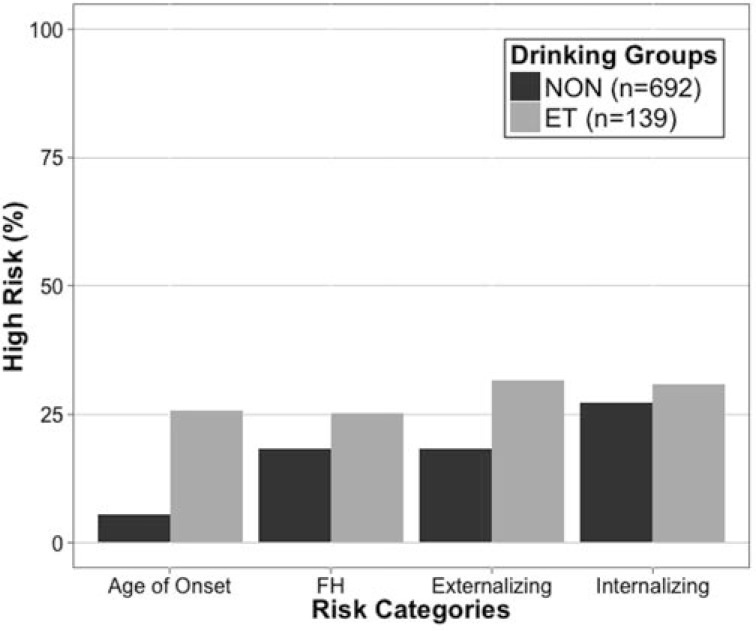
Results: The NCANDA sample of youth is nationally representative of sex and racial/ethnic groups. More than 50% have at least one risk characteristic for subsequent heavy drinking (e.g., family history, internalizing or externalizing symptoms). As expected, those who exceeded drinking thresholds (n = 139) differ from those who did not (n = 692) on identified factors associated with early alcohol use and problems.
Conclusions: NCANDA successfully recruited a large sample of adolescents and comprehensively assessed psychosocial functioning across multiple domains. Based on the sample's risk profile, NCANDA is well positioned to capture the transition into drinking and alcohol problems in a large portion of the cohort, as well as to help disentangle the associations between alcohol use, neurobiological maturation, and neurocognitive development and functioning.
Figures
References
-
- Achenbach T. M., Rescorla L. A. Manual for the ASEBA School– Age Forms & Profiles. Burlington, VT: University of Vermont, Research Center for Children, Youth, & Families; 2001.
-
- Achenbach T. M., Rescorla L. A. Manual for the ASEBA Adult Forms & Profiles. Burlington, VT: University of Vermont, Research Center for Children, Youth, & Families; 2003.
-
- American Psychiatric Association. Diagnostic and statistical manual of mental disorders. 4th ed. Washington, DC: Author; 1994.
-
- American Psychiatric Association. Diagnostic and statistical manual of mental disorders. 5 th ed. Arlington, VA: Author; 2013. doi:10.1176/appi.books.9780890425596.
-
- American Psychological Association, Task Force on Socioeconomic Status. Report of theAPA Task Force on Socioeconomic Status. Washington, DC: Author; 2007.
Publication types
MeSH terms
Grants and funding
- U24 AA021697/AA/NIAAA NIH HHS/United States
- AA021681/AA/NIAAA NIH HHS/United States
- K24 DA028773/DA/NIDA NIH HHS/United States
- U01 AA021696/AA/NIAAA NIH HHS/United States
- AA021692/AA/NIAAA NIH HHS/United States
- AA021690/AA/NIAAA NIH HHS/United States
- U01 AA021691/AA/NIAAA NIH HHS/United States
- U01 AA021681/AA/NIAAA NIH HHS/United States
- K01 DA032557/DA/NIDA NIH HHS/United States
- U01 AA021695/AA/NIAAA NIH HHS/United States
- U01 AA021692/AA/NIAAA NIH HHS/United States
- T32 AA013525/AA/NIAAA NIH HHS/United States
- AA021697/AA/NIAAA NIH HHS/United States
- U01 AA021690/AA/NIAAA NIH HHS/United States
- U24 AA021695/AA/NIAAA NIH HHS/United States
- AA021695/AA/NIAAA NIH HHS/United States
- AA021696/AA/NIAAA NIH HHS/United States
- U01 AA021697/AA/NIAAA NIH HHS/United States
- AA021691/AA/NIAAA NIH HHS/United States
LinkOut - more resources
Full Text Sources
Other Literature Sources
Medical