


Targeted screening of at-risk adults for acute HIV-1 infection in sub-Saharan Africa
- PMID: 26562811
- PMCID: PMC4714928
- DOI: 10.1097/QAD.0000000000000924
Targeted screening of at-risk adults for acute HIV-1 infection in sub-Saharan Africa
Abstract
Background: Patients with acute HIV-1 infection (AHI) have elevated infectivity, but cannot be diagnosed using antibody-based testing. Approaches to screen patients for AHI are urgently needed to enable counselling and treatment to reduce onward transmission.
Methods: We pooled data from four African studies of high-risk adults that evaluated symptoms and signs compatible with acute retroviral syndrome and tested for HIV-1 at each visit. AHI was defined as detectable plasma viral load or p24 antigen in an HIV-1-antibody-negative patient who subsequently seroconverted. Using generalized estimating equation, we identified symptoms, signs, and demographic factors predictive of AHI, adjusting for study site. We assigned a predictor score to each statistically significant predictor based on its beta coefficient, summing predictor scores to calculate a risk score for each participant. We evaluated the performance of this algorithm overall and at each site.
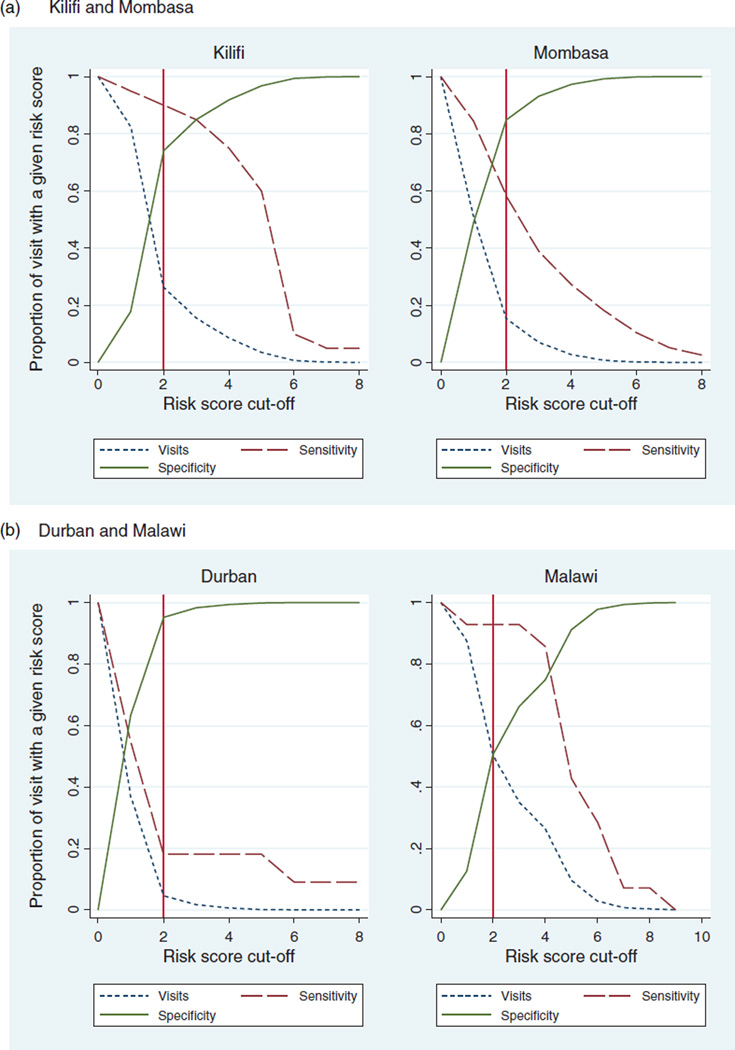
Results: We compared 122 AHI visits with 45 961 visits by uninfected patients. Younger age (18-29 years), fever, fatigue, body pains, diarrhoea, sore throat, and genital ulcer disease were independent predictors of AHI. The overall area under the receiver operating characteristics curve (AUC) for the algorithm was 0.78, with site-specific AUCs ranging from 0.61 to 0.89. A risk score of at least 2 would indicate AHI testing for 5-50% of participants, substantially decreasing the number needing testing.
Conclusion: Our targeted risk score algorithm based on seven characteristics reduced the number of patients needing AHI testing and had good performance overall. We recommend this risk score algorithm for use by HIV programs in sub-Saharan Africa with capacity to test high-risk patients for AHI.
Conflict of interest statement
There are no conflicts of interest.
Figures
References
-
- Sudarshi D, Pao D, Murphy G, Parry J, Dean G, Fisher M. Missed opportunities for diagnosing primary HIV infection. Sex Transm Infect. 2008;84:14–16. - PubMed
-
- Sanders EJ, Wahome E, Mwangome M, Thiong’o AN, Okuku HS, Price MA, et al. Most adults seek urgent healthcare when acquiring HIV-1 and are frequently treated for malaria in coastal Kenya. AIDS. 2011;25:1219–1224. - PubMed
-
- Wood E, Kerr T, Rowell G, Montaner JS, Phillips P, Korthuis PT, et al. Does this adult patient have early HIV infection? The rational clinical examination systematic review. JAMA. 2014;312:278–285. - PubMed
Publication types
MeSH terms
Substances
Grants and funding
- D43 TW001039/TW/FIC NIH HHS/United States
- F30 AI131496/AI/NIAID NIH HHS/United States
- T32 AI007001/AI/NIAID NIH HHS/United States
- R34 MH099946/MH/NIMH NIH HHS/United States
- R01 AI114320/AI/NIAID NIH HHS/United States
- KL2 TR001109/TR/NCATS NIH HHS/United States
- U19 AI051794/AI/NIAID NIH HHS/United States
- 092654/WT_/Wellcome Trust/United Kingdom
- P30 AI050410/AI/NIAID NIH HHS/United States
- R37 AI038518/AI/NIAID NIH HHS/United States
- R01 MH068686/MH/NIMH NIH HHS/United States
- R37 DK049381/DK/NIDDK NIH HHS/United States
- 077092/WT_/Wellcome Trust/United Kingdom
- U19 AI031496/AI/NIAID NIH HHS/United States
- 5R34MH099946/MH/NIMH NIH HHS/United States
- K23 AI001781/AI/NIAID NIH HHS/United States
- P30 AI027757/AI/NIAID NIH HHS/United States
LinkOut - more resources
Full Text Sources
Medical
