Arterial Stiffness and Decline in Kidney Function
- PMID: 26563380
- PMCID: PMC4670762
- DOI: 10.2215/CJN.03000315
Arterial Stiffness and Decline in Kidney Function
Abstract
Background and objectives: The independent link between arterial stiffness and CKD remains unknown. We investigated the association of indicators of arterial stiffness with decline in kidney function.
Design, setting, participants, & measurements: We studied 3666 participants (mean age =65 years old; 58% women) from the Rotterdam Study. Pulse pressure (PP), carotid stiffness, and pulse wave velocity (PWV) were measured. We created genetic risk scores for PP and PWV. Annual declines in kidney function and incident CKD were assessed using eGFR. To put our findings in context of the literature, we performed a meta-analysis of the available population-based studies.
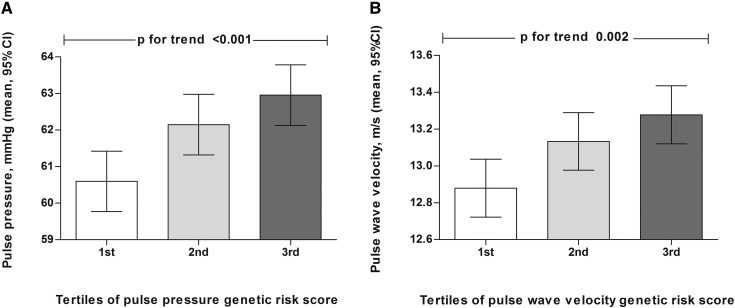
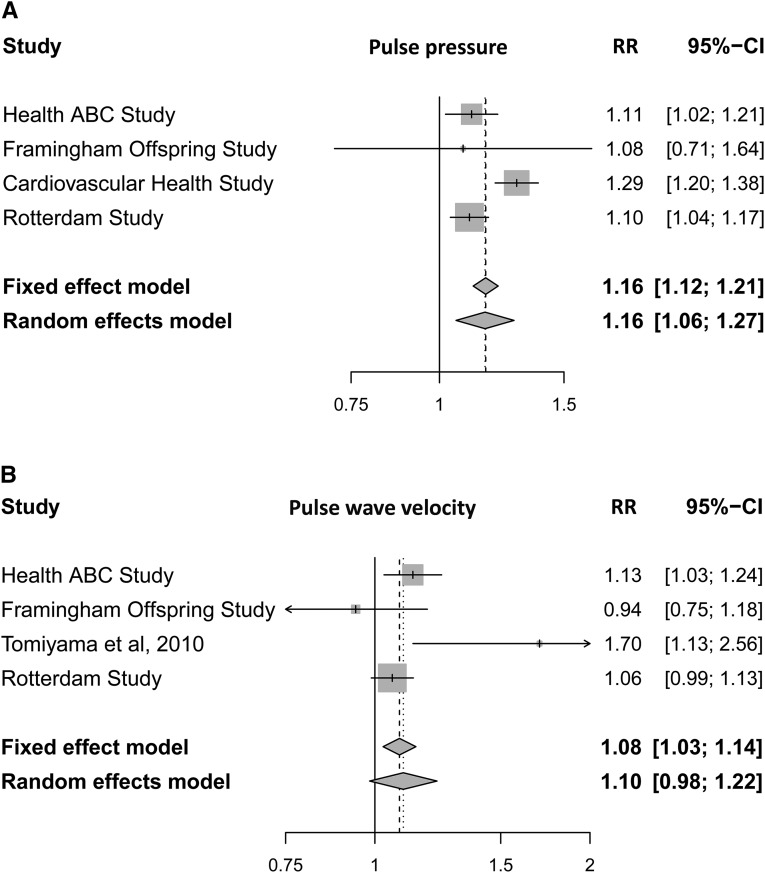
Results: After a median (interquartile range) follow-up time of 11 (10.7-11.3) years, 601 participants with incident CKD were recognized. In the model adjusted for age, sex, mean arterial pressure, heart rate, and baseline GFR, each SD higher PP was associated with 0.15-ml/min per 1.73 m(2) steeper annual eGFR decline (95% confidence interval [95% CI], 0.10 to 0.20) and 11% higher risk of incident CKD (95% CI, 1.05 to 1.18). Each SD greater carotid stiffness was associated with 0.08-ml/min per 1.73 m(2) steeper annual eGFR decline (95% CI, 0.04 to 0.13) and 13% higher risk of incident CKD (95% CI, 1.05 to 1.22). Each SD higher PWV was associated with 7% higher risk of incident CKD (95% CI, 1.00 to 1.14). Incorporating our findings in a meta-analysis, each SD higher PP and PWV were associated with 16% (95% CI, 1.12 to 1.21) and 8% (95% CI, 1.03 to 1.14) higher risks of incident CKD. Each SD higher PP genetic risk score was associated with 0.06-ml/min per 1.73 m(2) steeper annual eGFR decline (95% CI, 0.01 to 0.10) and 8% higher risk of incident CKD (95% CI, 1.03 to 1.14). There was no association between PWV genetic risk score and kidney function decline.
Conclusions: Higher indices of arterial stiffness are associated with steeper decline in kidney function. This suggests that vascular stiffness could be considered as a target for delaying decline in kidney function.
Keywords: arterial stiffness; blood pressure; carotid stiffness; chronic kidney disease; follow-up studies; genetic risk score; meta-analysis; pulse pressure; pulse wave analysis; vascular stiffness.
Copyright © 2015 by the American Society of Nephrology.
Figures
Comment in
-
Targeting Blood Vessel Stiffness to Protect Kidney Function.Clin J Am Soc Nephrol. 2015 Dec 7;10(12):2107-9. doi: 10.2215/CJN.11331015. Epub 2015 Nov 12. Clin J Am Soc Nephrol. 2015. PMID: 26563379 Free PMC article. No abstract available.
References
-
- Waheed S, Matsushita K, Sang Y, Hoogeveen R, Ballantyne C, Coresh J, Astor BC: Combined association of albuminuria and cystatin C-based estimated GFR with mortality, coronary heart disease, and heart failure outcomes: The Atherosclerosis Risk in Communities (ARIC) Study. Am J Kidney Dis 60: 207–216, 2012 - PMC - PubMed
-
- Schiffrin EL, Lipman ML, Mann JF: Chronic kidney disease: Effects on the cardiovascular system. Circulation 116: 85–97, 2007 - PubMed
-
- Mattace-Raso FU, van der Cammen TJ, Hofman A, van Popele NM, Bos ML, Schalekamp MA, Asmar R, Reneman RS, Hoeks AP, Breteler MM, Witteman JC: Arterial stiffness and risk of coronary heart disease and stroke: The Rotterdam Study. Circulation 113: 657–663, 2006 - PubMed
Publication types
MeSH terms
LinkOut - more resources
Full Text Sources
Medical
Research Materials
Miscellaneous