


Serum retinol in post-partum mothers and newborns from an impoverished South African community where liver is frequently eaten and vitamin A deficiency is absent
- PMID: 26564246
- PMCID: PMC6865866
- DOI: 10.1111/mcn.12223
Serum retinol in post-partum mothers and newborns from an impoverished South African community where liver is frequently eaten and vitamin A deficiency is absent
Abstract
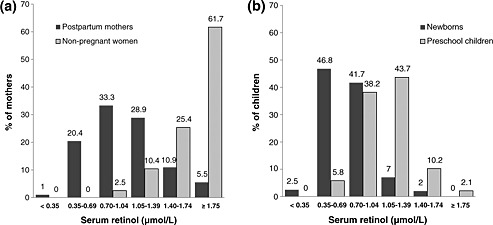
Serum retinol was assessed in mothers and newborns from an impoverished South African community where liver is frequently eaten and vitamin A deficiency known to be absent. Paired cord and maternal blood (n = 201) were collected after delivery and analysed for serum retinol and C-reactive protein (CRP). Liver intake during pregnancy and intention to breastfeed were also assessed. Mean serum retinol was 1.03 µmol/L ± 0.40 in mothers and 0.73 ± 0.24 µmol/L in newborns, with 21.4% and 49.3% having serum retinol <0.70 µmol/L (<20 µg/dL), respectively. Raised CRP was found in 59.9% of mothers, with a significant negative correlation between serum retinol and CRP (r = -0.273; p < 0.0001). Liver was eaten by 87.6% of mothers, and 99% indicated their intention to breastfeed. Despite consumption of liver, serum retinol was low in both the mother and the newborn. The conventional cut-off for serum retinol, i.e. <0.70 µmol/L may therefore not apply for the mother and newborn in the period immediately after delivery. Serum retinol may be influenced by factors other than vitamin A status, e.g. the haemodilution of pregnancy, as well as the acute phase response induced by the birth process, as suggested by raised CRP in 60% of mothers. In the newborns, the low serum retinol is likely to increase rapidly, as liver is frequently eaten by mothers and practically all of them intended to breastfeed. Our results confirm the need for better indicators of vitamin A status or alternative cut-off values during this period.
Keywords: cord blood; liver intake; newborns; post-partum mothers; pregnancy; serum retinol.
© 2015 John Wiley & Sons Ltd.
Conflict of interest statement
The authors declare that they have no conflicts of interest.
Figures
References
-
- Aliyu M.H., Wilson R.E., Zoorob R., Brown K., Alio A.P., Clayton H. et al. (2009) Prenatal alcohol consumption and fetal growth restriction: potentiation effect by concomitant smoking. Nicotine & Tobacco Research 11, 36–43. - PubMed
-
- Allen L.H. & Haskell M. (2001) Vitamin A requirements of infants under six months of age. Food and Nutrition Bulletin 22, 214–234.
-
- Bates C.J. (1995) Vitamin A. Lancet 345, 31–35. - PubMed
-
- Buss N.E., Tembe E.A., Prendergast B.D., Renwick A.G., George C.F. (1994) The teratogenic metabolites of vitamin A in women following supplements and liver. Hum Exp Toxicol 13, 33–43. - PubMed
-
- Catignani G.L. & Bieri J.G. (1983) Simultaneous determination of retinol and α‐tocopherol in serum or plasma by liquid chromatography. Clin Chem 29, 708–712. - PubMed
Publication types
MeSH terms
Substances
LinkOut - more resources
Full Text Sources
Other Literature Sources
Medical
Research Materials
Miscellaneous
